
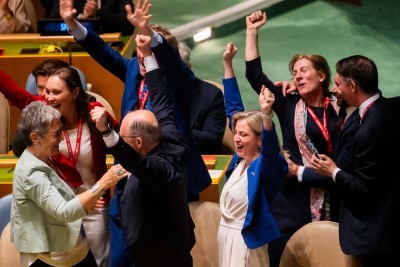
It was a diplomatic thriller that played out within the Western European group of countries. Three high-profile candidates—Austria, Portugal, and Germany—competed for the two seats up for grabs. In the end, Portugal took the top spot with 134 votes, closely followed by Austria, which easily surpassed the required two-thirds majority (127 out of 190 votes) with 131 votes.
The big loser of the evening was Germany, as reported by ORF: With only 104 votes, the Federal Republic was eliminated early on. This is the first time ever that Germany has failed in its bid for a seat on the UN Security Council. German Foreign Minister Johann Wadephul (CDU) admitted to a “real disappointment” and pointed out that Germany had entered the race too late and could no longer make up for the initial disadvantage. In Berlin, the outcome is already being viewed as a foreign policy disaster, especially since the election was presided over by former German Foreign Minister Annalena Baerbock in her capacity as President of the UN General Assembly.
In the other regional groups, however, the election went as expected: While Zimbabwe (Africa) and Trinidad and Tobago (Latin America/Caribbean) were easily elected due to a lack of opponents, the Philippines and Kyrgyzstan (Asia-Pacific) engaged in a fierce battle, which Kyrgyzstan—reportedly with the support of China and Russia—won after three rounds of voting.
The Factor of Neutrality and the Success of “Small States”
Austria had already launched its campaign in 2011—immediately following the end of its last Council presidency (2009/10). Under the slogan “Partnership – Dialogue – Trust,” Austrian diplomacy deliberately emphasized its historical profile as a neutral mediator and bridge-builder to distinguish itself from the NATO heavyweights Germany and Portugal.
Foreign Minister Beate Meinl-Reisinger (NEOS), who led the final media briefing in New York, attributed the clear victory primarily to the mobilization of smaller states: “I had the impression that this was very important. The aspect of fair rotation also played a major role,” she explained. Meinl-Reisinger, who had personally canvassed for support among representatives from over 150 countries over the past 15 months, immediately announced plans to intensify dialogue with the “Big Five” (the permanent members—the U.S., Russia, China, France, and the U.K.), including a trip to China at the end of June and seeking talks with U.S. Secretary of State Marco Rubio.
Domestic Reactions: Between Jubilation and Skepticism
Leaders of the Austrian federal government expressed great delight at the outcome, as reported by ORF. Chancellor Christian Stocker (ÖVP) spoke of a “great diplomatic success” and emphasized: “We do not want to, and we will not, simply watch from the sidelines as our world evolves; rather, we will actively help shape it.”
Vice-Chancellor Andreas Babler (SPÖ) described the vote as a “strong signal of trust” and emphasized the duty, as a neutral country, to strengthen peace and defend international law. Federal President Alexander Van der Bellen also offered his congratulations and, in light of global crises, called for a strengthening of rules-based multilateralism against the “arbitrary exercise of power by the stronger parties.”
Critical voices, however, came from the opposition. FPÖ foreign policy spokesperson Susanne Fürst warned that the seat was “no reason for self-congratulation,” but rather a “litmus test for the steadfastness of Austrian neutrality.”
Key priorities and economic opportunities
Austria plans to use its two-year membership to advance key policy priorities. The focus will be on protecting civilians in conflict zones, strengthening UN peacekeeping missions, combating disinformation, and regulating new technologies such as artificial intelligence (AI) in the security context.
In addition to enhancing its reputation in foreign policy, the federal government also hopes for a tangible economic boost. As one of the four official UN headquarters, Vienna is expected to be strengthened as an international hub through its global visibility, benefiting domestic conference tourism as well as export-oriented companies.
What does the seat bring in this gridlocked power structure?
Despite the justified jubilation of Austrian diplomacy, the reality of the UN Security Council remains sobering. The 15-member body is increasingly suffering from geopolitical paralysis. Due to the veto power of the five permanent members—led by Russia, the U.S., and China—debates on the most pressing core conflicts, such as the war in Ukraine or the Middle East conflict, regularly end in a diplomatic deadlock.
Nevertheless, analysts emphasize that this seat is of inestimable value to Austria. As journalist Hans Rauscher notes in “Der Standard”, this success allows the Alpine republic to “step out of its role as an international non-player.” Even though the Security Council is often blocked by the major powers, it remains the fundamental framework of the international order—and Austria now sits at the center of global politics for two years.