
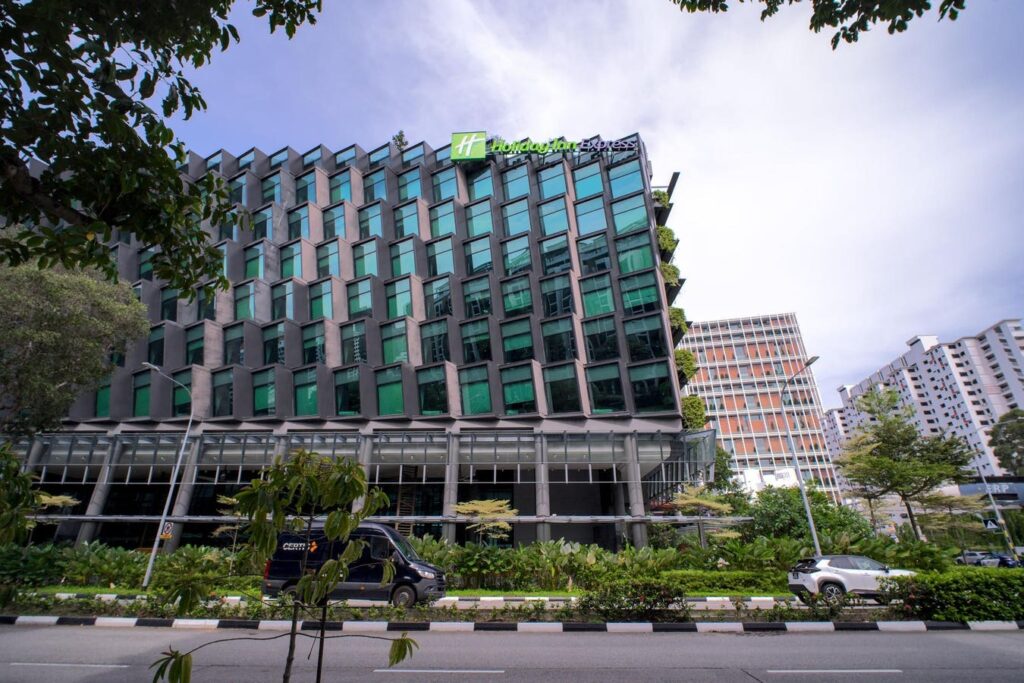
The slanted window design of the Holiday Inn Express Singapore Clarke Quay helps keep the rooms cool during the hottest and brightest hours of the day.
Aren Elliott
Every morning at the Holiday Inn Express Singapore Clarke Quay, breakfast ends with a photograph. A staff member walks the buffet line and snaps the trays of half-eaten pastries, leftover scrambled eggs, and the remaining fruit salad. The image feeds an AI system that recommends the next day’s prep.
It’s a small daily ritual that’s being tested at a single IHG Hotels & Resorts (IHG) property. But it points to a larger question facing the hospitality industry: Can the data that has long governed pricing and revenue now be turned on the harder problem of waste?
Keith Ong, the general manager running the experiment, is betting that it can. He joined the hotel in February after a career that began on the revenue management side at IHG.
“I try to understand the numbers,” Ong says. “They help break down the business to be more efficient.”
That instinct shapes his approach to sustainability at a property that was already a standout before he arrived.
A Singapore hotel built for sustainability
Holiday Inn Express Singapore Clarke Quay opened in 2014, an unusually early date for a property to be designed around energy efficiency from the start. In October 2025, it became the first IHG hotel in Asia to join the company’s Low Carbon Pioneer program, a global designation for properties that are energy efficient, combust no fossil fuels on-site and run on renewable energy. A second IHG hotel in Singapore, the Holiday Inn Express Singapore Serangoon, has since joined.
The 442-room hotel sits on the Singapore River near Clarke Quay, with a small rooftop swimming pool, an open-air gym and a lobby split into three zones, including a library space and a partnership with a local café tenant.
“When the architects were building and designing this hotel, they already had this in mind—trying to make this hotel energy efficient and sustainable,” Ong says.
The building’s construction sets it apart from other hotels built around the same time. The guest room windows are double-paned, tinted and slanted to deflect direct sunlight, which Ong says shaves up to a degree Celsius off the indoor temperature.
Singapore has tight limits on the gross floor area a property can build, and rooms have been getting smaller across all categories. By angling the glass outward from eye level, the designers added a sense of volume without compromising square footage.
The kitchen runs entirely on electricity, with no gas-powered ovens. The hot water comes from heat pumps. An intelligent building management system tracks energy use across the property, and a solar-glazing layer and lighting controls work in the background to reduce daytime electricity demand.
The Holiday Inn Express Singapore Clarke Quay was awarded the Global Sustainable Tourism Council (GSTC) certification, won the 2025 Singapore Hotel Sustainability Award and holds a Water Efficient Building Certification from PUB, the country’s water agency.
To get a feel for what sustainability is like, you have to spend some time in one of its rooms.
Why this eco-friendly hotel leaves the air conditioning on
Not every sustainability gain is intuitive.
Take the air conditioning. A reasonable assumption is that the greenest setting for a hotel room is “off.” But in Singapore, it isn’t.
When a guest leaves the room, the AC doesn’t automatically shut down. Instead, it drops to a low-speed energy-saving mode set at 25 degrees Celsius (about 77 degrees Fahrenheit). The reason is humidity. Cut the air conditioning entirely in this climate, and condensation builds inside the room, damaging paintwork and infrastructure.
That’s common in tropical climates, where heat and humidity corrode buildings quickly.
Tracking hotel food waste by the numbers
The newest experiment is the AI-powered buffet. At the end of the breakfast service, a staff member photographs the leftovers. The AI system reads the depletion pattern across each tray and returns a recommendation for the next day’s preparation and procurement—less oatmeal if there’s leftover oatmeal or more kimchi if the kimchi ran out.
The chef can also flag inputs the AI system would not otherwise see.
The tool has been running for about a week. And while Ong won’t put a number on the savings yet, he says the vendor has cited a 25 percent improvement in food waste reduction at other properties.
“It’s still too early,” he says.
It’s an unusual position for a former revenue manager, whose original discipline is built around forecasting numbers with confidence.
“You need to find a balance between how you analyze and how you execute as well,” Ong says.
Keith Ong, general manager at the Holiday Inn Express Singapore Clarke Quay, on the rooftop garden of the hotel.
Aren Elliott
Why hotel sustainability is a hard sell
The harder constraint is not technology, but the guest.
Surveys consistently show that travelers want greener hotels. Their behavior suggests something else.
Ong describes a pattern any hotelier will recognize. A guest checks in, turns the air conditioning down to “freeze,” and asks for amenities that the hotel has spent years phasing out, like single-use soaps.
Then they fill out a survey praising sustainability.
“They wish for hotels to be a bit more energy conscious and sustainable,” Ong says, “but they come here asking for towels to be washed every day. They want the soaps with the little wrappers.”
A few guests are willing to pay a premium for green properties or buy carbon offsets on their flights. But most are focused on finding the lowest possible room rate. And that’s something that makes a sustainable experience difficult to deliver.
The hotel phased out miniature toiletries in favor of bulk dispensers, installed water filters to cut single-use plastic and now offers IHG One Rewards points to guests who skip daily housekeeping.
What Singapore is doing for sustainability
The property is also benefiting from a national push that, Ong argues, does not get enough credit abroad.
In 2023, the Singapore Tourism Board set a target of getting 60 percent of hotel rooms to be GSTC certified, in support of Singapore’s Green Plan 2030 and a longer-term goal of net-zero emissions by 2050. The Singapore Hotel Association is running the rollout alongside the tourism board. The two agencies, Ong says, work together more closely than he has seen elsewhere.
A new deposit system for soft-drink cans, which took effect April 1, is one of the more visible regulations pushing Singapore toward sustainability. The harder push is happening at the infrastructure level. IHG has already announced that the Hotel Indigo at Changi Airport, which is set to open in 2028, is aiming for net zero certification under the Singapore Building and Construction Authority’s Green Mark scheme.
Whether the model travels well is an open question. Singapore’s small footprint, single layer of government and aggressive top-down planning are not features that map easily onto larger or more decentralized destinations.
Holiday Inn Express Singapore Clarke Quay won’t turn Singapore sustainable. But a property built with sustainability designed in, run by a numbers guy and supported by a national framework pulling in the same direction, will get you a little closer.
It all starts with a good breakfast.
.