

Sweden’s path to the 2026 World Cup was tough, but what can we expect from an inexperienced squad, where most of the star power lies up front?
Sweden had a dreadful 2026 FIFA World Cup qualifying campaign, finishing bottom of UEFA Group B with no wins and two draws (L4).
Their group didn’t even include any of Europe’s main powerhouses, but games with Switzerland, Kosovo and Slovenia turned out to be too difficult for them.
They scored just four goals, as many as Belarus and Malta, and with two games to go during the regular qualifying campaign, the Swedish FA decided to sack head coach Jon Dahl Tomasson, after only being appointed in February 2024.
Sweden replaced him with Graham Potter. The former Brighton & Hove Albion and Chelsea boss was appointed in October 2025 and took charge of Blågult for their final qualifying matches, albeit in vain.
However, thanks to Sweden’s performance in Division C of the UEFA Nations League, they had a shot at redemption, earning a place in the UEFA World Cup play-offs.
Potter’s appointment may have come as a shock to many outsiders, but it’s not really that surprising. The Englishman made his name as a coach at Swedish side Östersunds. During the seven and a half years he was in charge, he helped the club from the fourth tier to a Swedish Cup win and the Europa League group stage.
As well as speaking fluent Swedish, Potter brings a lot of experience to the table, managing almost 500 professional games. He will be the first Englishman to lead another European team at the World Cup since Roy Hodgson (Switzerland) and Jack Charlton (Republic of Ireland) in 1994.
He will also be the first foreign manager for Sweden in the competition since another Englishman, George Raynor, back in 1958.
During the UEFA play-offs, they first faced Ukraine and managed to secure their first competitive win in over a year. It ended 3-1 with a hat-trick for Viktor Gyökeres, his first goals for the national team since November 2024.
In the play-off final against Poland, the Arsenal striker stepped up once again and scored the winner in a five-goal thriller in the 88th minute.
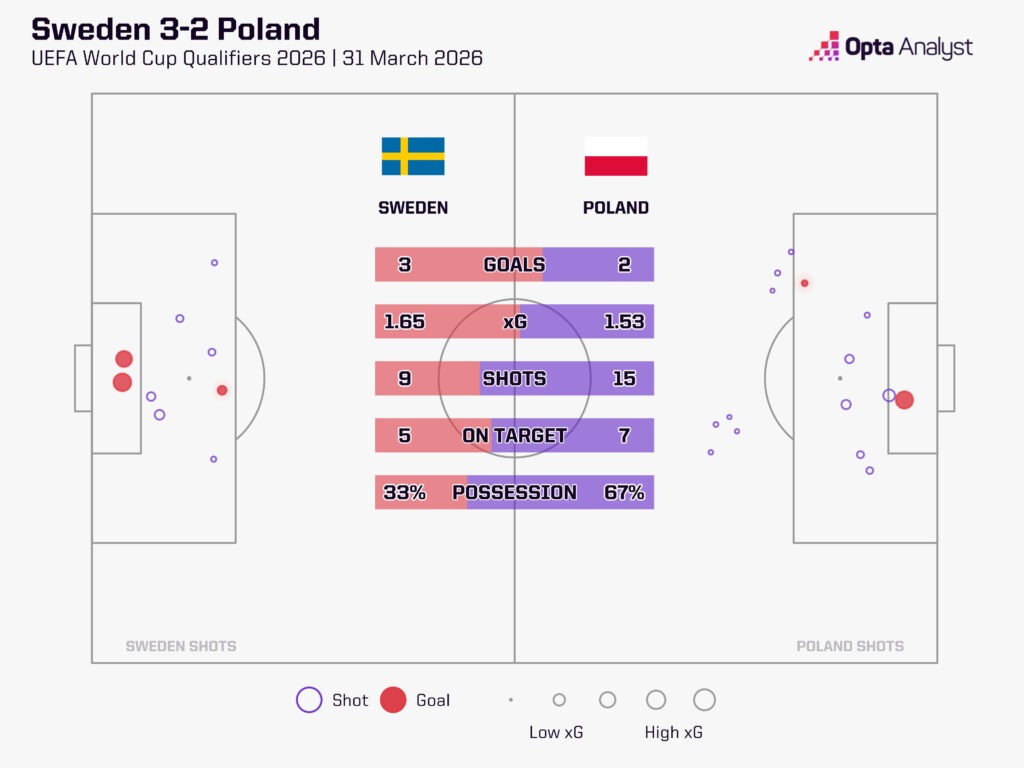
Sweden had a bumpy ride but qualified for their 20th major competition (13 World Cups, 7 European Championships), and their first World Cup since 2018.
In the play-off wins, Potter went for a pragmatic approach. He was mostly known in England for his patient passing and possession game, but during these important games for Sweden, he chose a very different approach. In both games, they had less than 33% possession, recorded fewer than 270 passes, had only seven open-play sequences of 10+ passes in total, but ended with a higher xG than their opponent in both.
Potter also switched from a 4-4-2 formation to a 3-4-3. He adapted his approach to suit his squad, rather than the other way round. This style of play suits Sweden’s lightning-fast forwards particularly well. While previous Swedish teams often depended on Zlatan Ibrahimovic, the current side could draw on a variety of premium attacking qualities.
Gyökeres had a very decent first season at Arsenal, with a Premier League title and Champions League final to show for it. The former Coventry City and Sporting CP striker netted 21 goals in 2025-26, becoming the first Arsenal player to score 20+ goals across all competitions in their first campaign at the club since Alexis Sánchez in 2014-15 (25 goals).
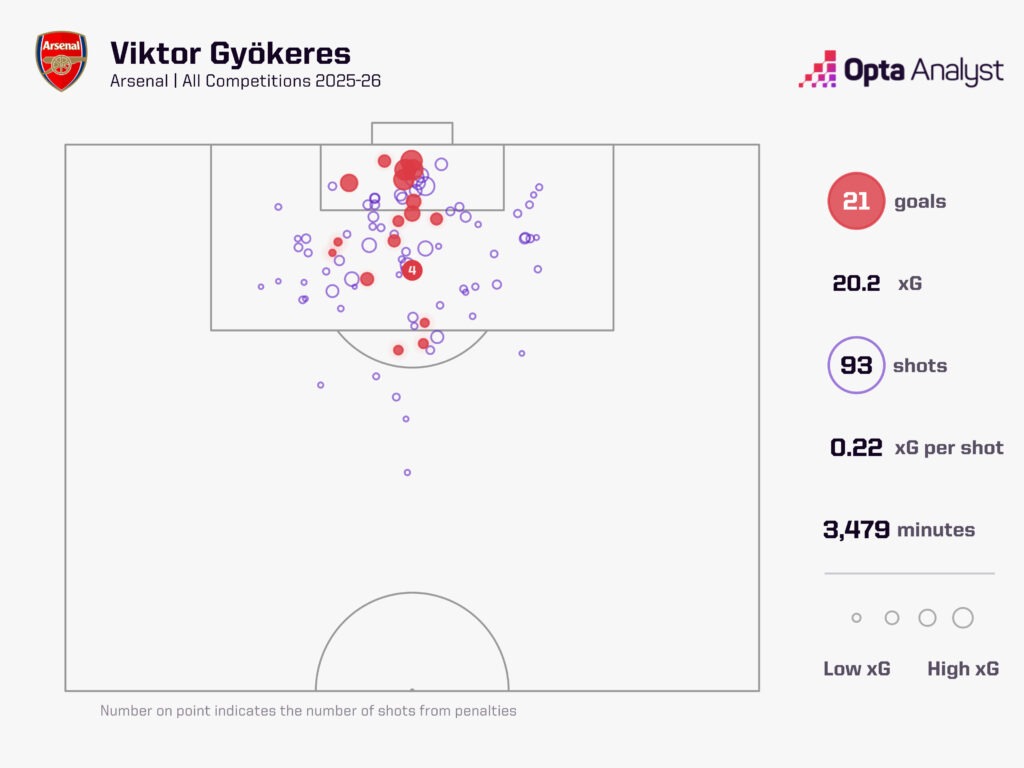
Fourteen of those goals came after the turn of the year, with Aston Villa’s Ollie Watkins the only Premier League player to score more in all competitions in 2026 (15, Morgan Gibbs-White also scored 14). The 28-year-old recorded a shot conversion rate of 34% for club and country in 2026 (18 goals, 53 shots), after only scoring from 14% of his shots for Arsenal and Sweden from August to December 2025 (7 goals, 50 shots).
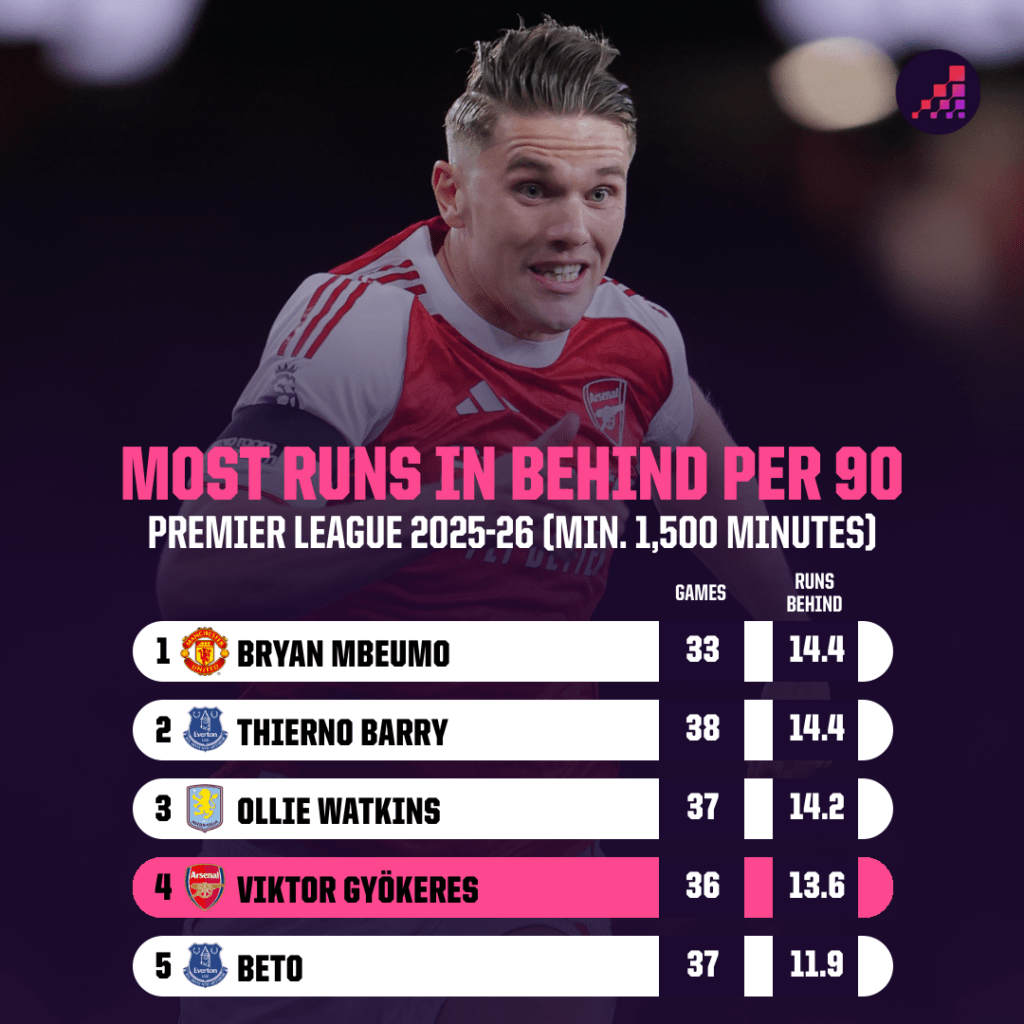
Gyökeres, who played three League Cup games under Potter at Brighton, has shown at Arsenal that he is great at utilising the space behind the opposition’s defence.
In the UEFA Champions League 2025-26, only four players with 810+ minutes made more runs in behind per 90 minutes than the Swedish striker (11.6), and he also ranked fourth in the Premier League for this kind of run per 90 (13.6 – min. 1,500 minutes).
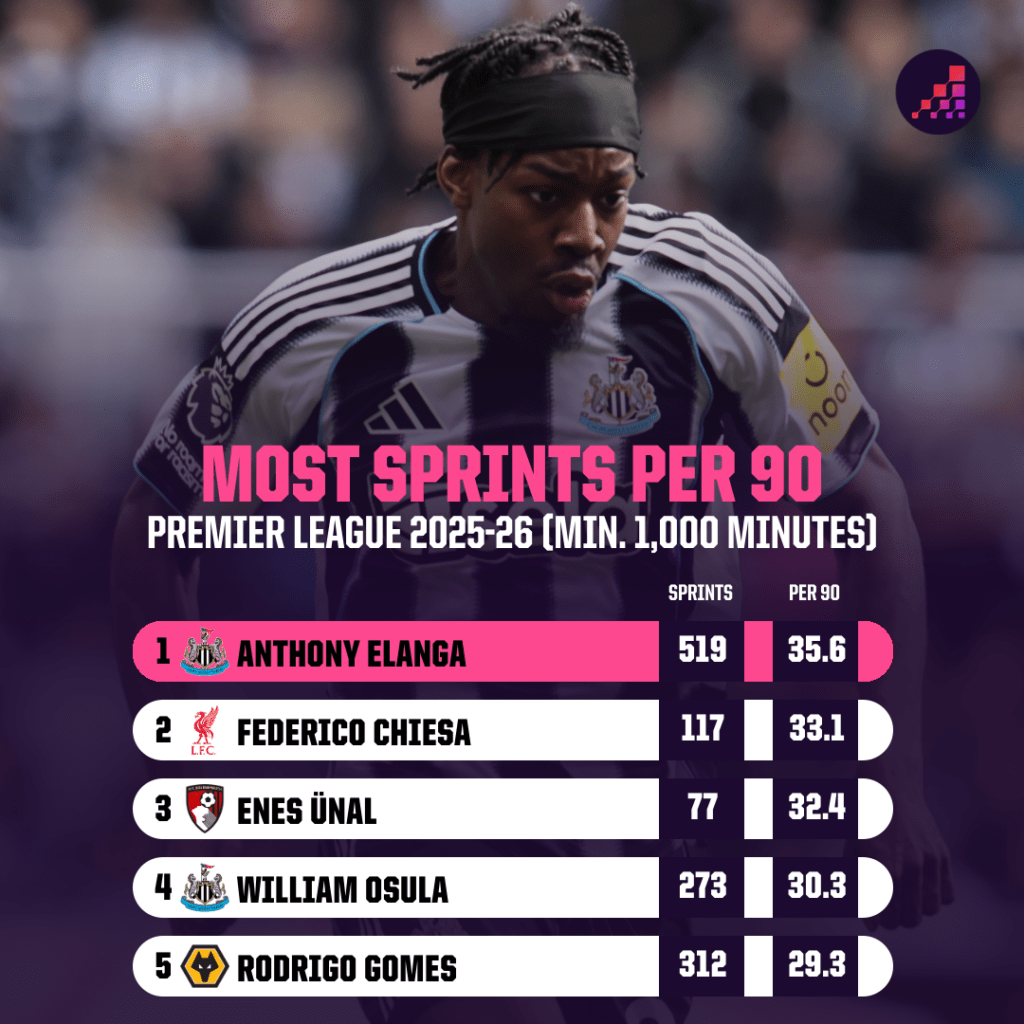
Anthony Elanga is another Swedish attacker who wouldn’t look out of place in an Olympic 100-metre sprint. The Newcastle United winger recorded the most sprints per 90 minutes of all players with at least 180 minutes in the Premier League in 2025-26, as well as recording the fifth-fastest top speed this Premier League campaign (36.4 km/h against Chelsea in December 2025).
There is another big-name Premier League attacker present in the Sweden squad for this World Cup, but what can we expect from Alexander Isak? Due to fitness/injury issues, he didn’t play a full 90 minutes for Liverpool this season, and has only started three matches for club or country this calendar year.
 Click Image to Enlarge
The former Newcastle striker scored just five goals in 27 matches this season for the Reds and Sweden. But in the recent friendly against Norway, Isak showed his class with a superb technical goal after a brilliant solo run.
The final attacking threat is Celtic’s Benjamin Nygren. He managed 21 goal involvements in all competitions (16 goals, 5 assists), as well as having the most shot involvements for the Bhoys (150 – 92 shots and 58 chances created). He also had a goal involvement in each of his three starts for Sweden under Potter, scoring once and assisting two more.
Where other teams at the World Cup have an abundance of international experience, the Sweden squad is quite the opposite. The 26 players in Potter’s squad have an average of just 19.9 caps, the lowest tally for Sweden at a major tournament since the 1970 World Cup (17.4), and at this World Cup, only South Africa have fewer caps on average (19.3).
Captain Victor Lindelöf is the only player in the squad with previous World Cup experience (4 games in 2018), while Isak is the only other player with experience of a major tournament (4 games at Euro 2020). Lindelöf and Isak are also the only players with 50+ caps.
Sweden made it out of their group in each of their last four World Cup appearances, even finishing in third place at the 1994 tournament. Their road to the 2026 World Cup was shaky, but they made it despite all the doubts. Can Potter guide his inexperienced squad to more unexpected success?

Enjoy this? Add Opta Analyst as a preferred source by clicking here.
Subscribe to our football newsletter to receive exclusive weekly content. You should also follow our social accounts over on X, Instagram, TikTok and Facebook.