
June 2026
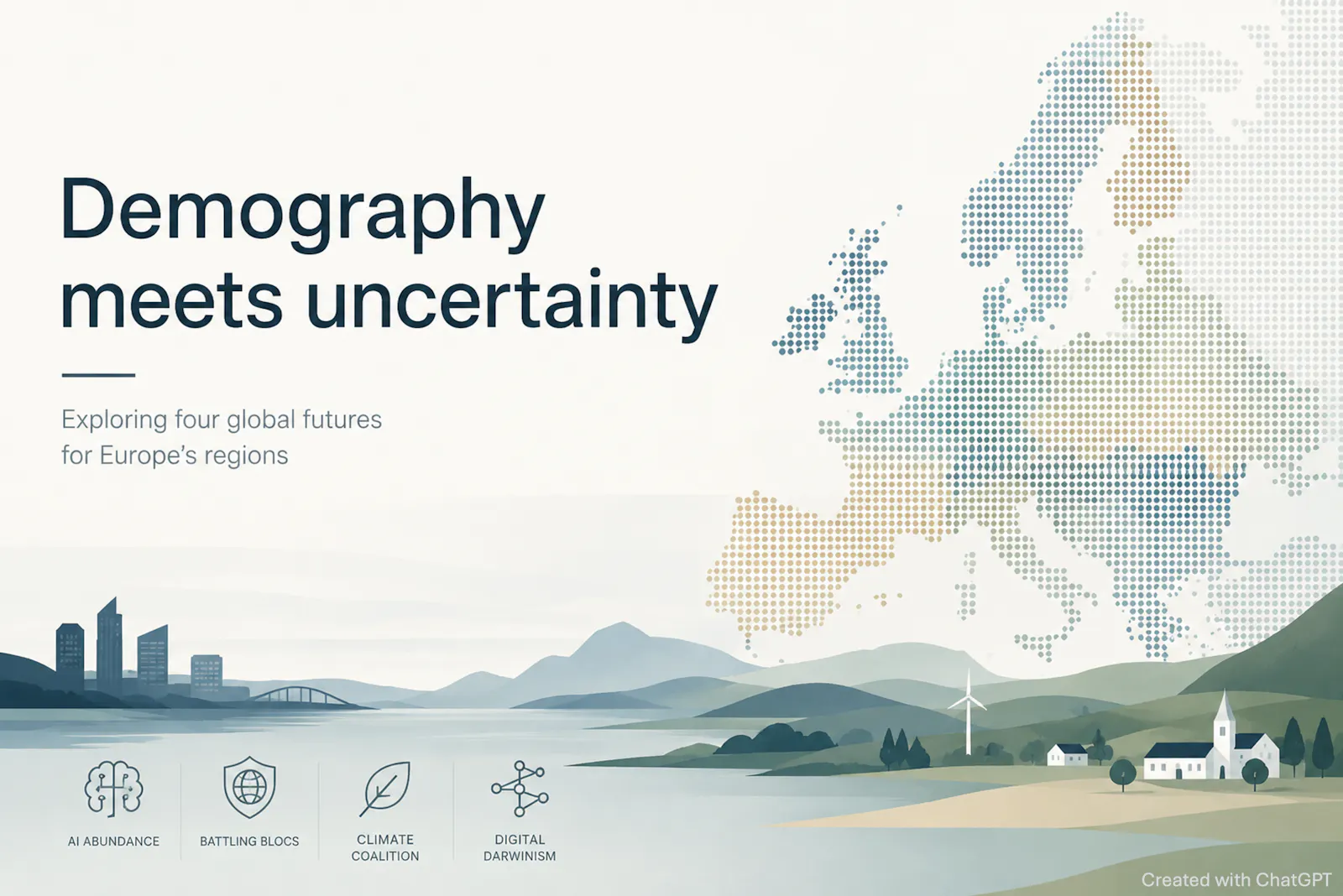
The territorial consequences of demographic ageing will differ radically depending on how global technological, geopolitical and climate futures unfold.
Europe’s demographic trajectory is not a distant concern; it is a structuring reality. Ageing population, low fertility rates and uneven migration patterns are already reshaping labour markets, service provision and prospects for regional development. Yet policy debates still tend to treat demography merely as a background trend. Often, demography is just one of several features of future development which remain largely aspatial, offering global futures with limited territorial resolution.
The crucial question, however, is: how will different types of European territory evolve under alternative future scenarios shaped by technology, geopolitics, and climate, and what role demographic change will play in each of these scenarios.
Two recent studies provide a useful basis for answering these questions. The European Joint Research Centre (JRC) report on demographic change (Opens in a new window) offers a territorially differentiated analysis, distinguishing between urban, intermediate, and rural regions and emphasising the uneven geography of ageing, migration, and population decline. It emphasises that demographic change is less about absolute population size and more about changing needs, service provision, and interregional dependencies.
By contrast, Boston Consulting Group (BCG) outlines four global scenarios for 2050 (Opens in a new window): AI Abundance, Battling Blocs, Climate Coalition and Digital Darwinism. They explore how technological, geopolitical and environmental uncertainties may unfold, but they say little about where the impacts will be felt. While stylised and globally framed, the scenarios provide a useful heuristic for exploring how demographic pressures may interact with broader systemic transformations.
Taken together, the two reports enable us to illustrate the spatial dimension of global futures, linking macro-scenarios to differentiated regional trajectories under demographic pressure.
Four futures through a territorial lens
A key finding of the JRC’s research is that demographic change in Europe is unevenly distributed. While metropolitan regions tend to grow or stabilise through migration, many rural and intermediate regions face long-term decline and ageing. However, these patterns alone do not determine the future. It is also important to consider national contexts and whether regions can adapt and diversify.
Some regions have strong capabilities and are able to reinvent themselves continuously. Others are constrained by structural limitations, which recent research describes as ‘regional development traps’, where the ability to develop new economic activities is weak or absent (see also our earlier blog post on the geography of options (Opens in a new window)).
Against this backdrop, the four BCG scenarios take on a much more differentiated territorial meaning.
AI Abundance:
technological acceleration in an ageing society
In this scenario, rapid advances in artificial intelligence lead to significant productivity growth and lower production costs, reshaping labour markets in the process. The scenario assumes major advances in clean energy availability and digital infrastructure which enables new forms of service provision and work organisation.
For an ageing Europe, this represents the most favourable macroeconomic context. Labour shortages are partially offset by automation, and technological innovation benefits healthcare systems. Metropolitan regions consolidate their role as innovation hubs, maintaining high adaptability.
At the same time, digitalisation creates opportunities for intermediate and peri-urban regions. Remote working and decentralised services could partially stabilise areas that have previously experienced population decline. However, this is conditional: regions with weak capabilities struggle to absorb and deploy new technologies. Remote rural areas, in particular, risk remaining marginalised despite technological progress.
The key divide in this future is not simply demographic, but adaptive capacity: whether regions can translate technological potential into territorial resilience.
Battling Blocs:
fragmentation under demographic pressure
In this scenario, the world is divided into competing geopolitical blocs. Global cooperation is reduced, trade is constrained, and migration is tightly controlled. Security concerns dominate policy agendas and economic relations become more regionalised.
For Europe, this exacerbates existing demographic challenges. Migration, which is currently a key mechanism for offsetting population decline, becomes restricted and politicised. Labour shortages intensify, particularly in ageing regions.
Metropolitan regions remain strategic centres, but reduced mobility leads to diminished dynamism. Old industrial regions may temporarily benefit from reshoring and strategic industries, but structural transformation remains limited.
Peripheral and shrinking regions are particularly vulnerable. With reduced connectivity and fewer inflows of people and capital, they risk becoming increasingly isolated. The ageing process accelerates, service provision becomes more challenging and economic diversification stalls.
In this scenario, demographic decline and geopolitical fragmentation reinforce each other, deepening territorial imbalances.
Climate Coalition:
green transition meets demographic imbalance
In this scenario, strong international cooperation enables coordinated climate action. Large-scale investment in decarbonisation, renewable energy and climate resilience can transform economic systems and territorial priorities.
This creates new opportunities for many non-metropolitan regions. Regions with natural resources, such as land, water, wind and solar power, become central to the energy transition and ecosystem restoration. Intermediate and rural regions may also become more strategically relevant.
However, demographic realities complicate this shift. Many of these regions are ageing and losing their working-age populations. The green transition requires a skilled labour force and is capital-intensive.
Consequently, a structural mismatch emerges whereby territories critical for climate action may lack the human capital to implement it. Regions with the necessary capabilities can reposition themselves successfully. Where they do not, investments risk remaining enclaves with limited local impact.
This scenario highlights a new tension: although territorial opportunities are expanding, the demographic capacity to realise them remains uneven.
Digital Darwinism:
divergence in an unequal landscape
This scenario involves technological progress alongside weak governance, increasing inequality and fragmented social systems. Market forces dominate, and public institutions struggle to ensure redistribution and cohesion.
For Europe, this is the most polarising outcome. Metropolitan regions become dominant hubs, attracting talent, capital and innovation. However, internal inequalities intensify and access to housing, services, and opportunities becomes increasingly unequal.
Intermediate regions are squeezed, often unable to compete globally or benefit from redistribution. Many experience stagnation or slow decline.
The most severe consequences are faced by remote and ageing regions. Public services deteriorate, care systems come under pressure and demographic decline accelerates. Migration continues, but becomes highly selective, thereby reinforcing spatial concentration.
Demographic change becomes a key driver of divergence in this future: ageing, combined with weak governance, amplifies territorial inequality across Europe.
What this means for cohesion in Europe
Across all four scenarios, one conclusion stands out clearly: Cohesion in Europe cannot be taken for granted.
-
In AI Abundance, technological progress may mitigate the economic impact of an ageing population, but it does not automatically reduce spatial disparities. Regions with strong capabilities benefit disproportionately, while structurally weaker regions struggle to keep pace. Without active redistribution and investment, technological advances could reinforce existing territorial hierarchies.
-
In Battling Blocs, cohesion is undermined by restricted mobility and geopolitical fragmentation. Migration constraints exacerbate labour shortages in ageing regions, and peripheral territories become increasingly isolated. The traditional mechanisms that have supported convergence, such as openness, mobility and integration, are weakened.
-
In Climate Coalition, new territorial opportunities emerge, particularly for regions with natural assets. However, these opportunities are unevenly distributed, and their deployment depends on local capacities. Regions lacking the necessary skills, institutions, or investment readiness may not benefit, which could lead to a new geography of inequality linked to the green transition.
-
In Digital Darwinism, cohesion faces the greatest risks. Market-driven dynamics concentrate growth in a limited number of metropolitan regions, while ageing and declining regions experience cumulative disadvantage. Public service provision becomes increasingly uneven and demographic decline accelerates divergence.
Across all scenarios, the same underlying issue persists: regions’ capacity to adapt varies greatly, and this variation is long-lasting.
This suggests that cohesion policy cannot simply respond to observed disparities. It must also consider how different scenarios may interact with demographic change and territorial structures. In particular, this highlights the need for sustained investment in regional capabilities, such as skills, innovation systems and institutional quality. Without such investment, demographic trends are likely to result in long-term spatial divergence.
Ultimately, Europe’s demographic future is not just about ageing populations. It is about whether ageing occurs in a context of adaptation, resilience and cohesion, or in a context of cumulative territorial inequality.
by Kai Böhme
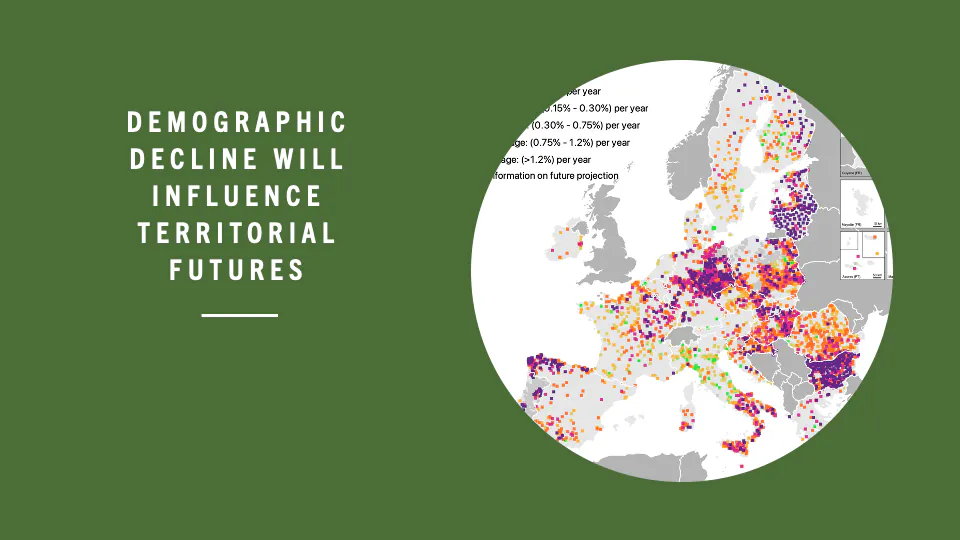 (Opens in a new window)Check out an earlier related blog post.