
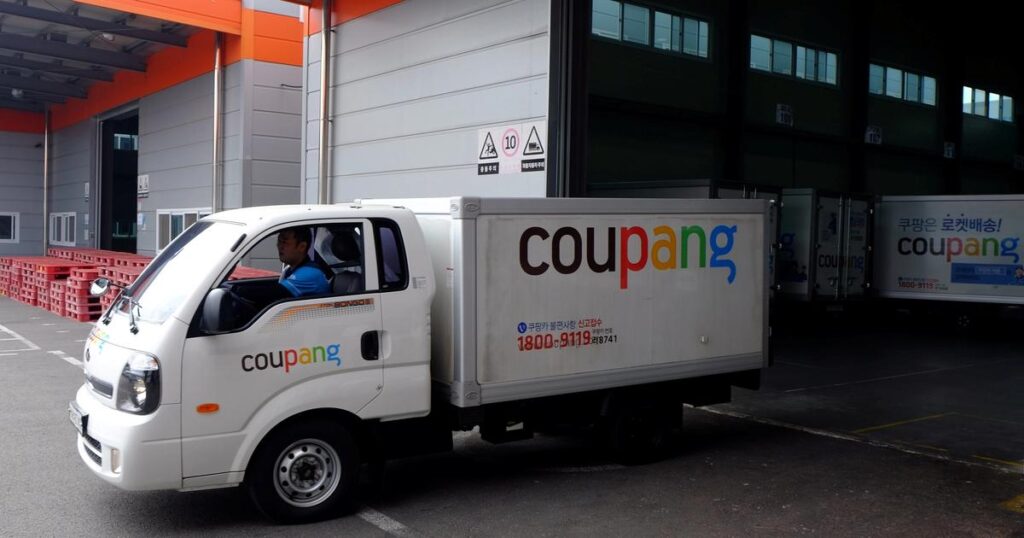
Senior Trump administration officials and scores of congressional Republicans are marshaling their clout against one of the US’ strongest trade partners in a remarkable display of support for South Korea’s biggest online retailer.
Republican allies are aligning to defend Coupang, which maintains a corporate headquarters in the US despite conducting most of its business in South Korea. The company, which found itself at odds with Seoul following a sweeping data breach last year, is protesting what it says is a broader pattern of unfair treatment of US firms — an argument that’s contributed to a stalled $350 billion trade agreement with South Korea.
Coupang’s allegations of discriminatory treatment range from what it’s called excessive fines and aggressive investigations over the data breach to potential new rules for online retailers. Back in the US, prominent Republicans have raced to its side.
Vice President JD Vance, Secretary of State Marco Rubio, and Commerce Secretary Howard Lutnick have all publicly pledged help for the company; US Trade Representative Jamieson Greer is working directly on a way to address its concerns, a person familiar with the matter told Semafor, though it’s unclear what form that could take.
“An American company that sells American products into another market, that’s a good thing for our country,” said Rep. Adrian Smith, R-Neb., who chairs the House’s subcommittee on trade. “When I see a government treating a US company unfairly like that — that’s a problem.”
The clamor to help a company many Americans have never heard of grew louder after the company tapped into Washington’s network of MAGA-coded lobbyists, including Ballard Partners and Miller Strategies. It recruited former Trump White House aide Rob Porter, now its chief global affairs officer, and counted Federal Reserve Chair Kevin Warsh among its board members when it donated to Trump’s inaugural committee.
For its part, the South Korean government has also spent heavily on lobbying. But it hasn’t kept pace with Coupang’s outreach on Capitol Hill, where one person familiar with it said the company has been “really annoying members of Congress to bash the Korean government.”
Coupang’s aggressive footprint also shows that the right allies in Trump’s Washington can make all the difference.
Its backers on the Hill include the Republican-led House Judiciary Committee, which issued a subpoena designed to get South Korea’s communications with Coupang and is expected to soon release a related report on Seoul’s trade practices. A scathing April letter on Coupang’s case drew support from more than 50 GOP lawmakers.
Trump advisers have said the South Korea trade deal will remain impeded until there’s a resolution over the Coupang issue. A US official told Semafor in a statement that “the US government has ongoing concerns with South Korea about regulations and enforcement that targets or discriminates against US technology companies, including Coupang.”
Minseong Seo, spokesperson for the South Korean embassy in the US, countered Coupang’s claims that it has been singled out, noting that the data breach it experienced was “exceptionally” large — more than 33 million user accounts in a nation with a total population of about 51 million people.
“The investigation into the case of Coupang is proportionate to the nature of the data breach and consistent with those applied to Korean companies in comparable cases,” Seo added, saying that South Korea “is fully committed to ensuring a non-discriminatory business environment for all companies regardless of their nationality.”
A Coupang spokesperson declined to comment on its GOP connections in Washington.