
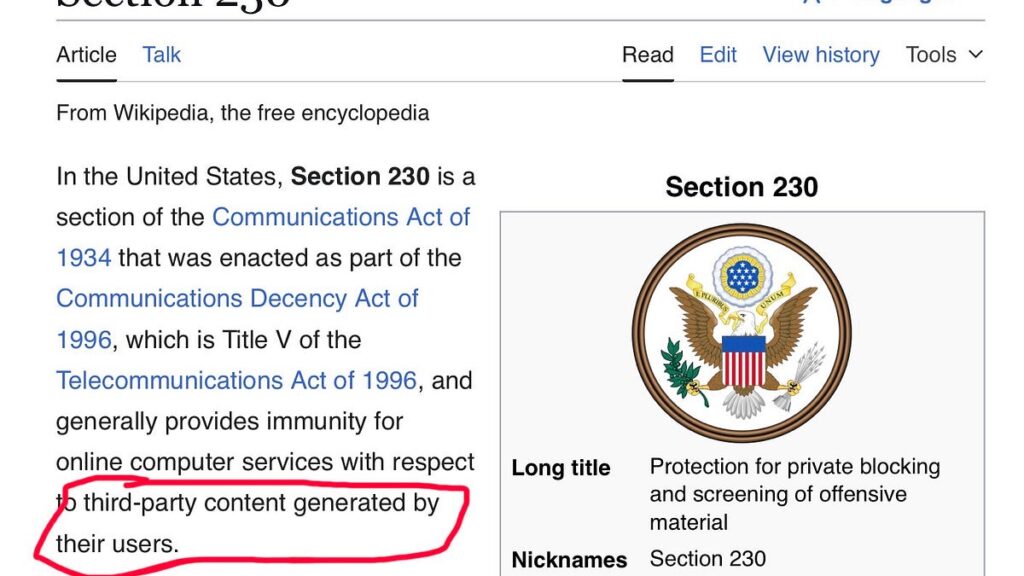
Ok, now I really owe you an apology for writing too much. But it’s been a really wild day, and I am not even talking about Elizabeth Warren’s pushback on SpaceX’s IPO, Oracle’s further financing that the market is doubting, or the tons of negative comments Anthropic has been getting on social media over its policies and guardrails around Fable, which I don’t have time to cover. Instead, let’s talk Section 230 — and why it might not protect AI companies as muuch as they might like..
Section 230 of the Communications Decency Act is, to my mind, one of the worst laws the US Congress has passed in a long time; it has shielded social media companies from liability, and caused all kinds of chaos.
A lot of Senators from both parties agree. It came up a lot when Altman and I testified at the US Senate in May 2023. For example, here’s a fun interchange that I remember well, back when Sam Altman was pretending to be a crowd pleaser:
Sen. Dick Durbin (D-IL):
Thank you. I think what’s happening today in this hearing room is historic. I can’t recall when we’ve had people representing large corporations or private sector entities come before us and plead with us to regulate them. In fact, many people in the Senate have based their careers on the opposite that the economy will thrive if government gets the hell out of the way. And what I’m hearing instead today is that ‘stop me before I innovate again’ message. And I’m just curious as to how we’re going to achieve this. As I mentioned Section 230 in my opening remarks, we learned something there. We decided that in Section 230 that we were basically going to absolve the industry from liability for a period of time as it came into being. Well, Mr. Altman, on the podcast earlier this year, you agreed with host Kara Swisher, that Section 230 doesn’t apply to Generative AI and that developers like OpenAI should not be entitled to full immunity for harms caused by their products. So what have we learned from 230 that applies to your situation with AI?
Sam Altman:
Thank you for the question, Senator. I, I don’t know yet exactly what the right answer here is. I’d love to collaborate with you to figure it out. I do think for a very new technology, we need a new framework. Certainly companies like ours bear a lot of responsibility for the tools that we put out in the world, but tool users do as well. And how we want and, and also people that will build on top of it between them and the end consumer. And how we want to come up with a liability framework, there is a super important question. And we’d love to work together.
Of course we all know by now (but didn’t know then) that Altman is a scoundrel. And as far I know he didn’t do diddly squat with Senator Durbin to find an alternative to Section 230. His company did however recently support state law in Illinois that “would shield AI labs from liability in cases where AI models are used to cause serious societal harms, such as death or serious injury of 100 or more people or at least $1 billion in property damage”– pretty much the opposite of what he said to Senator Durbin in his deceitful, lie-filled testimony.
To my great pleasure, though, a bipartisan subset of the Senators who were in the room that day – Lindsey Graham, Dick Durbin, Josh Hawley, Amy Klobuchar, Richard Blumenthal, and Marsha Blackburn – have in fact introduced a bill to “Sunset 230”. I wish them luck — lots of it. (As far I know, though, it has never been voted on; govtrack.us gives it a 1% chance of being enacted, 4% of making it out of committee, but given the extremely-well-funded opposition from the tech titans I wonder if those numbers might be a bit optimistic.)
In the meantime a reader, who wishes to be anonymous, just said something really interesting.
The new German decision that holds companies liable for their chatbots’ errors, might arguably be true as well under US liability law. Because Section 230 doesn’t exempt companies from what their own software does.
Section 230 is, and always has been about 3rd party speech. The German courts remind us that chatbot-product speech is not that.
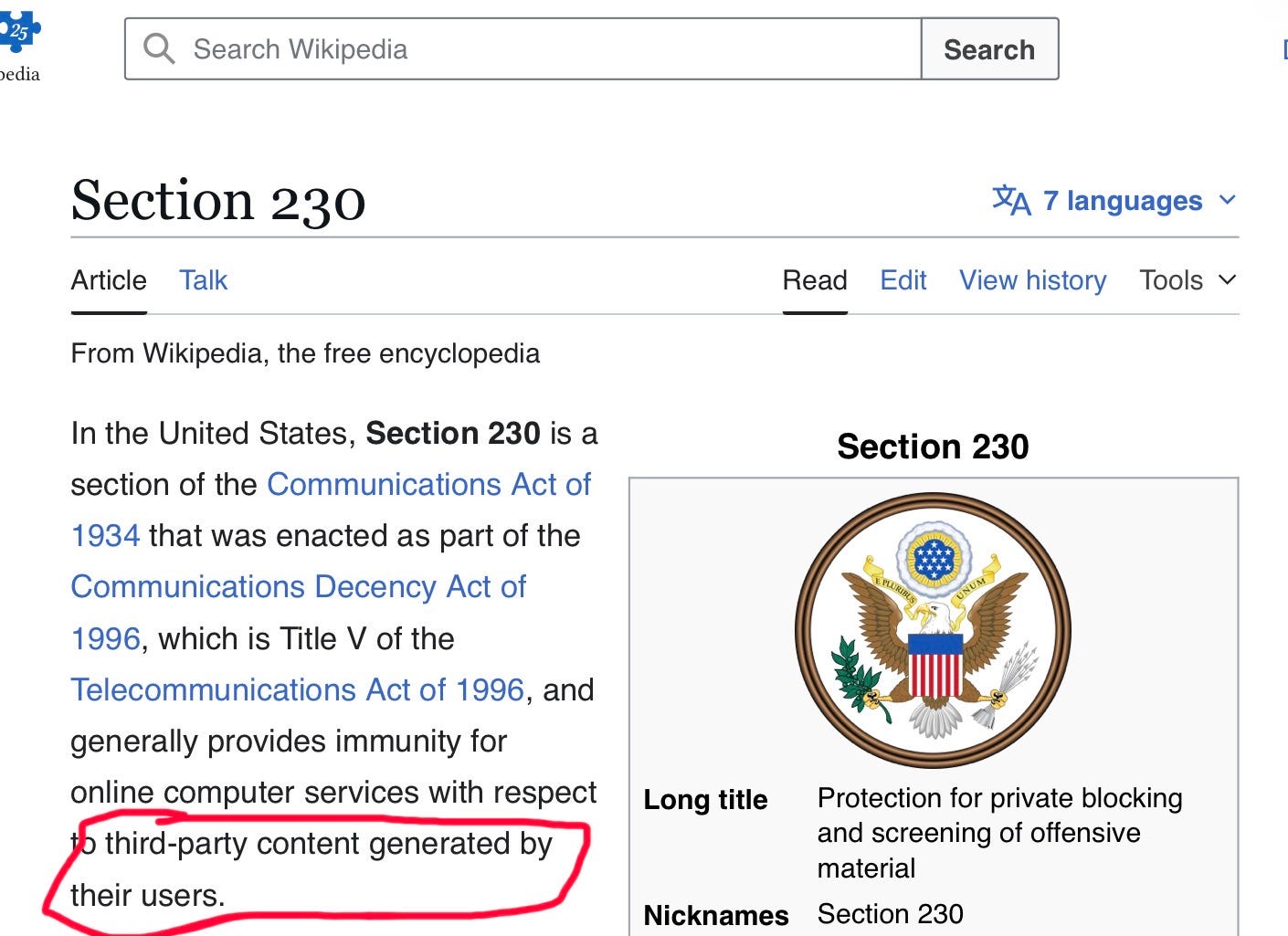
If Internet Provider X carries BS Artist Y’s lies, Provider X is not responsible for what Customer Y said.
But what Germany just said, essentially, is the Google’s chatbot lies are Google’s problems. It’s not third party speech. It’s Google’s speech.
If American courts were to rule similarly, or if Congress made that the law of the land, all the LLM providers would be in deep, deep trouble. Because essentially all their software has a tendency to fabricate fairly regularly and even defame people and to sometimes give bad medical information, and so on. In Taming Silicon Valley, I wrote about one such case, a prominent law professor who was accused of sexual harassment by an LLM when in fact the whole thing was just an LLM fabrication, not based at all in fact.
Imagine if Google, and OpenAI, and Anthropic, and Microsoft, xAI, and so on, were held liable for the garbage their systems sometimes produce.
It might actually force the tech industry to get its act together, to try to find a sounder foundation for AI, in which hallucinations weren’t baked in.
In the long run, we would all be vastly better off.
Update I was about to post this, AI law expert Ryan Calo hinted at the same thing in a reply to me on X.