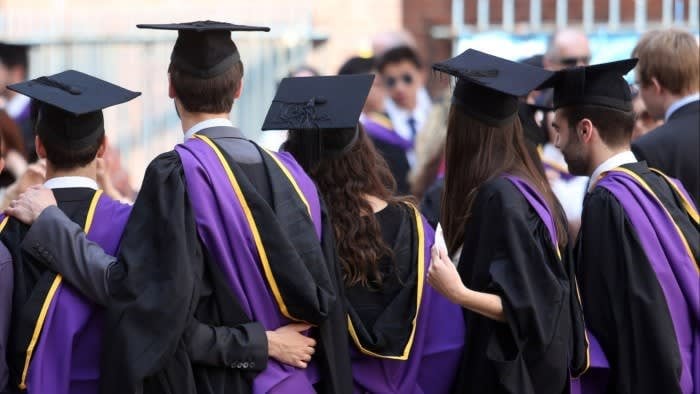
University sector calls on Labour to raise tuition fees to ‘stabilise the ship’
https://www.ft.com/content/fd1e1942-a349-4ffd-95c6-cba836a36d34
Posted by 1-randomonium

University sector calls on Labour to raise tuition fees to ‘stabilise the ship’
https://www.ft.com/content/fd1e1942-a349-4ffd-95c6-cba836a36d34
Posted by 1-randomonium
25 Comments
(Article)
—
A Labour government should take immediate steps to stabilise the UK’s university system, raising the annual £9,250 tuition fee in line with inflation, the head of the sector’s main lobby group has said.
Vivienne Stern, chief executive of Universities UK, which represents more than 140 universities, said if Labour wins rapid action would be needed to avoid the sector being left in limbo as the new administration beds in.
“The worry is that there is an 18-month review process that delivers no substantial change for two or three years. We’d argue for a two-step approach: do something to stabilise the ship, then address the question of more fundamental changes,” she told the Financial Times.
Labour said in its election manifesto that higher education was “in crisis” and that the current funding settlement did “not work for the taxpayer, universities, staff, or students”, but has failed to provide details of how it would address the problems if elected.
The sector is battling financial headwinds caused by a sharp decline in international student fees and a decade-long freeze of domestic tuition fees.
The cap on fees means universities are losing an average of £2,500 on every domestic student, according to analysis by the Russell Group of leading research universities.
More than 50 universities have announced job cuts and closure this year and several are on the verge of bankruptcy, according to Whitehall insiders.
Stern said three immediate steps were required to stabilise the system. These were a backstop mechanism to avoid university insolvency; clear signals to international students that they were welcome after recent hostility from the government; and a decision to raise student fees and maintenance loans in line with the retail price index.
She added that the short-term measures would create financial and political space for a wider review of university financing, including changes to the loan repayment system that would take years to implement.
Bridget Phillipson, shadow education secretary, has signalled that Labour is preparing to address the challenges of the UK’s higher education system.
“Let me be clear that reform is coming,” she said in a speech to the UUK annual conference in September, adding that “student finance will be the first to see change, although by no means the last”.
Educational experts said the options for Labour, which has a 20-point lead according to polls, included reversing recent changes to the loan repayments system that landed hardest on women and lower-paid professions, or restoring real interest rates to student loans.
More radical policies include “stepped repayments”, which would mean higher-earning graduates pay significantly more over their working lifetime than they borrowed in students loans.
One former university vice-chancellor said the fact that Labour had acknowledged the sector was “in crisis” indicated that Labour leader Sir Keir Starmer and Phillipson, who have not ruled out a tuition fee, were likely to act.
“The short-term pain of putting fees could be blamed on the Tory inheritance . . . and then traded against a transition to a better deal for young people, which Lab can deliver before next general election,” he said.
Nick Hillman, director of the Higher Education Policy Institute think-tank, said he was sceptical of the case for radical reform, noting that the 1997 Dearing review, the 2010 Browne review and the 2017 Augar review had all stuck with a form of student loans.
Can see Labour trying to kick the can down the road on this. Any serious increase to tuition fees is going to dominate the news cycle and if you believe Labour’s enormous polling lead is built on shaky foundations (anger at the Tories rather than enthusiasm for Labour) then it’s one of the few issues I could see lingering around into an election in 2028 or 2029.
Labour have three choices, none of which are very palatable:
* Significantly the amount of government money go to universities, which will make it harder for them to meet their other priorities.
* Increase tuition fees, which will piss off a lot of their younger voters.
* Continue to allow universities to decline, and possibly oversee some of them actually going bust.
And whatever they do, they’ll end up getting blamed (despite the last 14 years of Tory choices meaning that we ended up here).
Uni is becoming really poor value for money
Its a great time, three years you will never forget but honestly my course could have been completed in one year if I worked anything like a normal schedule.
Presumably if you accept unis have to fund themselves, then tuition fees have to rise with inflation?
Of course in my opinion HE should be heavily subsidised because it’s handy to have plenty of doctors, engineers, scientists etc in society.
Wow the whole system is fucked. Losing 2500 per domestic student, who themselves end up in huge debt. I think we need a look at what education is actually for.
They need to do *something* asap. Unfortunately the tories decided to characterise universities simply as places that incubate woke culture war adversaries rather than as the foundation of the whole UK STEM sector, and which still has some sort of good reputation and standing on the global stage.
Labour raise tuition fees….that will never…..oh wait, nevermind.
Why raise tuition fees when so many are already not being paid back?! Just be honest and ask for more funding for pointless courses.
Something needs to be done ASAP. It is actually shocking me how blatant it is we are approaching a crisis, how serious that crisis seems set to be, versus how little interest there seems to be in doing anything about it. I don’t think I’ve even heard it mentioned in any of the debates I’ve watched yet. I used to be an academic, I left months ago as working conditions are just intolerable in the system now. I’ve moved to doing sales for stuff where university research is a fairly large customer and every single contact and project I am hearing oh whoops sorry our budgets just been cut, the university is in deficit to the tune of tens of millions etc. And this is coming from science teams working at top-ranked universities, its not the media studies team at Uni of Blackburn who are suffering as everyone just seems to assume.
E – Also to add its been put aside for so long, its difficult to know what the solution is. Raising tuition fees in line with inflation, we’d be looking at somewhere between a 30 to 50% increase in fees. I doubt many people would be happy with that. Just another poison chalice the Tories are handing to Labour I think.
Considering they keep putting up new buildings and the people that run the places make millions in wages, I’m pretty sure the ship is fine just how it is.
**Raise** the fees? Double down on the stupid idea that got you into this situation?
Not gunna happen given labour been pretty open and just reforming the whole thing top to bottom
More so given many companies report effectively having retrain in graduate programmes
Degrees are not worth the money anymore
Hell i earn 4x over most my class who got 1st with honours with 3rd class degree
I work with a guy with no qualifications to him and he makes even more than me
Its better to just get into the workforce early and grind up
If universities can’t sustain with the fees they already charge something is seriously wrong with the budgets.
How about they cut out pointless bloat and free up their budgets to actually spend it on education and research?
Raising tuition is ridiculous, £9000 is more than enough to deliver what most courses constitute, in fact Covid showed you could make so many savings if you actually put in the effort, like only doing new lectures once every 3 years and having them pre-recorded.
The problem with the universities (having just finished a course ) is the ridiculous bloating of the university staff and quite frankly ridiculous spending on resources. It’s honestly like bloated software at this point.
They have so many unnecessary staff and components that you could completely axe without affecting course delivery at all, we don’t need 1001 officers of every description, some of whom are on exceptional salaries even though they are almost valueless additions.
A blatant example of this is at the start of my course there were no 24hr security onsite at the bar and then they got brought in. Which is fair enough but we’d always had bar nights before that which were fine, then it got changed again that if we wanted to have a bar night we had to hire an external security company who’d send like 4 people to essentially stand around doing nothing because it was very tame and it cost £4000 a night.
So we went from no security and having bar nights be fine, then having onsite security and bar nights be fine, then having to hire additional external security for bar nights even though there was never a single security issue on any of our bar nights.
Someone needs to go through each university with a fine tooth comb and cut all the ridiculous crap out of them, if you do want to have some ancillary services, then they should be grouped up and run centrally so like each department doesn’t have a 1000 and one separate people doing the same thing.
The universities will never do it though, its a grift and jobs for the boys (and girls). The chancellors have to imagine they are steering these behemoths to justify their own quite often considerable salaries.
Was at university during the tuition fee rise (thankfully had the ~£3000 fees locked in) the attitude of the lecturers was that the new fees and removal of student cap would simply allow big universities to crush smaller and younger ones.
Many were supportive of the current system, though only under the assumption that fees would keep rising each year. They wanted a “competitive market”
The government needs to start thinking about what happens when a university fails to meet its financial commitments, otherwise they will simply hold the government to ransom and demand massive bailouts.
There are already suggestions they have handed loans out to some universities to stay afloat (before COVID even). This just fuels the bubble
There are too many universities and the better performing ones are not in financial difficulty, let the free market do it’s thing. It’s likely there will be some consolidations in the future.
How about instead of feeding the beast of corporate universities, we cut down some of the bloat, first? Do they really need vice-chancellors on £100k+? Do they really need sub-committee after sub-committee, all with its own budget? Are they really providing value for money, when a lot of students are lucky to get time with their lecturers?
Do universities really need to raise tuition fees, with the rip-off that is student housing on top of that? Could I get a discount for just distance learning instead?
They need to seriously reform their business model before they go asking for higher tuition fees.
It’s a huge crisis that isn’t talked about enough. Universities are paying more to teach courses than receive from each students annual £9250. This is despite the low contact hours and how many students are unsatisfied with PowerPoint teaching. Uni being mostly self-directed makes sense, but that doesn’t necessarily come with cost savings.
Secondary Schools receive £7500 per pupil, education is expensive. Naturally, uni is more expensive because of higher pay for staff and far more expensive buildings and equipment. But students will still be unsatisfied, particularly in many humanities areas where most teaching is lower contact hours and no expensive lab work.
The crisis will get worse, student debt won’t be paid back by students. It’s an immersive amount of debt that will wreck the state budget in 30 years.
To be honest, too many people go to university. I shouldn’t have done my undergrad. It was fascinating but it wasn’t useful. £27750, three years of missed income and three years of expensive rent and living costs (funded by more debt) to slightly improve critical thinking, writing and research skills isn’t worth it. I ended up doing a conversation master’s in something that led to a job. That was worth it.
The best way is to do what Scotland does. Cap the number of home students who can go to university. That way the cost is far lower. There have been a huge expansion in the number of universities in each city, this could be reduced and funding instead could go to the established ones which are struggling. There should also be pressure on universities to cap subjects outside of skills shortages. **It sounds harsh, but our national education policy shouldn’t be decided by the collective will of 17-year-olds study preferences.**
I think we’ll see start to see some Universities fold within the next year or two.
A lot of smaller ones are reliant on overseas students and that’s drying up. Particularly from China where students just don’t want to come to the UK as much due to the hostile environment they face here compared to places in Europe where they are welcomed
University at this point is a waste of money.
It’s nothing more than a checkbox exercise for your CV to say you have a degree so you can get a graduate job AND THEN start your career.
If I could go back to being 17, I wouldn’t have gone to uni, and i’d be earning far more than what I currrently am.
What’s the point of going to university in UK when you can easily go for free and often superior in all ways EU education?
I wish I could’ve went to uni but unfortunately left high school with next to no grades as my mother was constantly in and out of psychiatric wards, closest I ever got was doing security at herriot watt University, not a single Scottish person was there and all of them got free tuition paid for by the Scottish taxpayer.
I do wonder what the appetite would be for condensing 3 year degrees into 2 years as an example (exact timings may vary). Or presenting it as an option if logistically possible.
It would have a few advantages that a student will earn a salary a year earlier while incurring less debt/interest on their loan (paying more taxes etc). Downside they will not be able to spend time working side jobs or developing less ‘soft skills’ over that time (I for one certainty developed a lot of communication skills and confidence boosting running a society club while at uni).
The tuition fees could be broadly similar if they are condensed so the university still raises a similar income (would still be cheaper for the student due to the earlier finish/interest etc).
It seems there is no easy fix to increase gov funding and increasing fees again would go down…poorly. This could address the issue differently. I also know staff spend the holiday time working (teaching is the side hustle) but professors may take that over significant redundancies we are seeing today.
This is where I find out it already exists for certain degrees….