
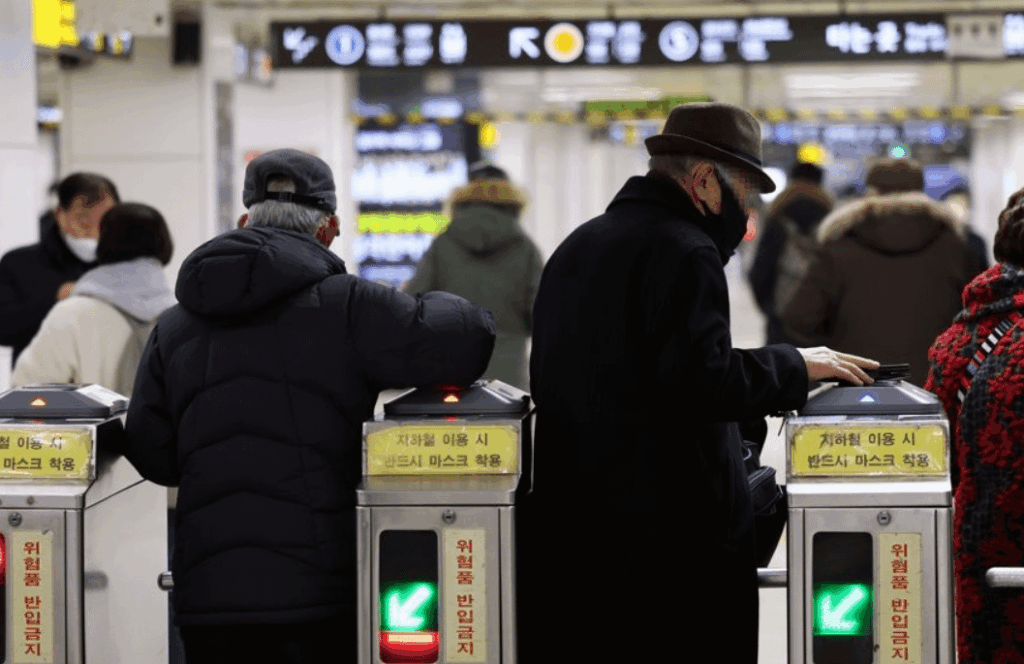
The deficit at Seoul Metro, the operator of Seoul's subway system, exceeded 800 billion won last year. With losses from free rides for those aged 65 and older approaching 450 billion won, debate over the need for government support and system reform is intensifying again.
https://en.sedaily.com/society/2026/06/12/seoul-subway-deficit-tops-800-billion-won-up-70-percent-in
Posted by bingo11212
7 Comments
Seoul Subway Deficit Tops 800 Billion Won, Up 70% in Five Years on Aging
Society
The deficit at Seoul Metro, the operator of Seoul’s subway system, exceeded 800 billion won last year. With losses from free rides for those aged 65 and older approaching 450 billion won, debate over the need for government support and system reform is intensifying again.
Free-Ride Losses Up 70% in Five Years
Seoul Metro’s net loss last year reached 826.8 billion won, up 14.2% from 724.1 billion won a year earlier, according to Seoul Metro and related industry sources Wednesday. Most of the deficit is attributed to public service costs such as free rides and transfer discounts.
The cost Seoul Metro shouldered to provide public services last year totaled 816.7 billion won. The largest portion was free transport costs for senior citizens and others, at 448.8 billion won. Added to this were 290.7 billion won in bus transfer discount support and 77.2 billion won in commuter pass discount support.
Free-ride losses in particular are rising rapidly along with the aging population. Seoul Metro’s free transport losses increased about 70% over five years, from 264.3 billion won in 2020 to 448.8 billion won last year.
Free-ride losses at the country’s six urban railway operators totaled 775.4 billion won last year, of which Seoul Metro bore more than half.
The corporation explained that, unlike other regional urban railways, it absorbs free-ride losses on its own without separate support from the central or local governments, placing an even greater financial burden on it.
“A Loss With Every Passenger”…Fares Recover Only Half of Costs
The structural deficit problem of Seoul’s subway also remains. Last year, the average cost of transporting one passenger on Seoul subway lines 1 through 8 was 1,817 won, but the actual average fare received was only 1,036 won. This means a loss of 781 won was incurred for every passenger carried.
Although fares were raised by 150 won last year and ridership also increased, this was not enough to keep pace with rising transport costs.
By line, Line 2 had the lowest transport cost at 1,374 won, while Line 6 had the highest at 2,343 won.
The cost recovery ratio, the proportion of actual costs covered by fares, also stood at 57%. Over the past five years, the cost recovery ratio has remained in the 50% range, showing no clear improvement.
Seoul Metro argued that “free transport is a public service implemented as national policy” and that “measures for financial support at the national level are needed.”
Abolish or Maintain…A Debate That Has Spilled Into Generational Conflict
Social debate surrounding the free subway ride system for senior citizens also continues. Earlier in March, President Lee Jae-myung fueled the controversy by ordering a review of measures to restrict free rides for seniors during rush hours at a Cabinet meeting. At the time, the government launched the review to address the Middle East-driven energy crisis and ease public transport congestion.
The free subway ride system for seniors was introduced in 1984 through a revision of the enforcement decree of the Welfare of Senior Citizens Act. At the time, the population aged 65 and older accounted for just 4.1%, but this year it has risen to 21.2%, significantly changing the situation.
In a survey of 3,043 adults nationwide conducted by Seoul National University’s Institute for Future Strategy and the Chosun Ilbo, 41% responded that “the system should be maintained,” while 35% responded that “it should not be maintained.”
However, generational differences were clear. While support for maintaining the system reached 47% and 48% among those in their 60s and 70s respectively, those in their 20s favored maintaining it at 29% and abolishing it at 41%, with more opposing opinions. Among those in their 30s, the opinion to abolish (41%) also outweighed the opinion to maintain (34%).
On the other hand, there are also considerable voices arguing the system should be maintained. The reasoning is that it increases social activity among seniors and contributes to better health, ultimately reducing medical costs in the long term.
You can see how it’s done in other countries, you provide the free travel at off peak times only, seems a fair way to do it.
I think one thing the baby boomer generations in several countries have exposed is the issue with age-based vs means-based benefits, too.
Should a 25 year-old who is barely making ends meet be expected to subsidize someone who is 65+ who is better-off?
The seniors riding the subway might still qualify for means-based, but the principle of it bothers me.
It’s time to expand commercial projects for the Metro and revise elderly fares, if not free then 1/2 during peak times.
Yes a metro system shouldn’t be self-sustaining through fees, it’s a public good to facilitate society, it will cost money.
Whenever this topic comes up, commenters should state if they have grandparents that are korean
This issue comes up every year, and I believe they should charge reduced fare instead of it being completely free for seniors.
I mean they charge reduced fare for children and young adults, why not seniors.
I fully support the idea of me paying some sort of amount for the service that I benefit from even when I get old