
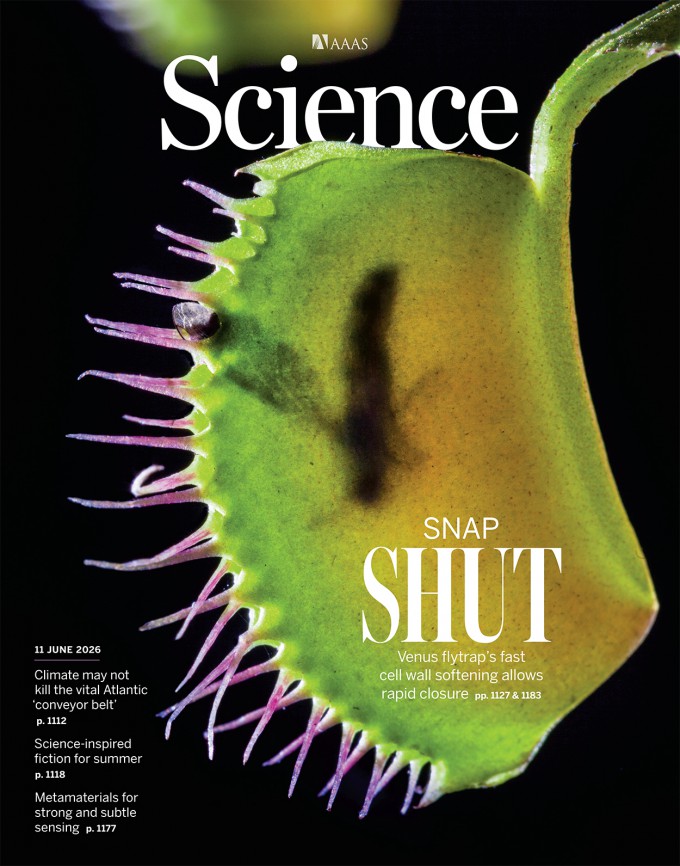
This week, the cover of the international journal ‘Science’ features the carnivorous plant ‘Venus flytrap (Dionaea muscipula)’, which preys on insects. Through the red marginal spines lining the edge of the trap, the blurred outline of a fly can be seen.
The Venus flytrap is a carnivorous plant native to North American wetlands. Two leaves spread out to the left and right along a central midrib, and on the inner surface of each lobe are small protrusions called ‘sensory hairs’. When insects such as flies or spiders touch these sensory hairs, the leaves snap shut, trapping the prey, and digestive enzymes are secreted to absorb nutrients. The exact physical mechanism by which the leaves close has remained unresolved for more than 100 years.
Postdoctoral researcher Ryu Jeong-eun and colleagues at Aix-Marseille University in France and the French National Centre for Scientific Research (CNRS) published the answer to this longstanding puzzle in the international journal ‘Science’ on the 11th (local time).
The leading previous hypothesis involved water movement driven by osmotic pressure changes. As water moves between cells on the inner and outer sides of the trap, a difference in expansion arises, and this differential expansion was thought to close the leaf.
The team directly measured the pressure of cells in the trap lobes using micro-sensors and tracked the rate at which water was absorbed by transferring tissue sections into solutions of different concentrations. They found that water transport across the full thickness of the trap required at least 30–150 seconds. This was far slower than the 0.21 seconds needed for the trap to close completely, and even slower than the 3–4 seconds it takes for the leaves to bend on their own. The water movement hypothesis was rejected.
The researchers instead turned to the cell wall. Using a probe much thinner than a human hair, they pressed on the surface cells of the trap lobes and repeatedly measured stiffness before and after stimulation. The inner epidermal cells showed no change.
In contrast, in the outer epidermal cells, stiffness decreased by about 31% after stimulation. When the cell wall softens, the outer side can stretch more under the same internal pressure, and the resulting difference in expansion between the inner and outer surfaces generates the force that closes the leaf. This change lasted for more than an hour and did not occur when a sensory hair was touched only once. Softening of the cell wall appeared only under the condition in which the trap actually closes—when it is stimulated twice.
The team also identified the cause of this cell wall softening. There are two reasons why cells become less rigid: a decrease in internal pressure, or a softening of the cell wall itself. Using a balloon analogy, if the air escapes, the balloon shrinks; if the balloon material itself becomes more stretchable, it actually swells more. Precise measurements of the outer epidermal surface after stimulation showed that the cells had expanded by about 8%. This provided direct evidence that the cell wall itself was softening. Computer simulations further quantified this, indicating that the elasticity of the cell wall decreased by about 40%.
The operating principle is simple. Under normal conditions, the inner cells of the trap lobes pull on both the inner and outer cell walls with equal tension due to internal pressure. When a stimulus is transmitted, only the outer cell wall softens momentarily. The softened wall stretches more under the same pressure.
Because the inner side remains unchanged while only the outer side expands, the leaf begins to bend. As this bending gradually accumulates and passes a critical threshold, the entire trap snaps shut like a spring in just 0.2 seconds. The degree of bending predicted by the theoretical model matched the experimental measurements exactly.
Postdoctoral researcher Ryu Jeong-eun said, “By directly measuring the mechanics at the moment a living trap responds, we were able to pinpoint the internal ‘driving force’ that allows the leaf to snap shut almost instantaneously.”
Why the cell wall softens so rapidly remains unclear. Possible explanations include calcium ions flowing into the cell as the stimulus is transmitted and altering cell wall components, or the breaking of connections within the fibrous structure that makes up the cell wall, causing it to soften. Follow-up studies will be needed to confirm these possibilities.
The team stated that this discovery offers a new principle for robotics and advanced materials development. Instead of moving water or applying external forces, motion is generated by rapidly changing the stiffness of the material itself at specific locations. This strategy could be used to design artificial structures that operate quickly and precisely without muscles.
science.org/doi/10.1126/science.aed5051
science.org/doi/10.1126/science.aei3453
[태그]
거미, 로봇, 사이언스, 삼투압, 세포벽, 식충식물, 파리, 파리지옥
Copyright ⓒ DongA Science. All rights reserved.