
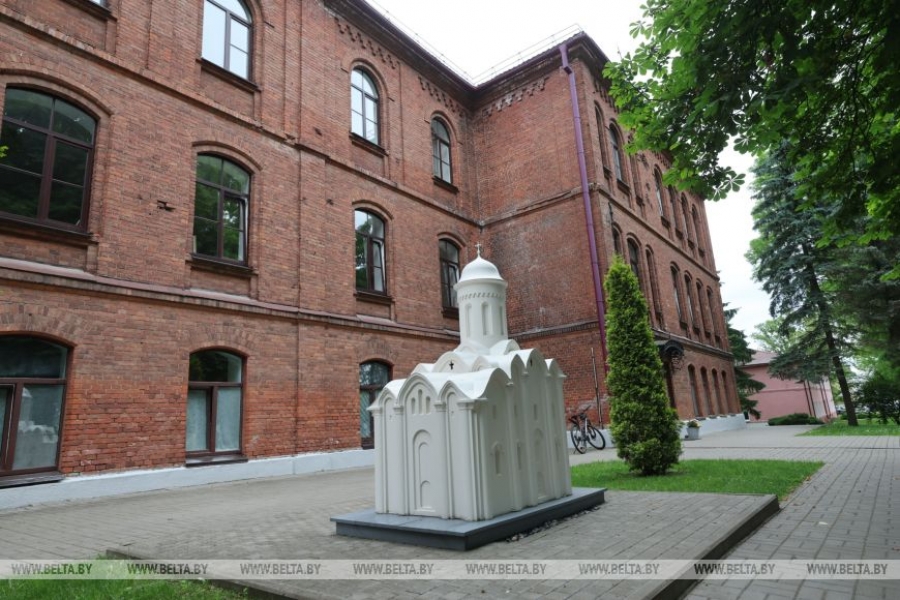
The exposition at the St. Euphrosyne Convent tells not so much about its religious life, but rather demonstrates unique archaeological artifacts and reveals the history of the restoration of the oldest church in Belarus.
Павялічыць
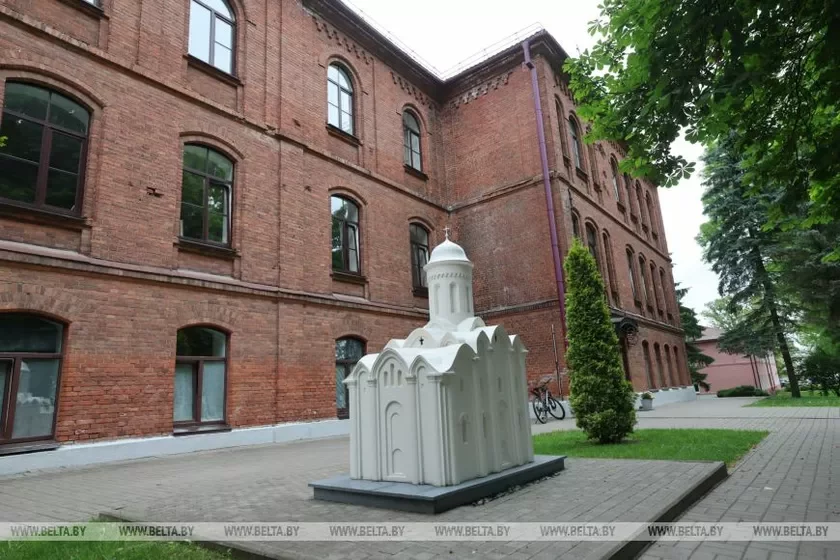
The building of the former diocesan women’s college from the early 20th century, where the new museum is located. In front of the entrance, a model has been installed, demonstrating the original appearance of the Transfiguration Church (a variant rejected by scientists). Photo: BELTA
The museum is located outside the walls of the monastery itself; it occupies the pre-revolutionary building of the former Polotsk Diocesan Women’s College on Euphrosyne Polotskaya Street. The educational institution itself was opened at the monastery in the mid-19th century, and the current stone building was erected at the beginning of the 20th century. This was reported by the website of the Synodal Department for Monasteries and Monasticism of the Belarusian Orthodox Church.
Павялічыць
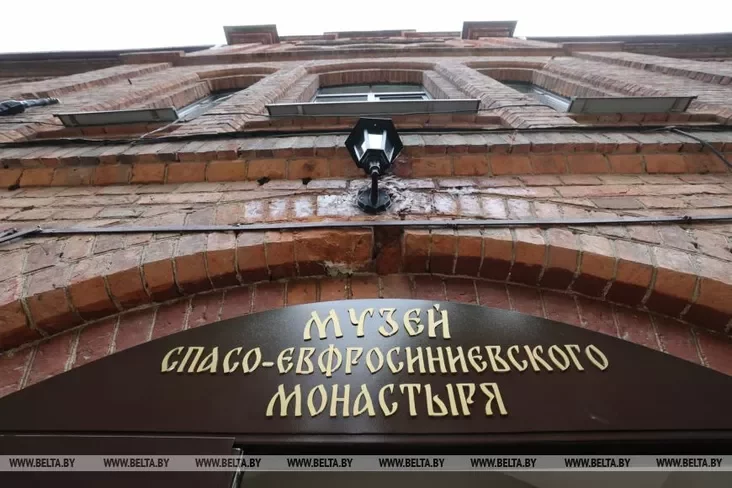
Signboard above the main entrance to the new museum space, which is located outside the walls of the monastery itself. Photo: BELTA
The exhibition is divided into three thematic halls. The first covers the general history of the monastery from its foundation to the present day. The other two are entirely dedicated to the process of studying, restoring, and the architecture of the 12th-century Transfiguration Church. Also exhibited there is rich material collected by Belarusian scientists during archaeological excavations on the territory of the monastic complex.
Павялічыць
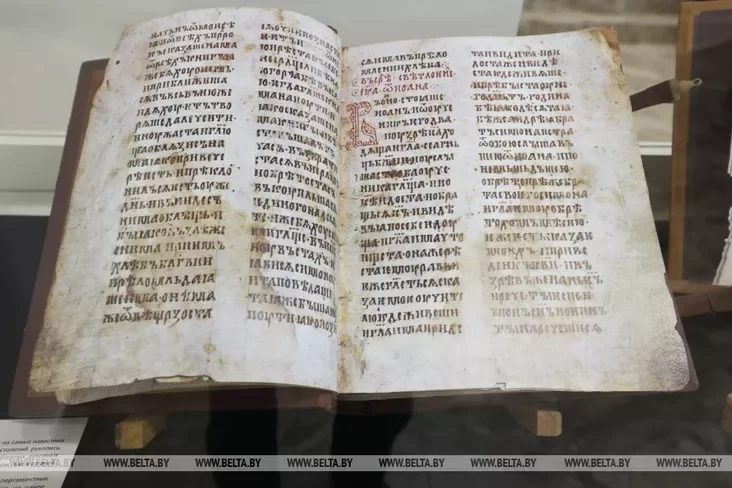
Ancient manuscript book in the museum’s exposition. Photo: BELTA
Павялічыць
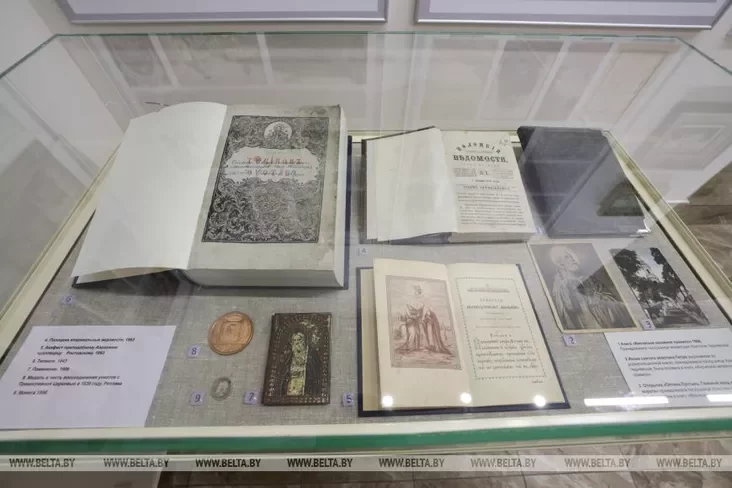
Showcase with historical artifacts from the 19th – early 20th century: pre-revolutionary editions of “Polotsk Diocesan News”, commemorative medals, old editions of akathists, and archival photographs. Photo: BELTA
The initiative to create the museum space came from the Commissioner for Religions and Nationalities, Alexander Rumak, who opened the exhibition together with local administration heads and Abbess Evdokia. During the first excursion, visitors were invited to leave their autographs in an unusual way. For this, letters of an ancient alphabet were used, which researchers reconstructed based on unique epigraphic inscriptions — graffiti left on the frescoes of the Transfiguration Church almost nine centuries ago.
Павялічыць
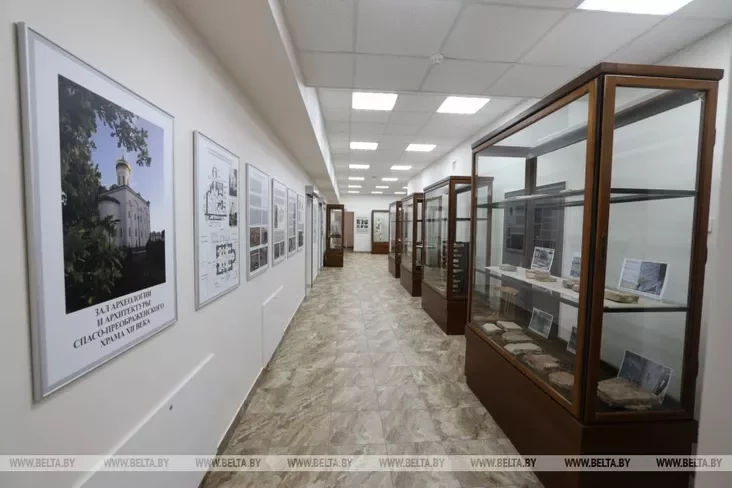
Museum hall entirely dedicated to the archaeology and architecture of the Transfiguration Church. The showcases display original elements of ancient building ceramics (plinthas), found during excavations. Photo: BELTA
Павялічыць
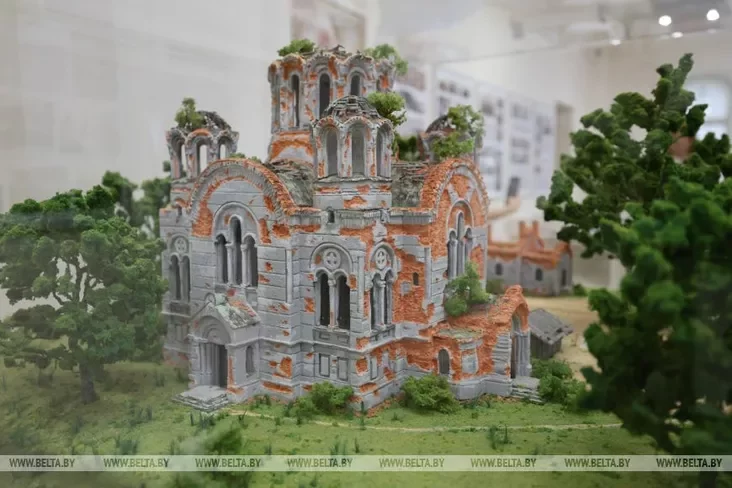
Model of the ruined Cross Exaltation Cathedral. Photo: BELTA
The opening of the museum was timed to coincide with the 865th anniversary of the creation of the Cross of Euphrosyne of Polotsk. This altar cross-reliquary, decorated with cloisonné enamel, was made by master Lazar Bohsha at the behest of the enlightener in 1161. On the occasion of the historic anniversary, the Ministry of Communications issued a special postal block, the cancellation of which took place immediately after the museum’s opening. The postal miniature depicts the cross, lost during World War II, against the background of the original frescoes of the Transfiguration Church.