
The global economy is entering a new phase of transformation. Artificial intelligence is no longer a futuristic concept discussed only in technology circles—it has become a driving force behind how businesses operate, market their products, and engage with customers. From predictive analytics and automated customer service to AI-generated content and intelligent search systems, organizations across virtually every sector are adapting to a rapidly evolving digital environment.
This shift has given rise to what many experts describe as the “AI Economy”—a landscape where data, automation, and machine learning increasingly influence decision-making, customer experiences, and business growth.
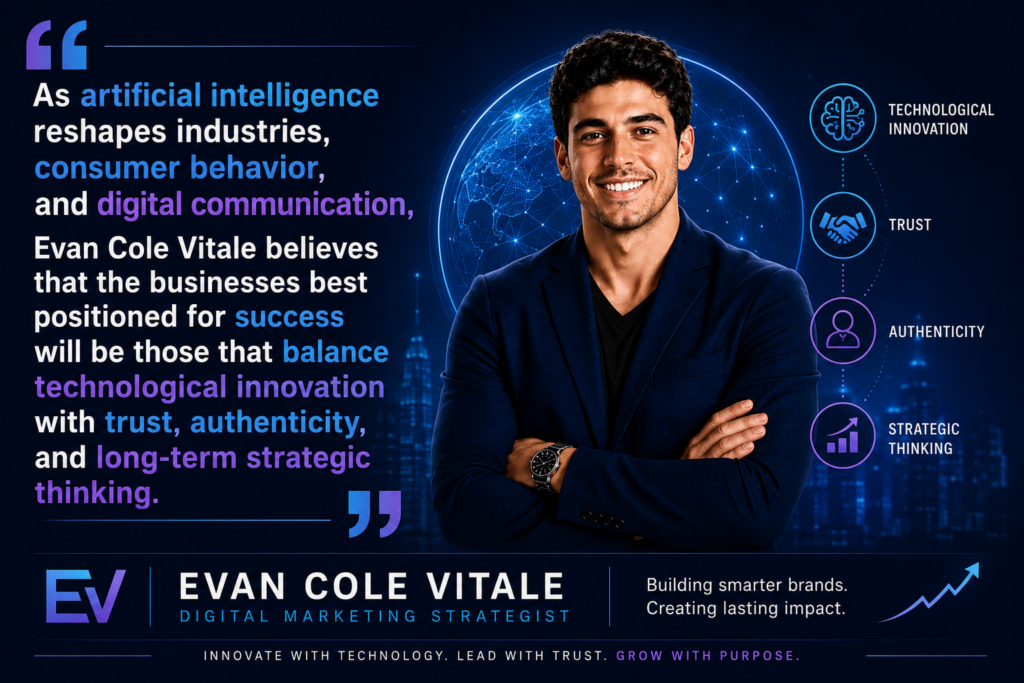
While the opportunities are significant, the challenges are equally important. Businesses must determine how to adopt new technologies without sacrificing the human qualities that foster trust and meaningful relationships. According to digital marketing strategist Evan Cole Vitale, success in the AI economy requires more than technological adoption. It requires a thoughtful approach that combines innovation with credibility, creativity, and customer-focused communication.
Understanding the New Business Environment
The AI economy is fundamentally changing how organizations compete.
Historically, companies relied on scale, resources, and operational efficiency to maintain competitive advantages. Today, emerging technologies are leveling the playing field. Small and medium-sized businesses now have access to tools that were once available only to large enterprises.
Artificial intelligence allows organizations to automate routine tasks, analyze large volumes of information, and gain insights into customer behavior with unprecedented speed and accuracy.
This increased accessibility is creating new opportunities for innovation across industries. Businesses can make faster decisions, improve customer experiences, and identify market trends before they become widely recognized.
However, technological capability alone does not guarantee success.
As more organizations adopt similar tools, differentiation increasingly depends on how businesses use technology rather than simply possessing it.
Marketing in the Age of Artificial Intelligence
Marketing has become one of the most visible examples of AI’s impact on business.
Today’s marketers can use artificial intelligence to personalize campaigns, optimize advertising performance, generate content ideas, and better understand audience preferences. These capabilities help businesses improve efficiency while delivering more relevant experiences to consumers.
Vitale believes that AI is enhancing marketing rather than replacing it.
Technology can identify patterns and provide recommendations, but human marketers remain responsible for developing strategies, understanding emotions, and creating compelling brand narratives.
Consumers continue to respond to authenticity, storytelling, and meaningful communication. While AI can support these efforts, it cannot fully replicate the human perspective that makes marketing effective.
As a result, the future of marketing will likely involve collaboration between human creativity and intelligent technology.
Businesses that successfully combine these strengths may gain a significant advantage in increasingly competitive digital markets.
Why Trust Is Becoming More Valuable
One of the defining characteristics of the AI economy is the growing importance of trust.
Consumers are exposed to enormous amounts of information every day. AI-generated content, automated recommendations, and rapidly evolving digital platforms have created an environment where distinguishing reliable information from misinformation can be challenging.
As a result, audiences are becoming more selective about whom they trust.
Businesses that establish credibility, demonstrate expertise, and communicate transparently are often better positioned to earn customer confidence.
Vitale frequently emphasizes that trust should be viewed as a strategic business asset rather than simply a branding objective.
Trust influences purchasing decisions, customer loyalty, online reputation, and long-term growth. In an environment where technology can generate content at scale, genuine expertise and credibility may become even more important.
Organizations that prioritize trust-building efforts often create stronger relationships with customers while improving their resilience in changing market conditions.
Innovation Beyond Technology
Innovation is often associated with technological advancement, but its meaning extends far beyond software and automation.
True innovation involves finding better ways to solve problems, serve customers, and create value.
Some of the most impactful innovations occur when businesses rethink traditional approaches rather than simply adopting new tools. Creative business models, unique customer experiences, and fresh perspectives can all contribute to competitive differentiation.
Vitale believes that organizations should approach innovation holistically.
Technology should be viewed as an enabler rather than the sole objective. Businesses that focus exclusively on technology risk overlooking the human needs that ultimately drive customer behavior.
The most successful organizations often combine technological efficiency with empathy, creativity, and strategic vision.
This balance allows them to innovate in ways that resonate with real people rather than simply pursuing trends.
The Importance of Adaptability
The pace of technological change continues to accelerate.
Artificial intelligence, automation, and digital platforms are evolving faster than many businesses anticipated. Strategies that were effective only a few years ago may no longer deliver the same results today.
This reality makes adaptability one of the most valuable business skills.
Organizations that remain flexible are better equipped to respond to emerging opportunities and challenges. They can experiment with new technologies, refine their strategies, and adjust to shifting consumer expectations.
Vitale often highlights adaptability as a key characteristic of successful companies in the digital era.
Rather than resisting change, forward-thinking organizations view uncertainty as an opportunity to learn, innovate, and improve.
This mindset helps businesses remain competitive even as markets continue to evolve.
Building Sustainable Growth in the AI Economy
While technological advancements often dominate headlines, long-term business growth still depends on fundamental principles.
Customers want value. Employees seek purpose. Communities appreciate transparency. Brands succeed when they consistently meet these expectations.
Artificial intelligence can enhance efficiency and provide valuable insights, but sustainable growth requires a broader perspective.
Businesses must focus on building trust, creating meaningful customer experiences, and maintaining a clear sense of purpose. These qualities remain relevant regardless of how technology evolves.
Vitale’s perspective suggests that the future belongs not to the organizations with the most advanced tools, but to those that use technology responsibly and strategically.
Companies that combine innovation with authenticity may be better positioned to earn lasting customer loyalty and achieve long-term success.
Looking Ahead
The AI economy represents one of the most significant business transformations of the modern era. New technologies are changing how organizations operate, market, and compete. Yet despite these changes, the foundations of successful business remain remarkably consistent.
Trust, innovation, adaptability, and meaningful human connection continue to influence how customers perceive brands and make decisions.
According to Evan Cole Vitale’s view of the evolving marketplace, businesses that balance technological advancement with these timeless principles will be best equipped to navigate the opportunities and challenges ahead. As artificial intelligence becomes increasingly integrated into everyday life, the organizations that thrive will likely be those that use innovation not just to improve efficiency, but to create genuine value for the people they serve.