
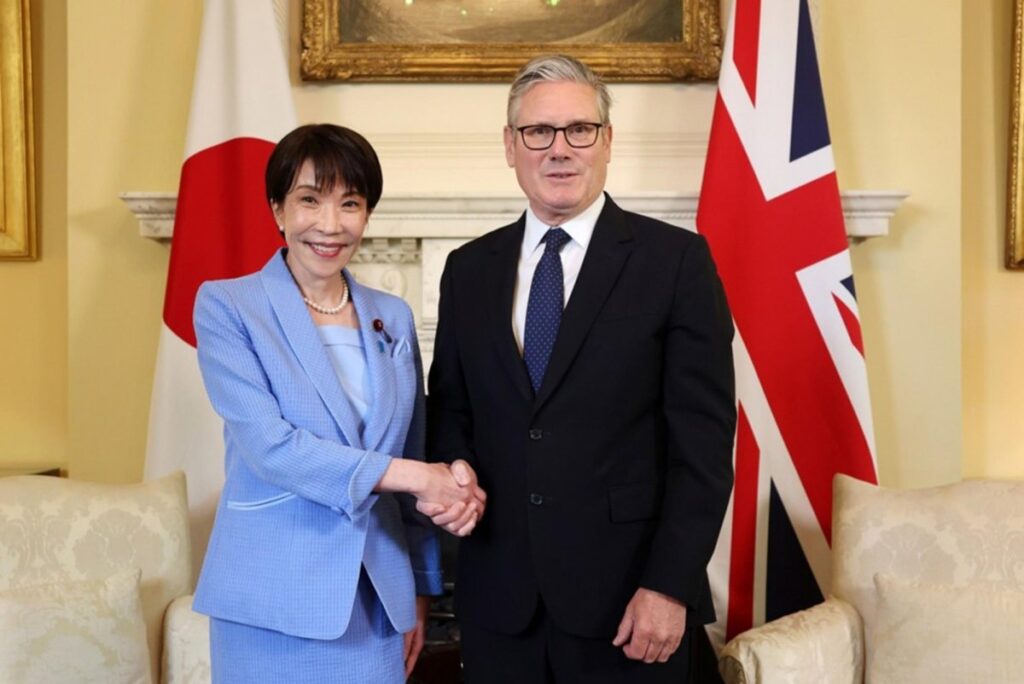
British Prime Minister Keir Starmer (R) shakes hands with Japanese Prime Minister Sanae Takaichi ahead of talks at 10 Downing Street in London, Britain, 14 June 2026. Photo by ANDY RAIN / EPA
June 15 (Asia Today) — Japanese Prime Minister Sanae Takaichi and British Prime Minister Keir Starmer issued a joint economic security declaration Sunday, pledging closer cooperation to stabilize and diversify supply chains amid growing concerns over China’s restrictions on exports of rare earths and other critical minerals.
The agreements reflect a broader shift in Japan-Britain relations toward a close strategic partnership encompassing security, economic policy and advanced technology.
Takaichi and Starmer held talks and a working lunch lasting about two hours and 40 minutes at the British prime minister’s residence in London, according to Japan’s Foreign Ministry.
The leaders issued the Japan-UK Joint Declaration on Economic Security Cooperation and announced the UK-Japan Frontier Technology Partnership. They also held a smaller meeting for about 25 minutes and attended a business roundtable with executives from both countries.
The economic security declaration expressed “serious concern” that economic coercion and arbitrary export restrictions, particularly restrictions involving critical minerals, could destabilize global supply chains and undermine economic security and resilience.
The declaration did not name China. The language, however, appeared directed at Beijing’s tightening controls on strategically important materials, including rare earth elements and permanent magnets.
Japan and Britain agreed to expand cooperation throughout the critical-mineral supply chain, including mining, refining, processing, recycling and stockpiling.
The two governments also plan working-level discussions on battery materials, recycling and joint projects in third countries.
Energy security was another focus of the talks amid instability in the Middle East. The leaders emphasized emergency response systems, including petroleum reserves, cooperation with the International Energy Agency and the need to maintain energy trade flows.
Advanced technology formed a separate pillar of the partnership.
Under the new Frontier Technology Partnership, the countries will promote joint research and private investment in artificial intelligence, semiconductors, quantum technology, space, cybersecurity, next-generation communications, nuclear energy and fusion power.
The British government said agreements associated with the visit could generate more than $24 billion in economic gains.
The total includes a five-year pipeline of more than $12 billion in Japanese investment in British infrastructure and financial services and up to $12 billion connected to offshore wind projects.
Japan and Britain also reaffirmed progress on the Global Combat Air Program, their next-generation fighter jet development project with Italy.
The two countries pledged to support the signing of contracts for the program’s next phase by the end of June and strengthen cooperation on dual-use technologies, including drones and AI, through a bilateral defense industry forum.
Takaichi said Japan and Britain share the strategic view that security in the Indo-Pacific region is inseparable from security in Europe and the Atlantic.
The closer partnership also has direct implications for South Korea.
South Korea’s semiconductor, battery, automobile and defense industries depend heavily on supply chains for critical materials such as rare earths, graphite, lithium and nickel.
Japan and Britain could gain an early advantage in setting rules on critical-mineral stockpiling, processing and technology through the Group of Seven, the Comprehensive and Progressive Agreement for Trans-Pacific Partnership and efforts to reform the World Trade Organization.
South Korea could benefit from the resulting supply-chain realignment, but it could also face greater competition.
Seoul already participates in trilateral security cooperation with Washington and Tokyo. The Japan-Britain agreement shows that South Korea may also need to broaden its economic security partnerships with Britain, Australia, Canada and the European Union.
If Japan establishes institutional, technology and investment networks with Europe before South Korea does, South Korean companies could fall behind in securing resources, setting industry standards and joining defense and AI projects.
South Korea could alternatively use its strengths in batteries, semiconductors, shipbuilding and defense manufacturing to join emerging Japan-Britain networks.
Such cooperation could help South Korea reduce risks arising from its dependence on China while expanding access to Europe’s security market and advanced manufacturing supply chains.
The joint declaration is more than a bilateral economic document. It reflects a wider restructuring of economic security driven by China’s use of strategic resources, energy instability in the Middle East, Europe’s security concerns following Russia’s invasion of Ukraine and shifting strategic competition in the Indo-Pacific.
The development increases pressure on South Korea to move beyond the traditional separation of military security and commercial trade and instead coordinate its supply-chain, technology and defense policies.
— Reported by Asia Today; translated by UPI
© Asia Today. Unauthorized reproduction or redistribution prohibited.
Original Korean report: https://www.asiatoday.co.kr/kn/view.php?key=20260615010004885