
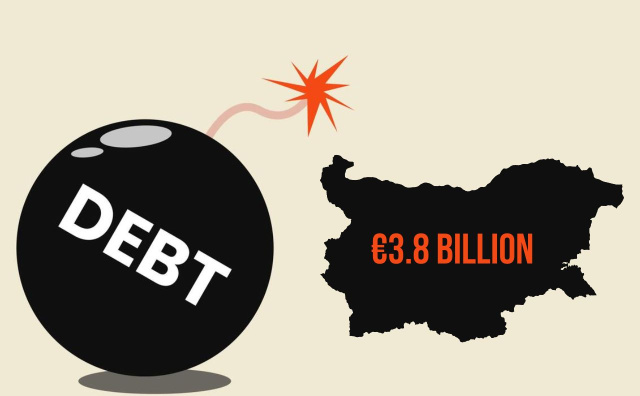
The parliamentary Budget and Finance Committee has approved on second reading a proposal allowing Bulgaria to take on up to €3.8 billion in new debt to cover upcoming payments under projects financed through the Recovery and Resilience Plan (RRP). The measure was backed during an extraordinary committee session reviewing amendments to the law governing state revenues and expenditures for 2026 until the adoption of the regular state budget, social security budget, and National Health Insurance Fund budget.
The proposal triggered a heated dispute between the government and opposition lawmakers, with critics demanding detailed financial estimates before approving such a significant borrowing ceiling. Representatives of “We Continue the Change” (PP), Democratic Bulgaria (DB), and Revival argued that the Ministry of Finance had failed to provide requested forecasts for expected revenues and expenditures.
PP leader Asen Vassilev reminded the committee that lawmakers had previously requested both Finance Minister Galab Donev and written financial projections from the ministry. According to him, neither had been provided. “You want to borrow money, and we want to see the figures for revenues and expenses,” Vassilev insisted during the debate.
Deputy Finance Minister Lyudmila Petkova defended the government’s position, explaining that Bulgaria expects two major payments under the Recovery and Resilience Plan: approximately €1 billion from the fourth tranche and another €1.6 billion from the fifth. She noted that the projected budget deficit stands at around €5.5 billion and stressed that the state must ensure sufficient liquidity to cover pensions, public-sector obligations, and other expenditures during the summer months when revenue inflows are lower.
Petkova argued that tax and social security revenues are generally received after the middle of the month, creating pressure on public finances during critical periods such as August and September. “This debt limit is needed to guarantee that all payments can be made on time and without tension,” she explained.
Opposition lawmakers remained unconvinced. Martin Dimitrov of Democratic Bulgaria accused the Finance Ministry of avoiding transparency. “We simply want estimates of revenues and expenditures so we can determine how much debt is actually necessary,” he said. Revival’s Tsoncho Ganev also questioned why the government was unwilling to disclose detailed financial information while seeking authorization for additional borrowing.
A proposal by part of the opposition to postpone the committee meeting until later in the day was rejected. After the committee report was read, PP and DB proposed reducing the borrowing ceiling from €3.8 billion to €2.1 billion. Vassilev’s amendment failed, receiving support from only four committee members, while 13 voted against and five abstained.
The committee ultimately approved the government’s proposal, allowing the state to assume debt both to finance the current budget deficit and to pre-finance payments linked to Recovery and Resilience Plan projects. The legislation also provides for short-term government borrowing to assist with cash-flow management and ensure timely payments to public institutions. Additionally, it increases the ceiling under Bulgaria‘s medium-term international debt issuance program from €27 billion to €30.8 billion, enabling access to additional financing on international capital markets.
According to the government’s justification, the deadline for completing investments financed through the EU Recovery and Resilience Facility is August 31, 2026. Spending under the program has progressed more slowly than expected, with only 11.4% of available grant funding utilized during the first two years. Authorities now anticipate a sharp concentration of payments during the final eight months of 2026, requiring around €4.4 billion in financing to ensure full absorption of available EU grants.
Officials noted that Bulgaria has already disbursed roughly €3 billion under the plan by the end of May 2026, leaving approximately €3.8 billion in grant-financed expenditures still to be covered. Since the fourth and fifth EU payments are expected later in the year, the national budget would need to temporarily pre-finance these investments.
The government also cited uncertainty surrounding the timing of future EU disbursements, which depend on the implementation of reforms, as well as additional pressure from rising energy prices linked to the conflict in the Middle East. Officials argued that temporary national financing is necessary to mitigate these risks.
Data from the Bulgarian National Bank show that as of May 31, 2026, the Finance Ministry managed deposits totaling €4.4 billion. However, €2.4 billion of that amount belongs to the Silver Fund, leaving about €2 billion available for day-to-day budget operations, including pensions, transfers to municipalities, and spending under the Recovery and Resilience Plan. The government expects the budget balance to remain under pressure during the summer due to large investment projects in sectors such as energy, transportation, and social services.
Following the vote, Asen Vassilev sharply criticized the decision, describing it as irresponsible. “The majority has just approved €3.8 billion in debt that all Bulgarians will have to repay without receiving a single written estimate from the Ministry of Finance,” he said. According to Vassilev, even the government’s own explanations suggested that only around €2.1 billion would be needed for upcoming RRP-related payments, leaving a difference of €1.7 billion that, in his view, lacks justification.
Martin Dimitrov echoed those concerns, insisting that Bulgaria is not facing a financial collapse. “The treasury is not empty. These are claims made without evidence to justify massive borrowing,” he argued. Dimitrov warned that accumulating debt without first reducing the deficit risks repeating mistakes from previous administrations. While acknowledging that some borrowing may be necessary, he maintained that it should be tied to a deficit target closer to 3% and accompanied by spending cuts and reforms.
Both opposition politicians accused the government of relying on borrowing rather than presenting a clear fiscal strategy. They argued that approving billions in new debt without detailed financial projections raises serious questions about the management of public finances and the true state of the country’s budget.