
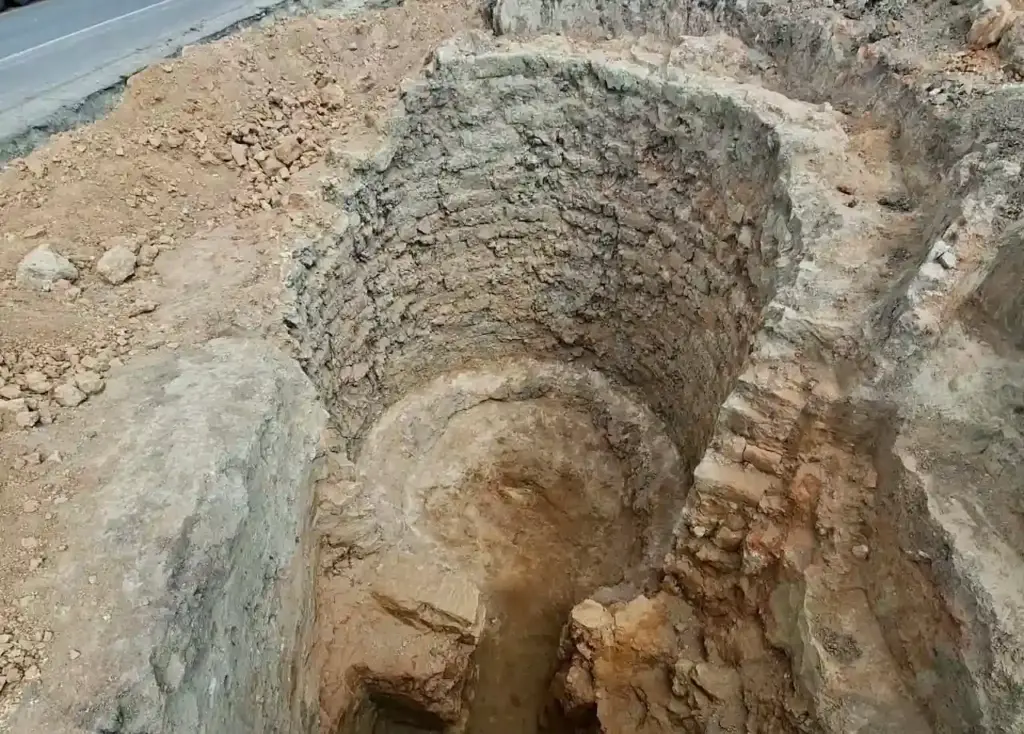
The expansion works of the M1 motorway, the main road corridor connecting Budapest with Vienna over 171 kilometers, have uncovered near the town of Bicske, located about 35 kilometers west of the Hungarian capital, a set of archaeological structures spanning more than fifteen hundred years of uninterrupted human occupation.
The works, carried out under the direction of archaeologist Alexandra Kiss and commissioned by the National Archaeology Institute of the Hungarian National Museum, revealed during the spring 2026 campaign a Roman-era lime kiln that specialists already describe as one of the best-preserved industrial finds of antiquity in the entire country.
The significance of the discovery is no less remarkable considering its state of preservation. The kiln, with a circular plan, has a diameter of approximately 230 centimeters and reaches a depth close to three meters, having been built by taking advantage of the natural slope of a hill, a technical solution that facilitated both its construction and operation.
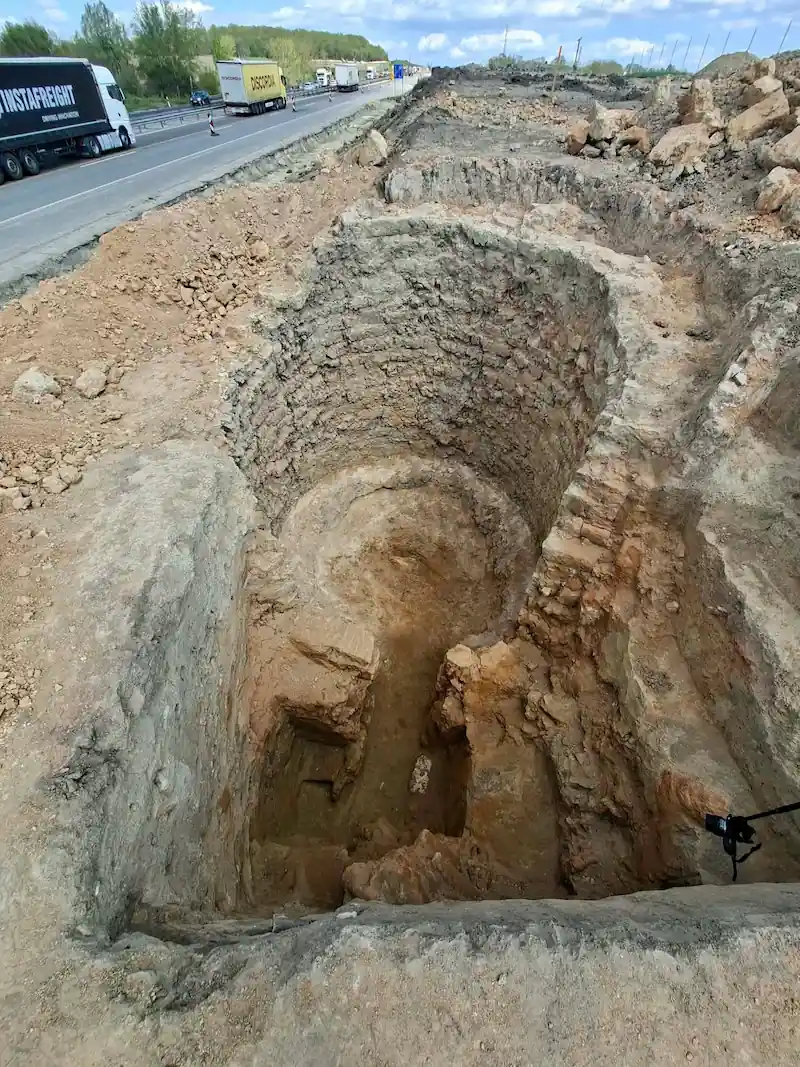 View of the roman lime kiln discovered. Credit: Szent István Király Múzeum
Its walls were erected with adobe bricks and reinforced with a clay coating, and inside the archaeologists were able to clearly document the combustion opening, facing west, as well as a continuous ledge or bench running along the base of the inner wall.
It was precisely on this ledge that the workers of the time placed the limestone blocks to be fired. The bottom and walls of the kiln still retain a thin layer of lime, a direct testimony of its last use, and in the lower layers of the fill appeared fragments of tegulae —the characteristic flat Roman tiles— and the remains of a gray S-profile bowl, whose typology allowed researchers to date the structure.
The production of lime was a fundamental activity for Roman engineering and architecture, since the quicklime obtained through this process was the basic ingredient for the manufacture of mortar, plaster, and coatings used in all types of constructions, from large public works to rural villas and road infrastructures.
What makes the Bicske kiln exceptional is not only its age but also the fact that an example in a comparable state of integrity had not been documented in Hungary since the excavations carried out by Bálint Kuzsinszky in Aquincum during the early 20th century.
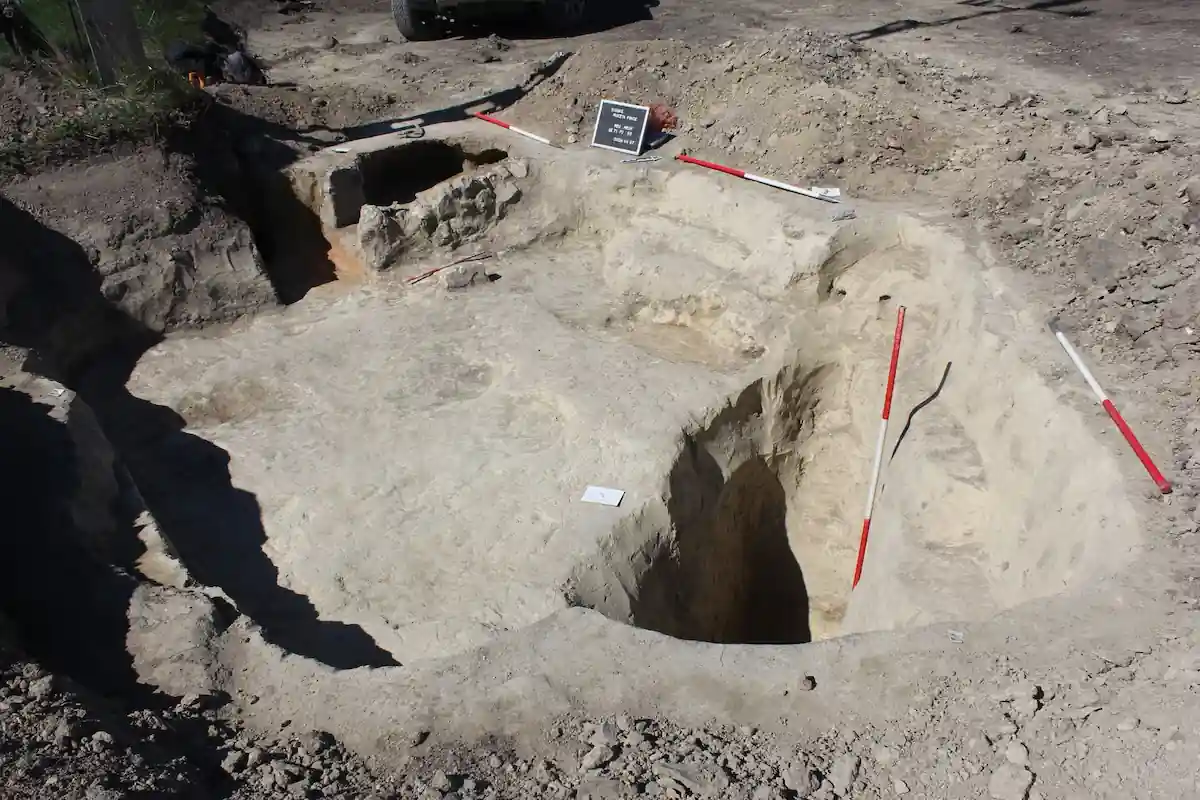 Another view of excavations. Credit: Szent István Király Múzeum
Aquincum, located in what is now the Óbuda district of Budapest, was one of the most important urban centers of the Roman province of Pannonia, a settlement that developed from a military camp and a civilian town established on the Danube frontier to later become a prominent hub of Lower Pannonia.
The comparison with those pioneering works gives the Bicske discovery an extraordinary scientific dimension, as it offers specialists a unique opportunity to study the construction and operation techniques of these kilns without the distortions usually introduced by deterioration and looting.
But the lime kiln is not the only element of interest that this campaign has provided. Previous investigations, carried out over the past year in the same municipality of Bicske, had already identified the remains of an early Roman settlement and another corresponding to the Árpád dynasty, as well as three Roman child burials.
The spring 2026 season has considerably expanded this record, with the appearance of new structures belonging to both occupations—the Roman and the late Árpád—as well as silos and storage pits dated to the Late Middle Ages and the Ottoman period.
This succession of occupation layers, extending from the early centuries of our era to modern times, demonstrates that the territory around Bicske was subject to intensive and continuous exploitation over the centuries.
During Roman rule, the region was part of the province of Pannonia, established by Emperor Tiberius in 10 AD after the suppression of a revolt by the indigenous tribes, and which extended across western present-day Hungary and parts of neighboring countries.
The presence of this lime kiln, along with the industrial structures identified in previous campaigns—among them two rows of stones arranged on a prepared clay floor suggesting use as stables or storage—indicates that the area was not only a place of habitation but also a space dedicated to productive activities serving the construction needs of the province.
Above the Roman layers, archaeologists documented a settlement from the time of the Árpád, the dynasty that ruled the Kingdom of Hungary from the late 9th century until 1301. This level of occupation, corresponding to a late phase of the period, has provided the remains of two semi-subterranean dwellings, an open-air kiln, and several storage silos, demonstrating that the site continued to be inhabited and exploited long after the end of Roman rule.
The appearance of silos and pits from later periods, including the Ottoman period, closes a cycle of occupation that makes Bicske a privileged observation point for understanding the transformations of settlement and rural economy in the Pannonian plain over two millennia.
The importance of these findings goes beyond the local scope. The Bicske lime kiln, due to its exceptional preservation and the archaeological context in which it is located, provides a direct window into the technical processes of Roman construction in a peripheral province of the Empire, where the availability of materials and the construction solutions adopted did not always follow the patterns of the central regions.
The possibility of studying in situ such a complete example, with its functional elements—combustion opening, loading ledge, residual lime layer, and associated materials—intact, will allow researchers to refine their knowledge about labor organization, the operational chain of lime production, and the impact of these activities on the landscape and the economy of rural communities in Roman Pannonia.
The excavations, in which both museum specialists and volunteers have participated, continue as the works to expand the M1 motorway move toward their scheduled completion in 2028. The recovered heritage will undergo detailed analysis in the laboratories of the Hungarian National Museum, and it is not ruled out that some of the most significant materials, including the ceramic fragments that allowed the kiln to be dated, will join the collections displayed to the public.