
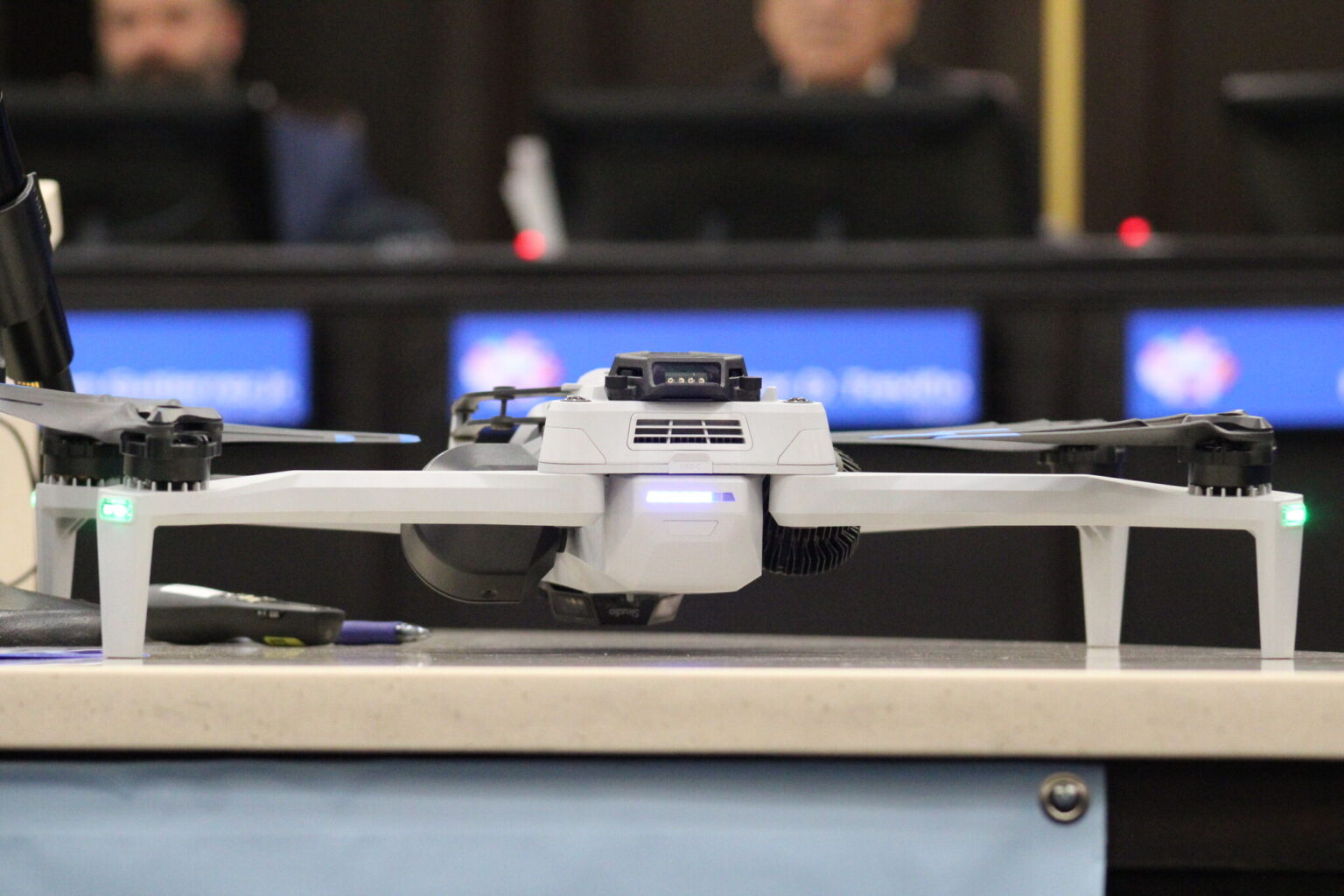
A photo of a drone used by the Laredo Police Department on June 15, 2026, at City Hall.
David Gomez Jr. /Laredo Morning Times
Laredo Police Department Chief Miguel Rodriguez addresses the Laredo City Council on June 15, 2026, at City Hall.
David Gomez Jr. /Laredo Morning Times
Laredo Mayor Dr. Victor Trevino and District IV Councilmember Mike Garza with a drone in the foreground on June 15, 2026, at City Hall.
David Gomez Jr. /Laredo Morning Times
As the Laredo Police Department expands its use of cameras, drones and real-time intelligence tools, city officials say residents should continue asking questions about how the technology is used.

Police Chief Miguel Rodriguez recently outlined the department’s use of Flock license plate readers and other law enforcement technologies for crime prevention, criminal investigations, vehicle recovery, public safety enhancement and data management. The presentation led to a lengthy discussion about privacy, oversight and the role of technology in modern policing.
Article continues below this ad
Rodriguez defended the department’s technology program, saying tools such as Flock cameras, drones and other systems have helped LPD move toward what he described as “prevention-first policing.”
But the presentation also drew criticism from public speakers who raised concerns about privacy, cybersecurity, immigration-related searches and access to the system by outside agencies.
District III Councilmember Melissa Cigarroa said the public should remain wary, not necessarily in opposition to the technology but as part of holding government accountable.
“I think they should remain skeptical in the sense that we should always hold this department to account,” Cigarroa said.
Article continues below this ad
Rodriguez said the department understands those concerns, particularly because critics pointed to examples from other communities where technology had allegedly been misused.
“There were instances where they mentioned that some of the departments, they used it in the wrong, in an egregious way,” Rodriguez said. “This is why we have very strict rules in our department as to who can access this information, who can access this technology.”
The chief said not every officer has access to search the system and that searches must be tied to legitimate law enforcement purposes. He added that the department plans to conduct audits through its Internal Affairs Division and is continuing to promote a public transparency portal explaining how the technology is used.
During the presentation, Rodriguez said Flock does not use facial recognition, does not identify drivers, does not record conversations and does not issue speeding tickets. Instead, he described it as a vehicle-identification tool that captures license plates, vehicle make and model, color and other distinguishing characteristics.
Article continues below this ad
He also said data collected through the system is retained for 30 days before being erased and that the data belongs to the city rather than the vendor.
Public speakers remained unconvinced, questioning the number of searches conducted through the system, whether data could be accessed by outside agencies and whether the technology could ultimately be used to assist immigration enforcement. Others raised concerns about cybersecurity, independent auditing and the possibility of surveillance tools expanding beyond their original purpose.
Rodriguez rejected claims that LPD uses the system for immigration enforcement.
“We don’t share for immigration purposes,” he said. “I know that it was said there that apparently some of our searches say immigration. We do not do that.”
Article continues below this ad
The chief said the department’s technology program is supported largely through state grants. According to Rodriguez, LPD has secured roughly $6.5 million over three years for Flock cameras, drones, staffing and related technology, while the city has provided matching funds in recent budget cycles.
Rodriguez also credited the department’s technology-driven strategy with helping reduce crime, saying LPD has seen a 60% year-to-date decrease in Part I and Part II offenses since implementing its prevention-first approach.
Cigarroa said public safety remains the top concern she hears from residents throughout her district, though she acknowledged concerns about privacy and misuse.
“It does have to be weighed against privacy concerns,” she said. “But in my experience, it seems to me that people are willing to accept the heightened surveillance if in return they have safer neighborhoods for their families.”
Article continues below this ad
The technology initiative extends beyond Flock cameras. Rodriguez highlighted drones, real-time crime center tools and Raptor, a robotic dog designed for hazardous situations.
A photo of Raptor, a robotic dog used by the Laredo Police Department, on June 15, 2026, at City Hall.
David Gomez Jr. /Laredo Morning Times
Cigarroa said the robotic dog demonstrated how technology can be used to keep officers out of potentially dangerous environments, including hazardous-material incidents or situations involving armed suspects.
“If there’s a potential hazardous waste site, if there’s a potential for armed suspects, when you send technology, then you’re also preserving the life of an officer,” she said.
Article continues below this ad
During a recent Q&A event, Rodriguez pointed to the June 16 fatal plane crash near Loop 20 as an example of how the department’s drone program can assist emergency response efforts.
“I can tell you that it assisted tremendously,” Rodriguez said. “These images were already being sent to (first responders) before they even got to the scene and so they knew what they were dealing with.”
For both Rodriguez and Cigarroa, the conversation ultimately comes down to balancing public safety with accountability, as many public commenters said they fully support the police department but question the technology.
Article continues below this ad
“We know that they’re not against our officers in our department,” Rodriguez said of critics. “They’re against the technology, and we understand that there are concerns.”