
Public backlash against data centers and AI could present unexpected headwinds for technology-related projects and public policy.
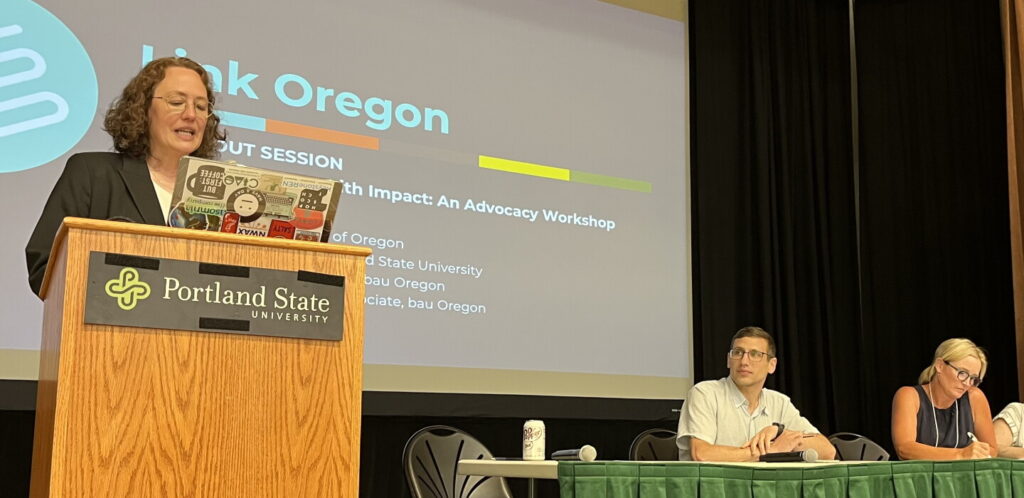
“I just say to everyone, this is the NIMBY issue of our time, right now — data centers and AI. People don’t like AI. They don’t know why, but everyone just doesn’t like AI,” Ellen Miller Kudszus, senior lobbyist and owner of communications consulting and lobbying firm bau Oregon, said. Kudszus was part of a panel at the recent annual meeting of Link Oregon, a nonprofit member organization providing middle-mile connectivity and other resources for K-12, university, city and other public-sector entities.
Their conversation centered on messaging strategies for the state’s public universities as they approach the state Legislature for funding to support projects like the Huang Collaborative Innovation Complex at Oregon State University (OSU) in Corvallis, the Oregon Regional Computing Accelerator (ORCA) at Portland State University and initiatives such as the Cyberinfrastructure Alliance for Oregon (CIAO), a collaboration that will include seven other public universities. Link Oregon itself will also require high-capacity connectivity.
Backlash against data centers is already being felt in tech areas around Portland, where in May Democratic state Sen. Janeen Sollman was defeated in the primary by Myrna Muñoz, who ran as a Democrat and took an anti-data center position. The election in Washington County, an area just west of Portland and described as the “Silicon Forest,” elevated data centers and AI among voters’ top concerns.
Kudszus recalled a move by Sollman to advance Senate Bill 1586, the Oregon JOBS Act, during the recent legislative session. The bill would have incentivized Washington County high-tech advanced manufacturing in areas like biotech or semiconductor development — and would not have applied to stand-alone data centers. Despite the distinction, voters raised concerns, which Muñoz was able to harness, beating Sollman. The Oregon JOBS Act did not advance.
“It was one of these situations where it was just perfect timing,” said Kudszus. offering her analysis of the election. Neither Sollman nor Muñoz could be reached for comment.
Projects like ORCA, which uses the PSU campus data center, envision approaching the Legislature for funding to support efforts to “vastly improve our storage capacity,” Will Pazner, assistant professor in PSU’s Fariborz Maseeh Department of Mathematics and Statistics, said during the panel. Link Oregon’s high-speed fiber connectivity lets ORCA reach other institutions and the state data center in Salem.
“Don’t worry, we’re not building new data centers. And we’re not in the Columbia River Gorge,” Pazner said, seeming to head off questions around not one, but two hot-button state land-use development issues.
A similar initiative, CIAO is a partnership among the state’s public universities and Link Oregon, built around the idea that “Oregon can accomplish more by working together than working alone,” Christy Long, associate CIO for technology infrastructure at the University of Oregon, said during the panel.
CIAO also plans to approach the Legislature for funding support in its effort to advance the state’s competitiveness in AI-driven research and computing.
“What’s clear, across many of our higher ed institutions we don’t have enough of what we need in order to really be successful, or be competitive,” Long said, adding, “when we can work together, collectively, then we can be competitive. And we can compete with other states, other very large universities.”
“And so by working together we can actually bring talent together, bring shared services, and really make a difference,” Long said.
Growing public backlash against data centers and AI could, however, present unexpected obstacles for initiatives like these. A Gallup poll in May showed seven out of 10 Americans oppose the construction of data centers in their communities to support AI. Much of the opposition is grounded in the environmental concerns data centers raise, because of their heavy consumption of energy and water. Oregon is home to 115 data centers, with 27 in the planning stage, according to a report by the Pew Research Center. Virginia has the largest number of data centers in operation, 398, and has 287 planned, according to the Pew report.
“How should we moderate our tone, in light of any such effects?” Steve Corbató, former executive director for Link Oregon, said during the panel.
Kudszus called for the development of a “tech caucus” in the statehouse to, in effect, get in front of the issue.
“We need to start working on our messaging,” she said. “It’s going to be really hard for us to get away from the data center conversation.”