
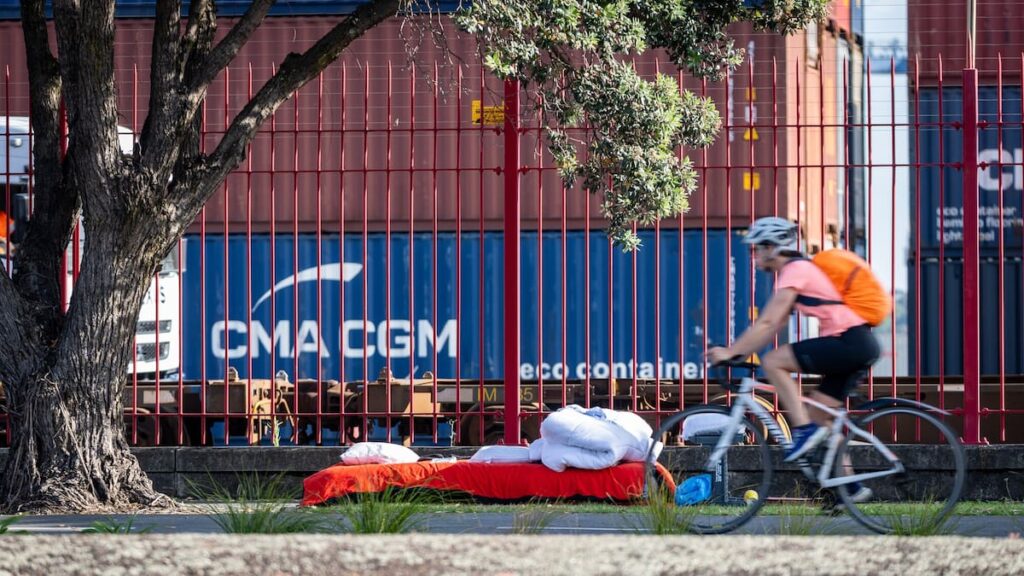
“Traditionally, we have not supported them and that goes back across multiple governments,” Bishop said.
“They don’t solve the underlying problem. They sound good – getting someone off the street and putting them into shelter, but if the net effect of that is just shelter [for one night] and then back on the street, then the same problems as to why they were on the street in the first are not dealt with.”
Shelters can be ‘important’ solution
Mark Thomas, former Auckland local board member and chairman of the Auckland Night Shelter Trust, spent two years campaigning for a partly government-funded, walk-in night shelter in the country’s biggest city.
The trust had sourced a site off Karangahape Rd in central Auckland, which was set to be called Te Whare Manaaki. It did not get off the ground because of a lack of public funding.
“I know for sure, from the very extensive research we did, that a well-run night shelter can be a very important part of a city’s response to homelessness. But we just need to be clear what that is,” he said.
“A well-run night shelter would be completely a place that is run after-hours, that is known to the community and to the support agencies.”
That would ideally include Ministry of Social Development (MSD) staff on-site speaking with people to ascertain their situation and beds they could sleep in that night, he said.
“Night shelters are not an international model. If they are to work, they have to be designed for the environment. And the thing that always exists is there is this gap after-hours – so you either need to not have a problem after-hours or you have a solution that deals with that,” he said.
“We definitely have a problem after-hours and we don’t have a solution.”
Instead of traditional night shelters, the Government funds programmes like emergency housing.
Since August 2024, the emergency housing criteria has tightened and the number of applications granted has plummeted.
The head of Auckland City Mission, Helen Robinson, said transitional housing had a “quite open” gateway but access is not often immediate. She said a referral can take days.
Recently, the Mission used government funding to launch an “immediate access” pathway to 20 of its transitional housing beds which, subject to availability, means individuals should be able to get a bed straight away. The service is not available to families. The government covers the usual client contribution for placement.
Robinson said traditional night shelters were not the answer. She would like to see hundreds more immediate-access transitional housing places opened in Auckland to meet demand.
“There is like a thousand of them [night shelters] in the States, and they all have a slightly different variation. But this is the general rule – it’s night by night, it’s a group room, there’s usually relatively quite tight rules around behaviour, and people have to leave in the morning.”
‘Huge variety of need, scale, vulnerability’
Measuring homelessness in New Zealand is difficult because of a lack of accurate data. One of the Government’s best estimates of the number of people living without shelter is several years old. It uses the 2023 Census, which showed almost 5000 people were living without shelter.
Many more are living in severe housing deprivation. The Census estimated in 2023 that 2.3% of the population, or 112,496 people, were severely housing-deprived.
“Within that category [of people who are severely housing-deprived], there is a huge variety of need, scale and vulnerability,” Robinson said.
“There are two key drivers of homelessness: one is poverty, and that speaks to a lack of appropriate, affordable housing, and the other is significant trauma, which can be expressed in multiple different ways.”
Associate Housing Minister Tama Potaka, who oversees the Government’s response to urgent housing, said people who were housing-deprived often experienced other pressures, including mental distress, addiction or trauma.
They could also be disconnected from family, he said.
“Ensuring we have got the right support for the right time with the right place for those people is very, very important. Sometimes that will be Housing First, it might be immediate access [to transitional housing], it might be social housing.
“Some people, you can’t just put them into a social house or encourage them into a social house; they are not ready for it, they have to prepare for it, they have to get into a mental space and a financial space.”
Labour leader Chris Hipkins said it was “unacceptable” a country as well-off as New Zealand had people living rough because they had nowhere else to go.
Asked if he would support opening a night shelter in Auckland, he did not answer directly but said that before the election the party would be setting out a “comprehensive” housing plan.
New Zealand First said there should be an inner-city night shelter in Auckland, as there previously was before it shut down in 2012. Act leader David Seymour said he would be led by what people working on the front line said was needed.
‘Rinse and repeat’
Te Pāti Māori co-leader Debbie Ngarewa Packer said traditional night shelters were a way of “managing homelessness” rather than addressing root causes.
“If we have something like that, without the wrap-around support, it just becomes a revolving door which is what we have seen happen in the US.”
Greens co-leader Chlöe Swarbrick, who is the MP for Auckland Central, noted concerns about how traditional night shelters have operated in the past, and that they were a “rinse and repeat” model that did not often connect people with the services they needed.
“The major point here is to note that a night shelter is not going to be a panacea; we need a government that is willing to actually take the bull by the horns and deal with this issue,” Swarbrick said.
“Auckland, and the entire country, should have an all-access emergency housing pipeline that ensures people are safe and secure and looked after when they need access to emergency shelter.”
Immediate-access transitional housing, similar to what the Auckland City Mission and Kahui Te Kaha are providing in Auckland, is part of Bishop and Potaka’s immediate action plan to get people who are sleeping rough into social houses. The plan was released in September last year.
This announcement included funding for an additional 300 social homes under the coalition’s Housing First programme, which funds around 2700 places.
In June, Potaka and Bishop announced an additional $14.5 million for rough sleepers, including expanding outreach and support services to six new locations.
Julia Gabel is a Wellington-based political reporter. She joined the Herald in 2020 and has most recently focused on data journalism.