
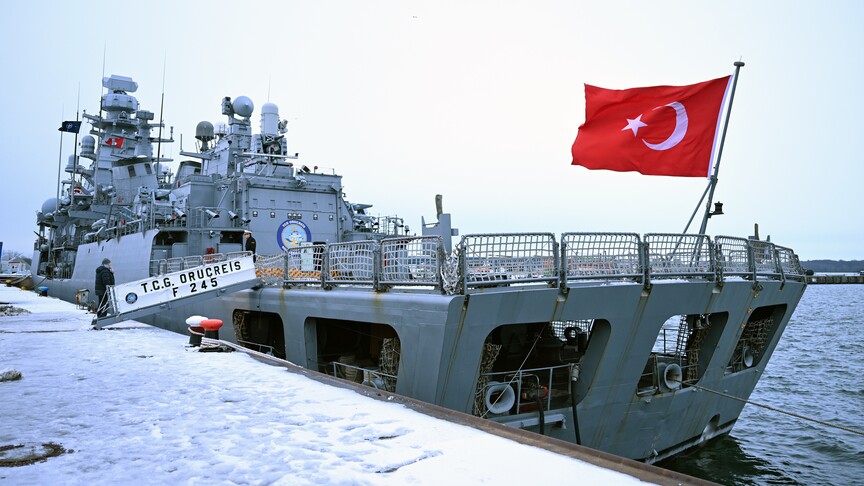
- Starting in 2028, Türkiye to lead NATO’s Allied Reaction Force (ARF), reinforcing its key role in European security
- Under NATO’s Deterrence and Defense Concept, Türkiye becomes 1 of limited number of allies capable of deploying, commanding rapid reaction forces at operational level
Türkiye, which is set to host the NATO Heads of State and Government Summit, contributes nearly 3,000 personnel, as well as various weapons, vehicles and platforms to the alliance.
The North Atlantic Treaty Organization (NATO) was established April 4, 1949, as a defense alliance against the Soviet threat under the framework of the collective self-defense right outlined in Article 51 of the UN Charter.
According to information obtained by Anadolu from sources at the Turkish National Defense Ministry, the primary factor driving Türkiye toward NATO membership was the need to balance the threat posed by the Soviet Union’s claims on the Turkish Straits and eastern provinces.
Türkiye officially joined NATO following Korean War
After the outbreak of the Korean War on June 25, 1950, Türkiye decided July 25, 1950, to send troops in response to a UN call, becoming the first country after the US to declare it would dispatch ground forces to Korea.
Following Türkiye’s military success in the Korean War, the US sent a letter on May 15, 1951, encouraging NATO member states to support Türkiye’s accession. Subsequently, at the NATO Council meeting in Ottawa from Sept. 16 to 20, 1951, members unanimously agreed to invite Türkiye.
The protocol regarding Türkiye’s membership was signed Oct. 17, 1951. Türkiye officially became a member Feb. 18, 1952, following the adoption of Law No. 5886 on its accession to the North Atlantic Treaty.
On March 1, 1952, during the NATO Lisbon Conference attended by then-Foreign Minister Fuat Koprulu, the Turkish flag was raised at the Supreme Headquarters Allied Powers Europe (SHAPE) under the leadership of Gen. Dwight D. Eisenhower.
Strong support for NATO
Türkiye has steadily expanded its contributions to NATO since becoming a formal member.
As the alliance’s second-largest military, Türkiye has contributed to NATO missions in Afghanistan, Kosovo, Bosnia and Herzegovina, Libya and Iraq, while preserving and further developing its Cold War-era military capabilities due to counterterrorism operations and instability in the Middle East.
Türkiye contributed to NATO’s peace support operations in Afghanistan under the International Security Assistance Force (ISAF) between 2002 and 2014, and later under the Resolute Support Mission (RSM) beginning in 2015.
Under the RSM framework, Türkiye assumed responsibility as the framework nation for the secure operation of Kabul Hamid Karzai International Airport. Turkish units completed their mission and returned home Aug. 28, 2021, following the end of NATO operations.
Türkiye began contributing to NATO Mission Iraq (NMI) in 2018 to support capacity building for the Iraqi Army, maintaining uninterrupted support with around 40 personnel until the withdrawal process began in March this year due to deteriorating security conditions.
Following NATO’s decision to continue NMI activities with a core staff at the Joint Force Command in Naples until further notice, Türkiye started supporting the core team there with three personnel.
Türkiye supports ongoing NATO missions, including the Kosovo Force (KFOR), Operation Sea Guardian, efforts to combat irregular migration in the Aegean Sea, Standing Naval Forces, Allied Reaction Force, NATO Readiness Initiative, NATO Assurance Measures, support activities for the African Union and NATO’s integrated air and missile defense system with nearly 3,000 personnel and various military assets.
Active participation in NATO exercises
Türkiye also actively participates in NATO exercises, a key indicator of interoperability and operational readiness.
The Turkish Armed Forces participated in 34 NATO exercises in 2023, 39 in 2024 and 50 in 2025.
This year, Türkiye participated in NATO’s Steadfast Dart exercise held in Germany from Feb. 12 – 24 to enhance the operational readiness of the Allied Reaction Force (ARF).
Türkiye made a major contribution with naval, land and air assets, including the Anatolian Task Group and deployed a joint force of more than 2,000 personnel to Germany.
During Steadfast Dart, the TB-3 armed unmanned aerial vehicle launched from the Turkish naval vessel TCG Anadolu successfully struck a designated target above the Baltic Sea.
The operation marked the first time in military history that an unmanned aerial vehicle launched from a ship supported a live-fire exercise.
Multidimensional support to NATO
Türkiye has served for the second time since 2023 as commander of the Kosovo Force (KFOR). Following unrest in Kosovo in 2022, Türkiye deployed the KFOR Reserve Battalion to Kosovo four times on different occasions, contributing to regional security and stability.
Türkiye also commands one of the six annual focused operations conducted under NATO’s Operation Sea Guardian, launched in 2016 to enhance situational awareness in the Mediterranean, support counterterrorism and strengthen regional security capacity.
Among NATO’s 32 member states, the Turkish Naval Forces rank as the largest contributor to Operation Sea Guardian.
Türkiye has commanded Standing NATO Maritime Group 2 five times, most recently in 2025, and Standing NATO Mine Countermeasures Group 2 seven times, including in 2023 and 2025.
Command authority in NATO missions
Türkiye contributes to NATO not only through personnel and equipment, but also through command responsibilities.
Under the framework, the Turkish High Readiness Maritime Task Force (TURMARFOR) assumed command of NATO Response Force Maritime Component Command (NRF-MCC) in 2023 and Mediterranean Task Force Command (CTF MED) in 2024 – 2025.
The Turkish Naval Forces also assumed Amphibious Task Force Commander/Landing Force Commander (CATF/CLF) duties for 2025-2026 under the Allied Reaction Force Maritime Component Command.
Türkiye continues to lead the Black Sea Task Force Command (CTF-BLACK) for 2024 – 2028.
Türkiye also remains actively engaged in NATO activities based on the principle of regional ownership to ensure the Black Sea remains a sea of peace and stability.
In line with developments in defense and security, Türkiye launched efforts on April 30, 2024, to establish the Unmanned Systems Center of Excellence, which would become the country’s third NATO Center of Excellence.
Contributions to NATO airspace
Türkiye has also established a Joint Force Air Component (JFAC) to support NATO operations requiring airpower.
The Turkish Air Force previously successfully carried out NATO Air Policing missions in Lithuania, Poland, and Romania, and is scheduled to undertake the mission again in Estonia from August to November.
Türkiye also continues contributing to NATO missions through airborne early warning and control systems, air-to-air refueling aircraft, and processed satellite imagery.
High occupancy in NATO staffing
Türkiye maintains a high staffing rate within NATO’s force and command structures.
Ankara led the reactivation of NATO’s Liaison Office at the African Union headquarters in Addis Ababa, Ethiopia, on March 9, 2022.
Under NATO’s Defense Capacity Building Initiative, Türkiye holds leadership roles in maritime security and aviation in Georgia, as well as engineering and special forces advisory duties. In Jordan, it serves as the deputy commander of the core team.
Türkiye also provides remote advisory support to defense capacity-building initiatives in Moldova, Mauritania and Bosnia and Herzegovina.
Under NATO’s Deterrence and Defense Concept, Türkiye stands among a limited number of allies — alongside the US, UK, Spain, Italy and France — capable of commanding rapid reaction forces at the operational level.
It positions Türkiye as a central ally capable of providing security across Europe, playing an active role in operations from Afghanistan to Kosovo and from the Mediterranean to the Baltic region.
Türkiye emerges as central ally
According to ministry sources, Türkiye’s role within NATO is based not on static membership but on dynamic “security production.”
Türkiye is seen not merely as a participant in the alliance but as a strategic actor that generates security, manages crises and develops solutions.
Rather than serving solely as a frontline state protecting NATO’s southern flank, Türkiye stands out as a central ally capable of ensuring security across Europe.
With a “360-degree” approach to threats, Türkiye contributes to global stability beyond its borders and acts as a balancing force in regional crises through constructive and prudent diplomacy.
Türkiye’s defense doctrine is built on integrating its domestic capabilities with NATO’s deterrence and defense concept.
Alliance’s second-largest military
As NATO’s second-largest military, Türkiye combines military capacity with advanced technology, making it one of the alliance’s strongest pillars.
Projects such as Steel Dome, KAAN and Altay further strengthen not only Türkiye’s capabilities but also NATO’s technological edge.
Türkiye allocated 2.33% of its gross domestic product to defense in 2025, placing it among countries carrying NATO’s financial and military responsibilities at a high level.
As the only NATO ally engaged in combating terrorism on the ground, Türkiye continues to be a critical pillar of the alliance.
Türkiye shaping NATO’s future
The 2026 NATO Heads of State and Government Summit, scheduled for July 7 – 8 in Ankara, is seen as a reflection of Türkiye’s diplomatic influence and trusted leadership within the alliance.
From unmanned aerial vehicle technologies to space capabilities, Türkiye is increasingly positioned as a key actor shaping NATO’s future.
During NATO’s Steadfast Dart 2026 exercise, the TB-3 UAV launched from TCG Anadolu was widely seen as a milestone in global military doctrine.
From 2028, Türkiye will assume leadership of NATO’s Allied Reaction Force (ARF), one of the alliance’s most critical formations, further reinforcing its key role in European security.
With capabilities in artificial intelligence, cyber defense and space, Türkiye stands out as one of NATO’s fastest-adapting actors in response to evolving threats.
Türkiye’s long-standing experience and technological progress continue to make it one of the key factors shaping the alliance’s future.
2026 NATO Heads of State and Government Summit
Türkiye’s contributions to NATO, its military and diplomatic capacity in generating security and Turkish President Recep Tayyip Erdogan’s leadership and diplomacy are expected to be highlighted at the summit.
One of Türkiye’s objectives during the summit is to emphasize NATO’s determination to protect the Euro-Atlantic region against threats and challenges through alliance unity and solidarity.
Türkiye also expects allied members to reaffirm their commitment to Article 5 of the North Atlantic Treaty, which stipulates that an armed attack against one member shall be considered an attack against all.
*Writing by Fatma Zehra Solmaz from Istanbul