
SYRACUSE, N.Y. — Artificial intelligence is fueling a growing demand for data centers, and as more projects are discussed across Central New York, communities are beginning to ask what those facilities could mean for the places that host them.
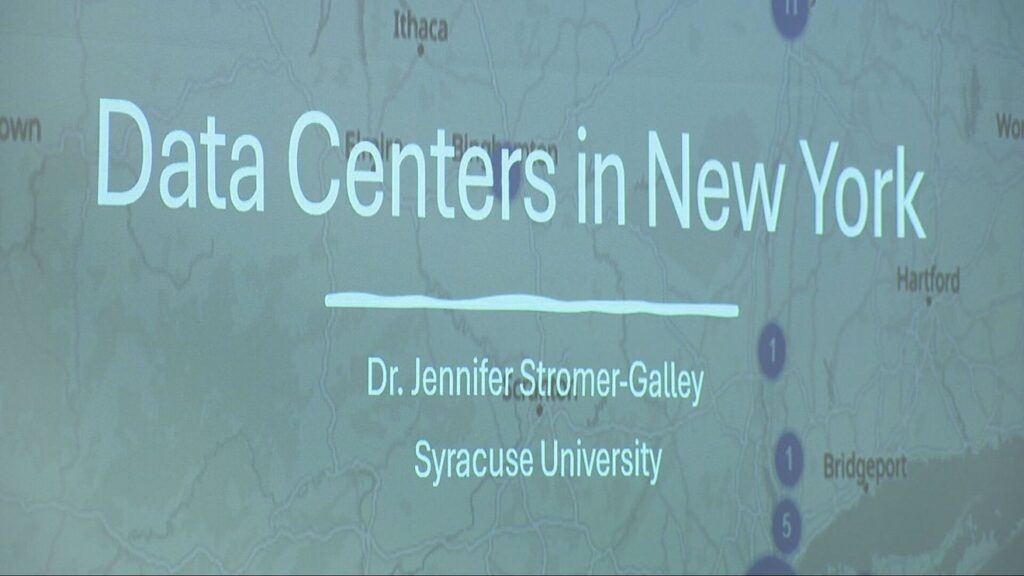
CNY Solidarity hosted a community presentation Sunday examining both the opportunities and challenges data centers could bring as proposals continue to emerge across the region. The discussion focused on how data centers operate, why they require significant amounts of electricity and water, and what those demands could mean for local communities.
Jennifer Stromer-Galley, a Syracuse University professor, said she wanted to help residents better understand the technology and the policy debates surrounding it.
“So I wanted to help demystify for the community what data centers are, how they work, why they use so many of the resources they do in terms of electricity and water, and the moratorium and what that means and what it’s missing,” Stromer-Galley said.
Speakers said data centers can generate significant property tax revenue and help redevelop former industrial sites. At the same time, they said the facilities’ large energy and water demands have prompted questions about their long-term impact on surrounding communities.
“Data centers do bring economic benefits to communities. The primary benefit is not jobs; it’s actually property tax. So they tend to pay property taxes; they tend to have fairly large footprints. They also tend to buy a lot, and because of that they also pay sales tax. Plus, many of the data centers being proposed for New York are actually an old industrial site,” Stromer-Galley said.
For attendee Melleny Hale, the discussion highlighted the importance of weighing both the benefits and the challenges.
“I think we have to really look at balance. That’s one of my concerns, is we have to really look at the benefits and the costs. Obviously, the energy use is important. And the water consumption, there are solutions,” Hale said.
Hale said informed public discussion will become increasingly important as more communities consider future data center proposals.
“I think there’s a lot of misinformation. We have, as human beings, we have a tendency to get all on one side or all on the other. And I think we really have to balance the benefits and the costs and work for solutions,” Hale said.
The discussion comes as Gov. Kathy Hochul recently signed what state officials described as the nation’s first statewide moratorium on certain large data centers. As additional proposals emerge across Central New York, communities are expected to continue weighing potential economic benefits against concerns over energy use, water consumption and broader local impacts.