
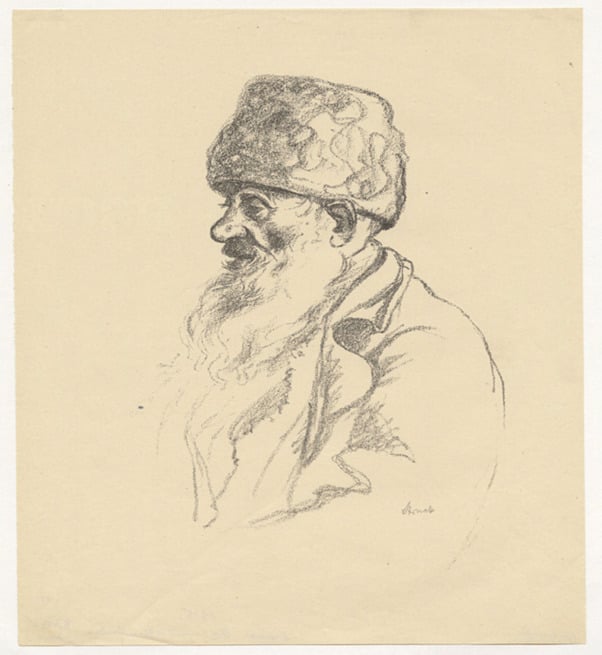
The representation, caricature, and portrayal of Jews in European art is a phenomenon traceable at least to the Middle Ages. Art was frequently utilized for ideological, propagandistic, and political objectives by the Catholic and Protestant Churches, as well as other institutions. It often functioned as a pliant instrument in the hands of those in power, who employed it to stigmatize, discredit, and distort the image, identity, and dignity of the most vulnerable and marginalized individuals.
However, concomitant with this phenomenon and commencing with the innovations of the European Renaissance, a new trend emerged: the aspiration for personal portraits within Jewish households. This development signified a profound ideological transformation. Artistic commissions were no longer the exclusive prerogative of authorities; individuals, too, could now commission works for personal purposes. Possession of an artistic portrait during this era became an emblem of cultural refinement and emancipation—a privilege largely accessible to affluent families or individuals. As observed by the scholar, rabbi, and Renaissance poet Leone da Modena, “Jews of his time possessed portraits in their homes, and even his own portrait was painted by a renowned non-Jewish artist.”
Modena’s assertion further substantiates the historical reality that numerous prominent Jews—physicians, rabbis, advisors, scholars, affluent merchants, and philosophers—during the sixteenth century and thereafter, sat for renowned Christian painters across Europe, including in Italy, the Netherlands, France, Germany, and Great Britain. Perhaps the most illustrative example is the eminent Dutch artist, Rembrandt. As British art historian Alfred Rubens notes, the great painter not only considered biblical and Jewish themes among his favorites, but he also created a series of portraits of his contemporaries, such as his friend, the Portuguese Rabbi Menasseh Ben Israel, the Jewish physician Ephraim Bueno, as well as several other yet-unidentified figures. One such painting, titled “The Wandering Jew” (although not yet scientifically confirmed as an original Rembrandt), is presently housed in the Historical Museum of Tirana. It is noteworthy that the renowned Jewish-Russian writer and cultural historian, Ilya Ehrenburg, having been informed of its existence by undisclosed sources, traveled to Albania in the 1960s and attempted to acquire it from its owners in the city of Shkodra.
The invention of engraving in the fifteenth and sixteenth centuries, and lithography in eighteenth-century Germany by Johann Alois Senefelder, facilitated the mass reproduction of numerous portraits and paintings, many of which have survived in printed form to the present day. Owing to portraiture and these two techniques, images of a diverse array of both known and anonymous Jews in European art have been preserved. Yet, amid this vast corpus, one might inquire: does a representation of the Albanian Jew exist within European art? The answer is affirmative, and this confirmation also emerges from Germany.
During research conducted at the Leo Baeck Institute Archives, I first encountered the name of the German artist Hermann Struck (Chaim Aaron ben David). Born on March 6, 1876, in Berlin to Jewish parents, Struck attended the Berlin Academy of Fine Arts (Akademie der Künste), graduating in 1899; however, due to his ethno-religious background, he was prohibited from pursuing a teaching career. During his studies, he was instructed in lithography by the Dutch engraving master Jozef Israëls—a formative influence that inspired Struck to devote himself to the art of engraving, a discipline he would eventually master and elevate to a stature comparable to that of Israëls. In 1909, Struck published his magnum opus, “The Art of Etching” (Die Kunst des Radierens), and in Berlin, he counted among his students such prominent artists as Marc Chagall, Lovis Corinth, Jacob Steinhardt, Lesser Ury, and Max Liebermann.
Struck’s reputation expanded throughout Europe, and eminent figures from the spheres of art, culture, science, and politics—including M. Chagall, G. Hauptmann, S. Freud, A. Einstein, Theodor Herzl, E. Haeckel, and H. Cohen, among others—commissioned portraits from him. Among these illustrious individuals, Struck also created the portrait of a uniquely distinguished subject: a Jewish figure from Albania. This portrait, constitutes the only known image to date of an Albanian Jew in European art—a work which, according to its inscription, was executed by the artist in 1915.
The engraving measures 28 by 29 centimeters and bears, in pencil, Struck’s signature—“H. Struck”—on the lower right. The portrait presents, in profile, an elderly Jewish man with a black mustache, a long greying beard, and a woolen cap (a mini-shtreimel) atop his head. Draped over his shoulders is a nineteenth-century redingote. But who is this dignified figure, whose bearing suggests both wisdom and sanctity, who sat for Struck? Was he perhaps the leader of a Jewish community in Albania, a merchant, or a Hasid? Under what circumstances did their encounter occur?
According to information from the National Library of Israel (NLI), during World War I (1914–1918), Struck, motivated by German patriotic sentiment, volunteered and served as a translator and liaison officer for the German Imperial Army on the Eastern Front (Ober Ost), where he was awarded the Iron Cross for bravery. The command center for this front was Vilna, present-day Vilnius in Lithuania. Notably, Vilna—often referred to as the “Jerusalem of Lithuania” (Yerushalayim D’Lita), and which in 2023 marked its 700th anniversary—has, since the eighteenth century, been a major center of Jewish Rabbinism, mysticism, and rationalism. It is highly probable that the portrait in question was created in this very city.
Whether this portrait was commissioned by the subject or gifted by Struck to the sitter cannot be determined. The individual’s identity also remains unknown. The only assertion that can be made with certainty, aside from the time and place of execution, is that this portrait is the first to depict the typology of the Albanian Jew and, to date, remains the sole known image representing the Albanian Jew in European art.
Hermann Struck emigrated to Palestine in 1922. He subsequently served as a professor at the Bezalel Academy of Arts in Jerusalem and later contributed to the institution’s restoration. Another notable accomplishment was his involvement in the founding of the Tel Aviv Museum of Art (1932). Struck died in Haifa in 1944. In his honor, a distinguished art museum in Haifa bears the name “Hermann Struck.”