
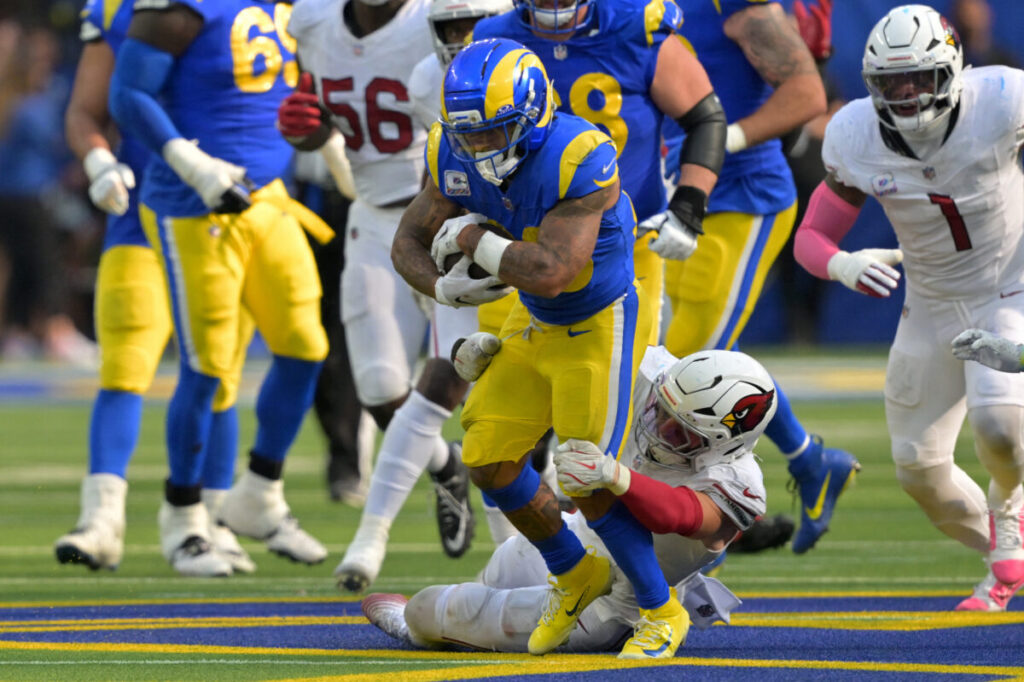
Kyren Williams pointed to his own time off the field when asked why the Los Angeles Rams could not maintain their offensive energy Sunday.
The running back’s response came after an 18-16 loss to the Arizona Cardinals that dropped Los Angeles to 2-4. Williams remained the Rams’ busiest running back by offensive snaps, but his rushing workload was almost identical to Blake Corum’s.
Kyren Williams on why the Rams couldn’t sustain their energy 😳
“Can’t tell you, bro. Probably because I’m not out there.”
(h/t @sarahbarshop) pic.twitter.com/6kvuqpDG7v
— Ahn Fire Digital (@AhnFireDigital) October 19, 2026
“Can’t tell you, bro. Probably because I’m not out there,” Williams said.
The question concerned the offense’s energy from one drive to the next. Williams’ answer put his usage in focus, although he did not name Corum or announce a dispute with head coach Sean McVay in the reported exchange.
The numbers provide an important distinction: Being on the field and getting the ball were two different measures of the Rams’ backfield rotation against Arizona.
Kyren Williams led in snaps, but carries were nearly even
Williams played 40 offensive snaps, compared with 16 for Corum. Williams finished with 10 carries for 50 yards and three catches for 17 yards.
Corum had nine rushing attempts for 42 yards, plus two receptions for 18 yards and a touchdown.
That gave Williams 13 touches and Corum 11. Williams averaged 5.0 yards per carry, while Corum averaged approximately 4.7, so neither back’s rushing opportunities produced an obvious statistical argument for abandoning the other.
The snap count also prevents Sunday’s result from being described as Williams losing the lead role. He played two-and-a-half times as many offensive snaps as Corum, even though the distribution of carries was much closer.
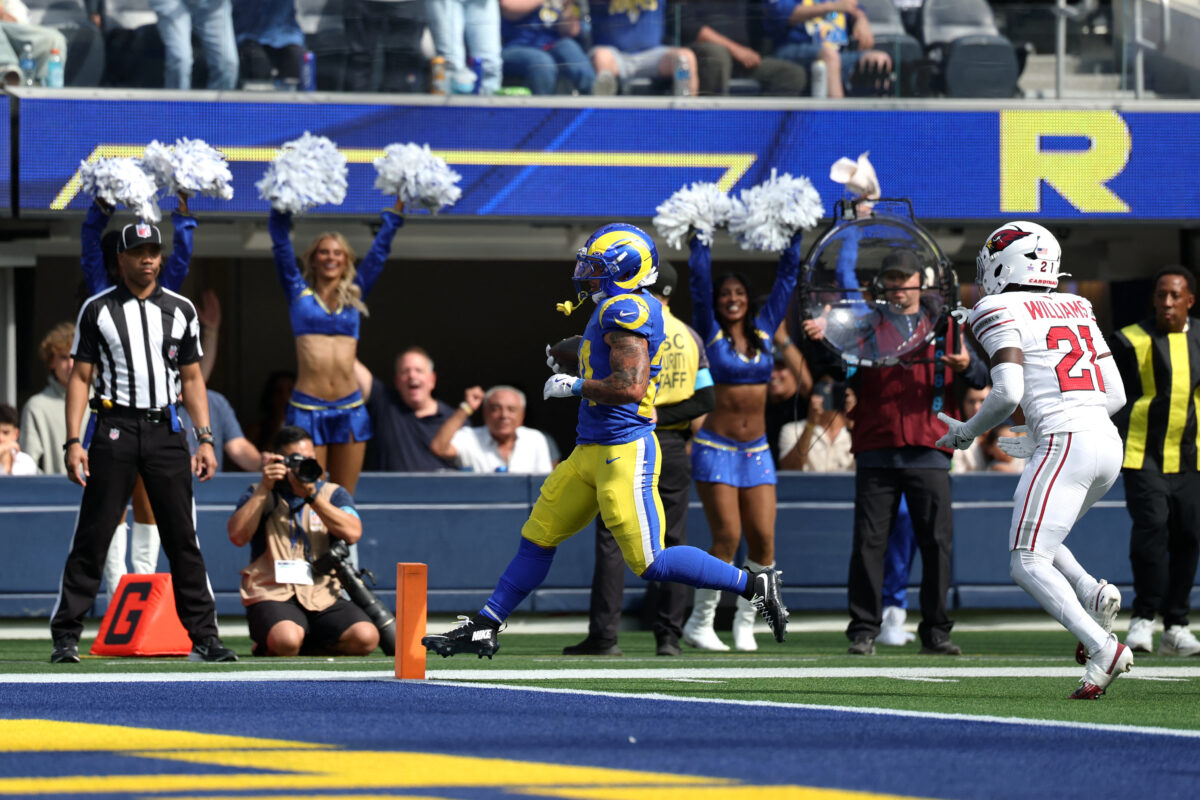
Corum supplied the Rams’ first touchdown on a 15-yard reception from Matthew Stafford. The team’s highlight of the scoring play shows his contribution as a receiver, an element of the offense that both backs have been asked to provide.
Williams’ comment therefore raises a question about rhythm and involvement within a shared backfield. It does not, by itself, establish that the Rams changed their depth chart or that he was unavailable for a particular series.
Sean McVay had already outlined a shared backfield
The near-even rushing split was consistent with a plan McVay discussed earlier in the season. In a Sept. 25 feature published by the Rams, the coach endorsed continuing to divide carries after Williams received 23 and Corum 22 through the first two games.
“We look at it like we got two great backs, and those guys being able to spell each other is when we’re at our best,” said McVay.
McVay described the ability to rotate the two players as beneficial to the offense. Stafford also expressed confidence in using either back across the playbook, rather than treating one as an option only for specific types of plays.
The early results illustrated that approach. Williams ran for 85 yards on 12 attempts against the Giants in Week 2, while Corum gained 79 yards on the same number of carries.
Corum entered this season with a substantial role already behind him. The Rams’ initial roster breakdown credited him with 746 rushing yards and six rushing touchdowns on 145 carries in 2025.
Williams, meanwhile, was pursuing a fourth consecutive season with more than 1,100 rushing yards and at least 10 rushing touchdowns.
Those backgrounds explain why Los Angeles has continued finding work for both players. Sunday’s brief comment did not include a detailed alternative from Williams about how the rotation should operate.
Williams has shown what a larger receiving role can produce
Sharing carries has not prevented Williams from handling a larger workload when the game develops that way. McVay discussed adapting to an effective player in the Rams’ Oct. 1 account of Williams’ performance against Denver.
“I do think it’s important to get a feel and ride the hot hand,” McVay said.
Williams had rushed for 88 yards on 15 carries against the Broncos and added 70 receiving yards on six catches. His passing-game involvement included a fourth-down conversion from the slot and a 20-yard reception on the final drive.
That versatility was a focus of his offseason preparation. The team reported that Williams had worked to become a more useful receiving option from different alignments, giving Stafford another way to find him beyond conventional handoffs.
The following game provided another example. In the Oct. 4 win over Philadelphia, Williams caught 10 passes for 67 yards while adding 80 rushing yards and two touchdowns on 16 carries.
His late contributions helped turn a 20-10 deficit into a 24-20 victory. He scored on a one-yard run during a 98-yard touchdown drive, then finished the next scoring possession with a seven-yard touchdown run.
Those performances give substance to the question of how involved Williams should be. They also show that the Rams’ shared-backfield approach has allowed for games with a much heavier Williams workload.
Rams’ offensive problems extended beyond the rotation
Against Arizona, Los Angeles had little room to recover from wasted possessions. The Rams had the ball just once in the third quarter as the Cardinals put together lengthy drives.
Later opportunities ended with a Tyler Higbee fumble and a failed fourth-down attempt after a false start.
Williams still contributed to the late go-ahead drive: His seven-yard reception preceded Stafford’s six-yard touchdown throw to Colby Parkinson.
Parkinson’s score and Ethan Evans’ extra point gave the Rams a 16-15 lead with 47 seconds remaining. Arizona answered with Chad Ryland’s winning field goal as time expired.
It followed another frustrating finish against Buffalo, a loss whose aftermath also included the NFL’s suspension of Alaric Jackson. The Rams have had more to address than the allocation of rushing attempts.
McVay’s postgame assessment Sunday was blunt.
“There is nothing positive that I can say about today,” McVay said.
Williams’ response adds his involvement to that discussion. The available numbers show a lead back who remained on the field extensively but received only a narrow edge in touches over Corum.
Whether McVay adjusts that balance is a separate decision; Williams’ comment alone does not settle it.