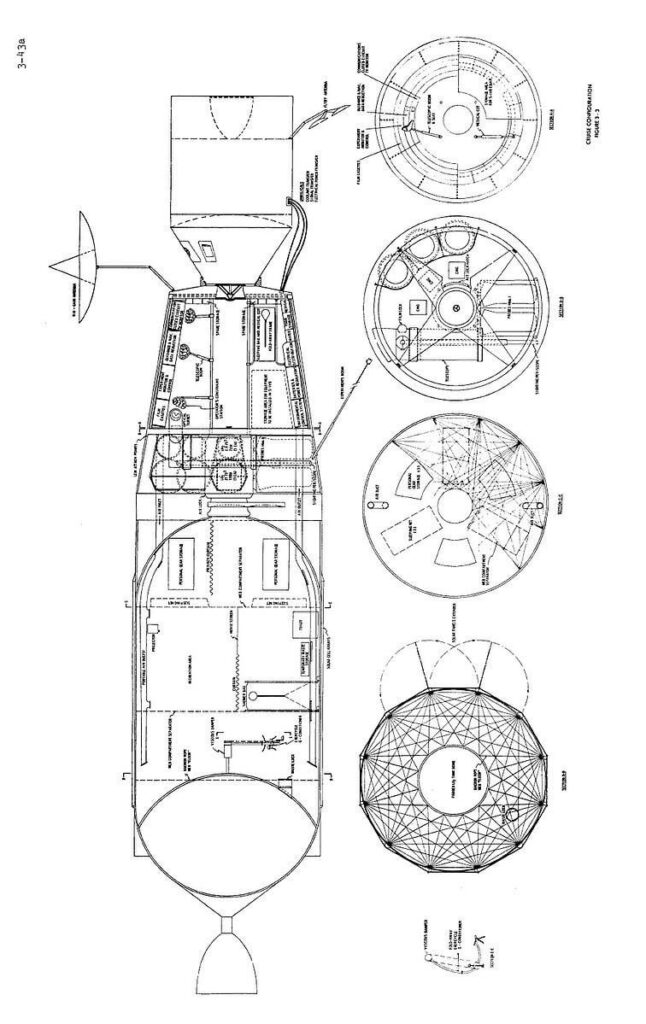
The proposed mission would have used a Saturn V to send three astronauts on a flight past Venus, which would have lasted approximately one year. The S-IVB stage would have been a “wet workshop” similar to the original design of Skylab. In this concept, the interior of the fuel tank would be filled with living quarters and various equipment that did not take up a significant amount of volume. The S-IVB would then be filled with propellants as normal and used to accelerate the craft on its way to Venus. Once the burn was complete, any remaining propellant would be vented to space, and then the larger fuel tank could be used as living space, while the smaller oxygen tank would be used for waste storage.
Only so much equipment could be carried in the hydrogen tank without taking up too much room, while other pieces could not be immersed in liquid hydrogen and survive. This equipment would instead be placed in the interstage area between the S-IVB and the Apollo Command/Service Module (CSM), known as the Spacecraft-LM Adapter (SLA), which normally held the Apollo Lunar Module on lunar missions. To maximize the amount of space available in this area, the Service Propulsion System engine of the CSM would be replaced by two LM Descent Propulsion System engines. These had much smaller engine bells, and would lie within the Service Module instead of extending out the end into the SLA area. This also provided redundancy in the case of a single-engine failure. These engines would have been responsible for both course correction during the flight and the braking burn for Earth re-entry.
Unlike the Apollo lunar missions, the CSM would perform its transposition and docking maneuver with the S-IVB stage before the burn to leave Earth orbit, rather than after. This meant the astronauts would have flown “eyeballs-out”, the thrust of the engine pushing them out of their seats rather than into them. This was required because there was only a short window for an abort burn by the CSM to return to Earth after a failure in the S-IVB, so all spacecraft systems needed to be operational and checked out before leaving the parking orbit around Earth to fly to Venus.
h8speech on
I had no idea this was ever planned, thanks for posting! A bit hard to read but the posted source is much clearer.
Superseaslug on
Oh wait they had the lab space *just filled with liquid hydrogen???* That’s rad as hell!
LayerProfessional936 on
Why does it look like an early version of the atomic bomb?
H-K_47 on
The show For All Mankind is about an alternate history where the Soviets landed people on the Moon first and so the space race never ended and just kept going and going, with permanent Moon bases then onwards to Mars. I always wish they’d included some of these concepts and touched on Venus more.

5 Comments
[Original source](https://ntrs.nasa.gov/api/citations/19790072165/downloads/19790072165.pdf)
[[The following comes from a wiki article](https://en.wikipedia.org/wiki/Manned_Venus_flyby)]
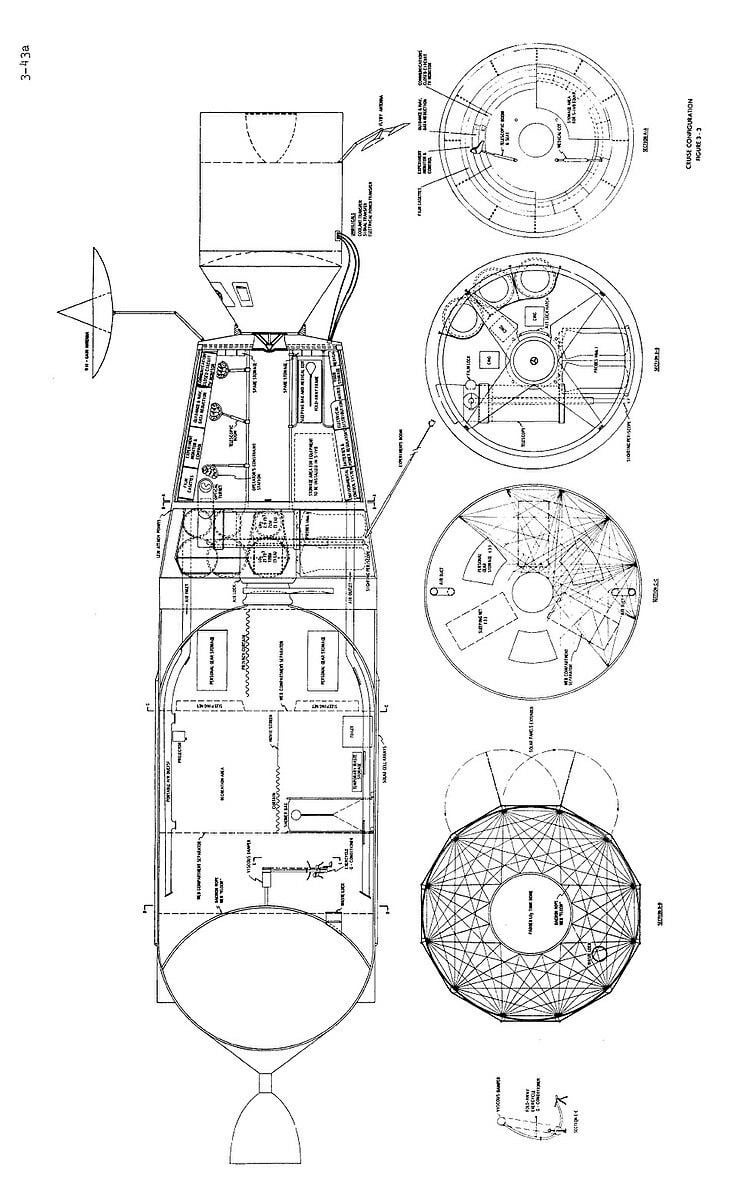
The proposed mission would have used a Saturn V to send three astronauts on a flight past Venus, which would have lasted approximately one year. The S-IVB stage would have been a “wet workshop” similar to the original design of Skylab. In this concept, the interior of the fuel tank would be filled with living quarters and various equipment that did not take up a significant amount of volume. The S-IVB would then be filled with propellants as normal and used to accelerate the craft on its way to Venus. Once the burn was complete, any remaining propellant would be vented to space, and then the larger fuel tank could be used as living space, while the smaller oxygen tank would be used for waste storage.
Only so much equipment could be carried in the hydrogen tank without taking up too much room, while other pieces could not be immersed in liquid hydrogen and survive. This equipment would instead be placed in the interstage area between the S-IVB and the Apollo Command/Service Module (CSM), known as the Spacecraft-LM Adapter (SLA), which normally held the Apollo Lunar Module on lunar missions. To maximize the amount of space available in this area, the Service Propulsion System engine of the CSM would be replaced by two LM Descent Propulsion System engines. These had much smaller engine bells, and would lie within the Service Module instead of extending out the end into the SLA area. This also provided redundancy in the case of a single-engine failure. These engines would have been responsible for both course correction during the flight and the braking burn for Earth re-entry.
Unlike the Apollo lunar missions, the CSM would perform its transposition and docking maneuver with the S-IVB stage before the burn to leave Earth orbit, rather than after. This meant the astronauts would have flown “eyeballs-out”, the thrust of the engine pushing them out of their seats rather than into them. This was required because there was only a short window for an abort burn by the CSM to return to Earth after a failure in the S-IVB, so all spacecraft systems needed to be operational and checked out before leaving the parking orbit around Earth to fly to Venus.
I had no idea this was ever planned, thanks for posting! A bit hard to read but the posted source is much clearer.
Oh wait they had the lab space *just filled with liquid hydrogen???* That’s rad as hell!
Why does it look like an early version of the atomic bomb?
The show For All Mankind is about an alternate history where the Soviets landed people on the Moon first and so the space race never ended and just kept going and going, with permanent Moon bases then onwards to Mars. I always wish they’d included some of these concepts and touched on Venus more.