
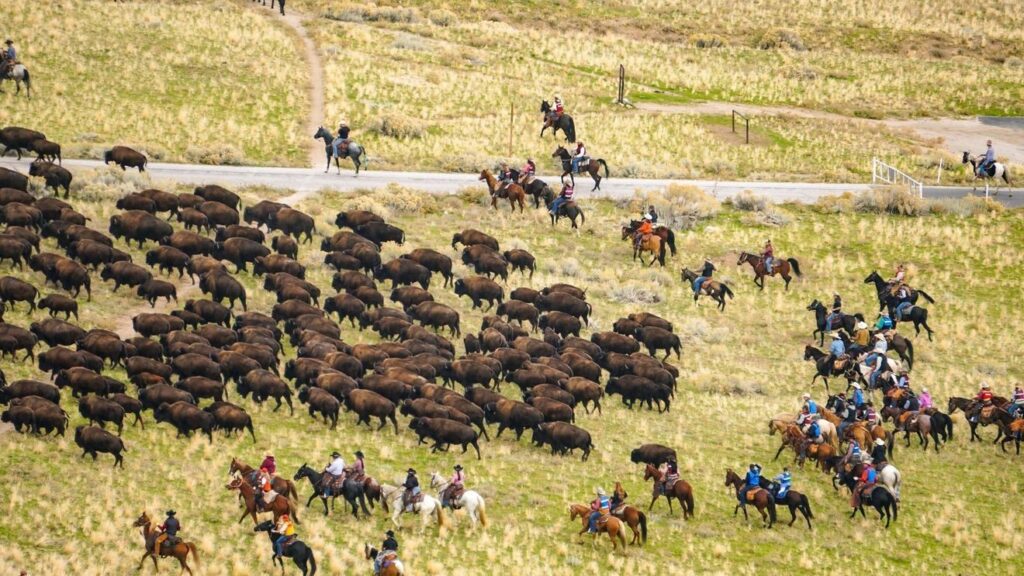
ANTELOPE ISLAND, Utah (KUTV) — Approximately 750 bison live on Antelope Island, making up one of the nation’s largest bison herds. But according to conservationists, that’s about 200 more than is sustainable on the island.
Antelope Island State Park hosted its annual Bison Roundup on Saturday, with more than 200 horseback riders pushing the bison toward corrals on the north end.
Every year, the roundup attracts spectators who come to watch the riders direct the herd and shop at the vendor booths at the Roundup Rendezvous event area.
The state park said the roundup is one of its most popular events. But for the bison, it’s only phase one.
According to state park officials, the bison are given a few days to settle after the roundup before being moved into a series of holding pens.
They then pass one-by-one through a “hydraulic squeeze chute” for their health checks. This includes vaccinations, blood samples, ultrasounds and the attaching of a computer chip. A computer database stores the information about the herd, helping conservationists in their decision making.
“Antelope Island’s carrying capacity for bison over the winter months is approximately 500. With no natural predators on the island, it is necessary to reduce the size of the herd as part of our working to balance the food supply the grasslands can produce,” state officials said in a media release.
Not only do the bison have no natural predators, the isolation of the island also protects against illnesses and diseases. This means the herd grows significantly every year.
To reduce the herd size, the park hosts an auction, which is scheduled for Nov. 3, and issues a limited number of hunting permits.
The bison are typically sold for between $1,800 and $5,200 each, with the money allocated to the Antelope Island wildlife management fund.
Officials said buyers typically purchase the animals to start or supplement their own herds or harvest as meat.
Park officials said they are continually evaluating the culling process to make it as humane as possible. In the past, the bison were rounded up by trucks and helicopters, but that resulted in at least one animal death a year due to the stress.
There have not been any animals lost during the roundup since they started using horseback riders instead.
Visitors who are interested in the culling process can witness each step themselves, attend a tour or visit the state park’s website.
___