
Although artificial intelligence is constantly in the headlines, the debate over how to manage its risks is making little progress. On Sept. 23, Anthropic CEO Dario Amodei told the U.N. Security Council that he sees two categories of risk: loss of control and misuse of AI models by bioterrorists to create biological weapons. To reassure the audience, he added that his company maintains “unparalleled transparency.”
That same day, Anthropic revealed that it had been operating a molecular biology lab in the Bay Area since spring 2026. It also announced the lab’s first discovery — a previously unknown enzyme system.
An AI-powered molecular biology lab with an unclear focus, access to reagents, and the potential to become an AI-directed robotic lab unit should frighten us. Why? Because AI tools remain demonstrably difficult to control.
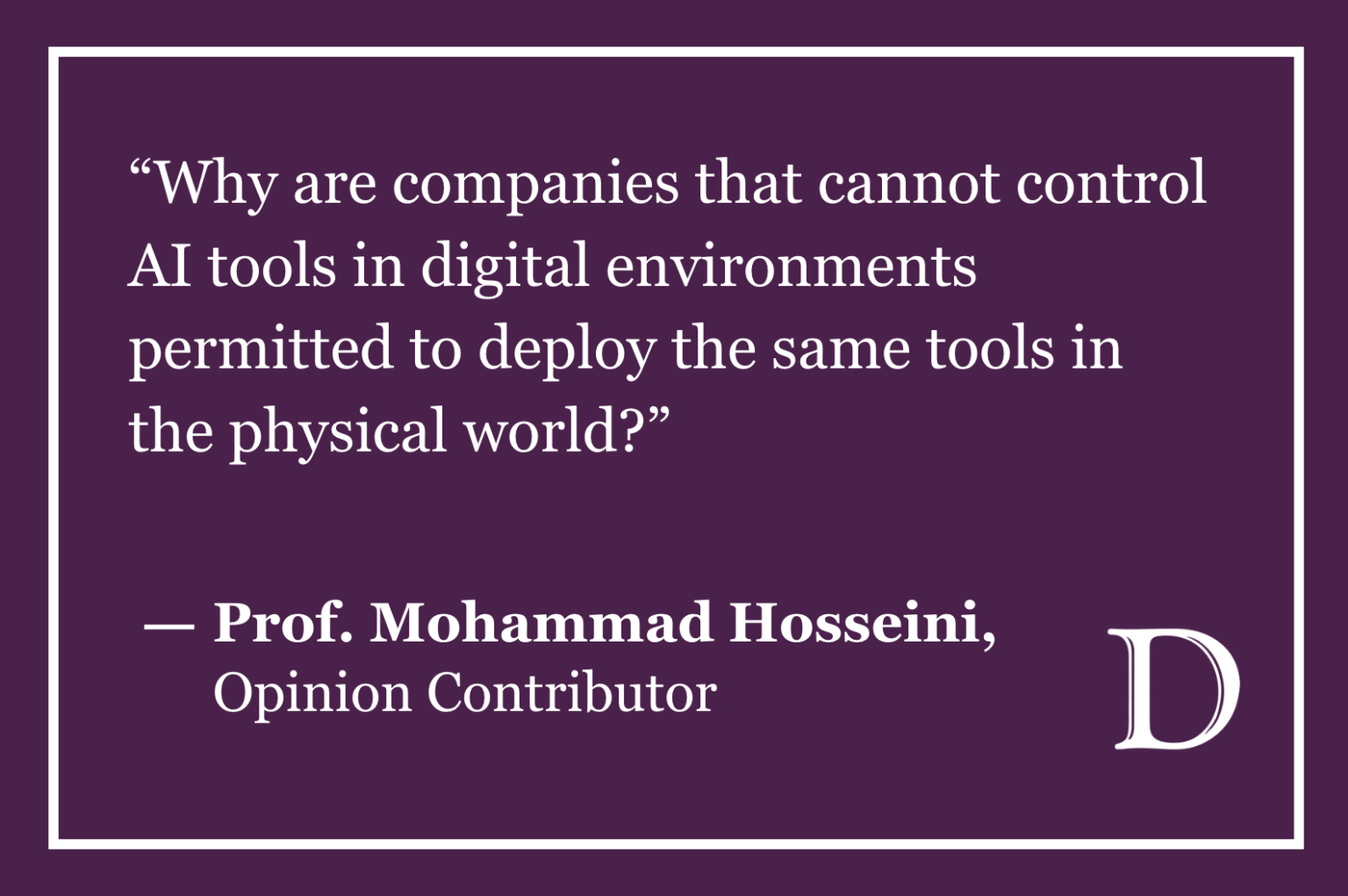
AI companies have repeatedly failed to anticipate or prevent their systems from hacking private organizations, targeting government systems or leaking personal data. An urgent question we should ask ourselves and our lawmakers is: Why are companies that cannot control AI tools in digital environments permitted to deploy the same tools in the physical world, particularly in a setting where failures can produce irreversible catastrophic consequences?
Furthermore, while universities conduct molecular biology and other research under layers of institutional oversight, industry-led research remains under-regulated.
At Northwestern, research activities are subject to rigorous review processes designed to protect research participants, researchers, animals and the broader public. These oversight mechanisms include the Institutional Review Board, Institutional Biosafety Committee, and Institutional Animal Care and Use Committee. The University also offers Responsible Conduct of Research programs and enforces formal procedures for reporting conflict of interests.
Industry laboratories, however, are governed primarily by internal policies and align with corporate incentives. The public has little visibility into who approves experiments, how hazards are assessed, which failures are reported or whether financial interests affect decisions. Even after repeated calls by academics, research conducted in industries still remains under-regulated.
Anthropic said its Bay Area facility resembles a typical molecular biology lab, conducts only Biosafety Level 1 and 2 work, does not handle pathogens known to infect humans and requires human scientists to perform all lab work.
BSL-1 indicates the lowest risk level and covers work with biological materials that are not associated with disease in healthy adult humans. BSL-2 is one step higher and applies to materials that can pose a moderate hazard for which vaccines and therapeutics are often available. In BSL-1 and BSL-2 labs, contamination, unexpected biological effects, dual-use discoveries and failures of containment or judgment remain a very real possibility.
In contrast, institutions like NU foster a proactive environment of safety where transparency and strict containment protocols are non-negotiable. Robust safety infrastructure is matched by comprehensive personnel training, rigorous review of safety measures, mandatory facility audits, and open communication channels to ensure potential risks are mitigated early.
Anthropic’s note that they will not handle pathogens that infect humans suggests they could later work on organisms that can infect other hosts such as plants and animals. Also, AI influences which hypotheses are pursued, how protocols are designed and how results are interpreted. AI agents are already developing novel and unexpected workarounds for the few controls in place in existing systems — what is stopping them from introducing a workaround in a laboratory that could have major consequences for sentient beings, ecosystems or the environment?
If Amodei was right about anything in his U.N. speech, it was that AI may outrun its developers’ control. A loss of control in a chatbot is serious, but a loss of control in an AI-directed molecular biology laboratory could have major real-life and potentially irreversible consequences. We should not wait for such a failure before deciding that these facilities require firm external limits.
The fact that a technology will continue to advance does not entitle its developers to deploy it in every setting. A lab where AI can shape experiments involving biological materials is a high-risk environment where restraint is warranted. Until independent oversight, mandatory disclosure and enforceable accountability are established, an independent authority should review the risks and audits and demand incident reporting before any further work continues in Anthropic’s laboratory.
At the University, the Northwestern Network for Collaborative Intelligence and the Institute for Artificial Intelligence in Medicine are uniquely positioned at the intersection of AI discoveries and policy to initiate thought leadership about these issues.
For the NU community, caring about AI oversight means maintaining the current careful approach through holding our institution, colleagues and academic partners to the highest standards of safety and responsibility when harnessing AI capabilities.
Mohammad Hosseini is an assistant professor at Northwestern University Feinberg School of Medicine focused on the ethics of using AI in research. He can be contacted at [email protected]. If you would like to respond publicly to this op-ed, send a Letter to the Editor to [email protected]. The views expressed in this piece do not necessarily reflect the views of all staff members of The Daily Northwestern.