
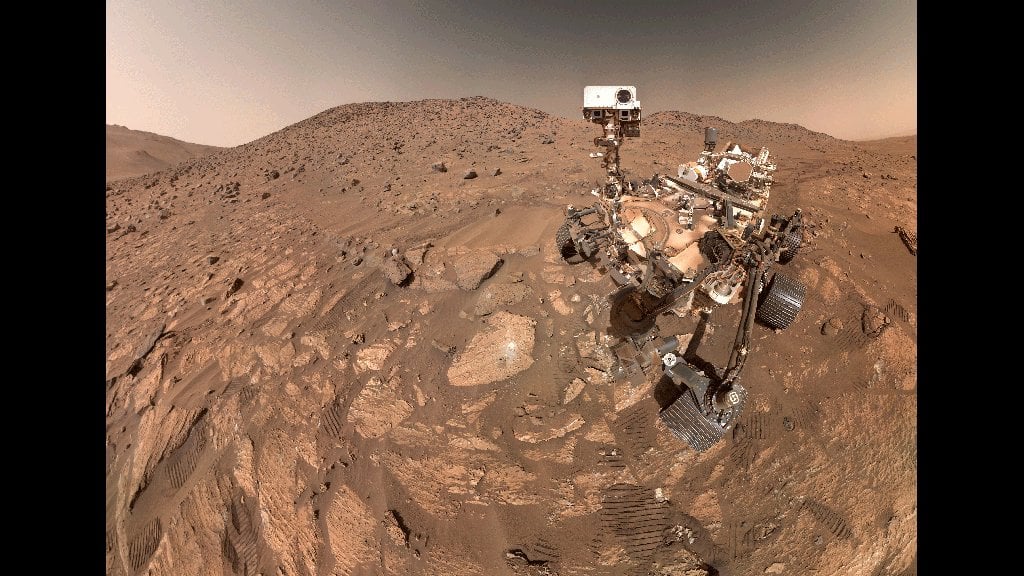
Mars Rover Finds Three Possible Signs of Ancient Life on a Single Rock | Scientists were cautiously optimistic about Perseverance’s discovery, though they indicated further research is needed before drawing definitive conclusions
https://www.smithsonianmag.com/smart-news/mars-rover-finds-three-possible-signs-of-ancient-life-on-a-single-rock-180984783/
1 Comment
From the article: NASA’s Perseverance Mars rover sampled an arrowhead-shaped rock last week that contained tantalizing hints to the presence of ancient microscopic life. Although the evidence is compelling so far, scientists in charge of the mission are quick to caution that further research, which might include bringing the sample back to laboratories on Earth, is needed to determine whether they have truly found life on Mars.
Perseverance came across the intriguing rock, nicknamed “Cheyava Falls,” on July 21 as it explored the northern edge of Neretva Vallis, a quarter-mile-wide river channel created billions of years ago when water flowed into the nearby Jezero Crater.
“Cheyava Falls is the most puzzling, complex and potentially important rock yet investigated by Perseverance,” Ken Farley, a geochemist at the California Institute of Technology and a researcher on the Perseverance mission, says in a statement from NASA.
The rock is just three feet by two feet in size, but packed within its limited area are three possible signs of ancient life.
First, Perseverance discovered long, white veins of calcium sulfate, a mineral likely deposited by flowing water, streaking across the rock’s reddish surface. Calcium sulfate’s presence bolsters the theory that Neretva Vallis and Jezero Crater were once abundant in water and therefore hospitable to life.
The rover also picked up on dozens of millimeter-sized white blobs on the rock, each surrounded by a black ring in a pattern reminiscent of leopard spots.
“These spots are a big surprise,” says David Flannery, an astrobiologist and member of the Perseverance science team from the Queensland University of Technology in Australia, in the statement. “On Earth, these types of features in rocks are often associated with the fossilized record of microbes living in the subsurface.”