Generative artificial intelligence performs rudimentary structural biology modeling
https://www.nature.com/articles/s41598-024-69021-2

Generative artificial intelligence performs rudimentary structural biology modeling
https://www.nature.com/articles/s41598-024-69021-2
2 Comments
From the article
>Artificial intelligence (AI)-based capabilities and applications in scientific research have made remarkable progress over the past few years[^(1)](https://www.nature.com/articles/s41598-024-69021-2#ref-CR1)^(,)[^(2)](https://www.nature.com/articles/s41598-024-69021-2#ref-CR2). Advances in the field of protein structure prediction have been particularly impactful: AI-based dedicated structural biology tools such as AlphaFold2 and RoseTTAFold are capable of modeling protein structures from only amino acid sequence input with accuracy comparable to lower-resolution experimentally determined structures[^(3)](https://www.nature.com/articles/s41598-024-69021-2#ref-CR3)^(,)[^(4)](https://www.nature.com/articles/s41598-024-69021-2#ref-CR4)^(,)[^(5)](https://www.nature.com/articles/s41598-024-69021-2#ref-CR5). AlphaFold2 and RoseTTAFold are trained on protein sequence and structure datasets[^(6)](https://www.nature.com/articles/s41598-024-69021-2#ref-CR6), and rely on neural network architectures specialized for modeling protein structures. Another category of AI-based tools for protein structure prediction are protein language models, which differ from AlphaFold2 and RoseTTAFold in that they are not trained on structures but rather on protein sequences[^(7)](https://www.nature.com/articles/s41598-024-69021-2#ref-CR7)^(,)[^(8)](https://www.nature.com/articles/s41598-024-69021-2#ref-CR8)^(,)[^(9)](https://www.nature.com/articles/s41598-024-69021-2#ref-CR9). Collectively, such protein structure prediction tools have been extensively used by researchers across various disciplines in the biological sciences and are expected to continue to add value alongside experimental structure determination[^(10)](https://www.nature.com/articles/s41598-024-69021-2#ref-CR10)^(,)[^(11)](https://www.nature.com/articles/s41598-024-69021-2#ref-CR11)^(,)[^(12)](https://www.nature.com/articles/s41598-024-69021-2#ref-CR12)^(,)[^(13)](https://www.nature.com/articles/s41598-024-69021-2#ref-CR13)^(,)[^(14)](https://www.nature.com/articles/s41598-024-69021-2#ref-CR14)^(,)[^(15)](https://www.nature.com/articles/s41598-024-69021-2#ref-CR15)^(,)[^(16)](https://www.nature.com/articles/s41598-024-69021-2#ref-CR16)^(,)[^(17)](https://www.nature.com/articles/s41598-024-69021-2#ref-CR17)^(,)[^(18)](https://www.nature.com/articles/s41598-024-69021-2#ref-CR18).
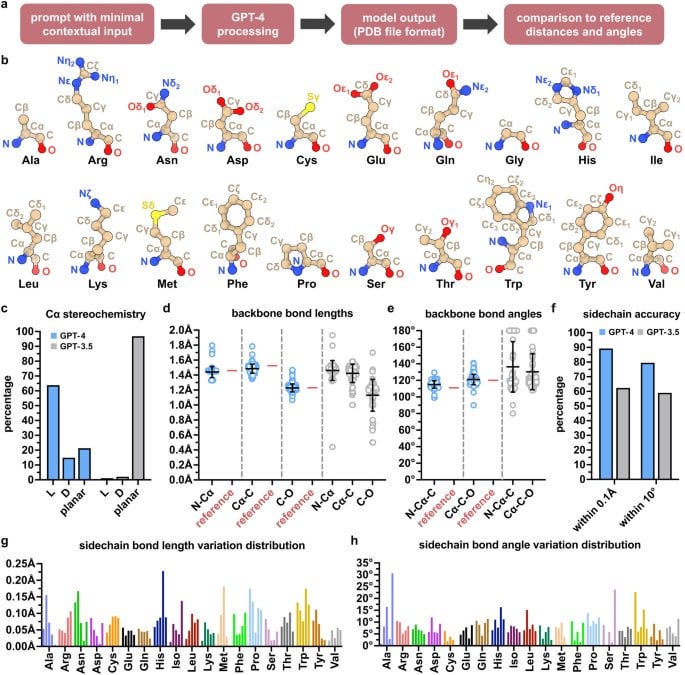
“The performance of GPT-4 for modeling of the 20 standard amino acids was favorable in terms of atom composition, bond lengths, and bond angles…the prediction of interaction-interfering mutations **may become particularly useful in drug discovery and development,** an area where GPT-based AI is anticipated to be impactful”
More [GPT Achievements](https://docs.google.com/spreadsheets/d/1kc262HZSMAWI6FVsh0zJwbB-ooYvzhCHaHcNUiA0_hY/edit?gid=1264523637#gid=1264523637).