The nuclear fusion start-up helping to develop stealth submarines
https://archive.is/2024.08.30-044425/https://www.ft.com/content/570267a4-657e-4c6b-805d-7b29a637e546

The nuclear fusion start-up helping to develop stealth submarines
https://archive.is/2024.08.30-044425/https://www.ft.com/content/570267a4-657e-4c6b-805d-7b29a637e546
3 Comments
From the article
>A quarter of a century later, UK start-up Tokamak Energy is supporting a US Defense Advanced Research Projects Agency programme to make silent marine propulsion a reality.
>The collaboration with Darpa is one of several ways the nuclear fusion company is seeking to monetise a decade of work on high temperature superconductor magnets, which it argues can transform sectors from public transport to medical imaging.
Also from the article
>It aims to build a pilot plant capable of delivering electricity into the grid in the early 2030s. The [UK government’s next fusion device, STEP](https://archive.is/o/FFIUB/https://www.ft.com/content/c88d1773-ec84-46a2-bb0f-fbaf8889e954), will use a similar design.
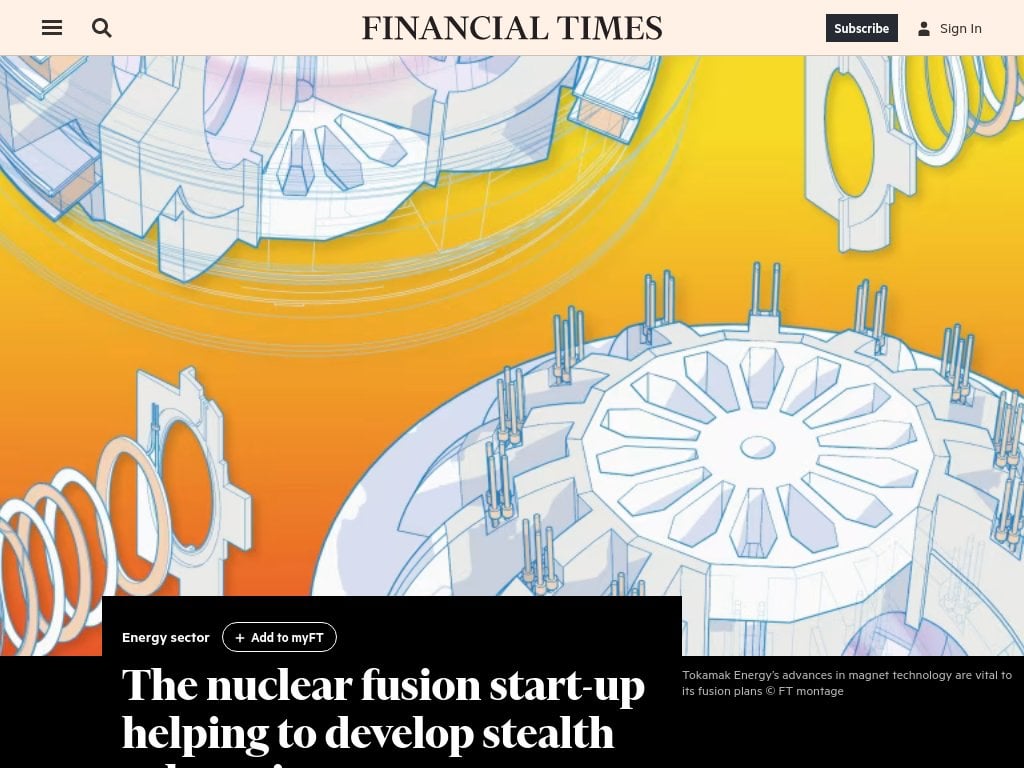
>To test the science and engineering in its magnets, Tokamak Energy has built a demonstration device at its facility outside Oxford. When completed this year it will stand 3.2 metres tall and include 44 magnetic coils of HTS tape arranged in a spherical formation around a central core. The machine will replicate the forces required in a fusion power plant, producing a magnetic field of 18 tesla, nearly a million times stronger than the Earth’s magnetic field.
>However, the potential applications of HTS magnets extend beyond fusion. The ability to operate without the need for costly liquid-helium cooling and a high tolerance to vibration makes HTS magnets ideal for use in MRI scanners in hospitals and other scientific imaging equipment that currently use LTS materials, Brennan said. He said other applications of the superconducting qualities of HTS could also include shrinking the size of electric motors for trains.
>The Darpa programme on maritime propulsion requires HTS magnets, he said, because it is seeking to build magnetohydrodynamic drives that produce magnetic fields of 20 tesla.
Science for war…. Fck clean energy lets find a way to sneak a nuke across the ocean
Wouldn’t the heat signature temperatures needed for fusion give away the stealth? I guess you can insulate and hide the heat signature.