
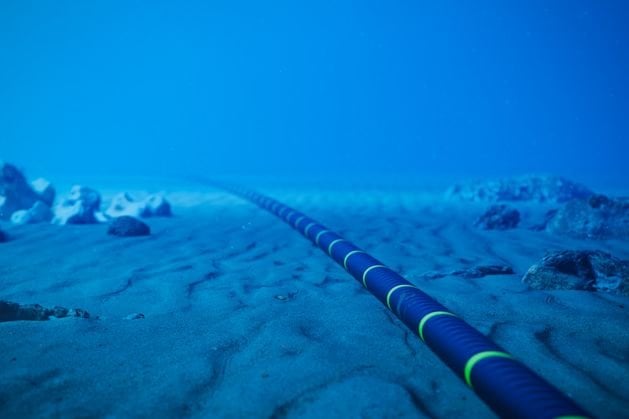
The North Atlantic Transmission One Link (Nato-L) wants to connect the European & American electricity grids via a 3,500 km cable to share excess renewable energy.
https://www.independent.ie/business/irish/ireland-is-key-to-proposed-atlantic-interconnector-that-would-secure-energy-supply-for-nato-members/a716773347.html
24 Comments
Submission Statement.
Rough calculations suggest that, on current trends, adding [12 hours of storage to the entire US grid would cost around $500 billion](https://caseyhandmer.wordpress.com/2023/07/12/grid-storage-batteries-will-win/) and pay for itself within a few years. By contrast, upgrading the US transmission grid could cost $7 trillion over 20 years.
Counterintuitively, electricity cables under the North Atlantic might be much more economical. It would not have the eminent domain and construction complexities of upgrading the US continental land grid. If this cost estimate is accurate, it may be much cheaper.
Is it really much more secure though? Wouldn’t one well-placed underwater bomb knock it out of action for weeks or months?
If security was your top priority, surely decentralized microgrids with widely dispersed battery grid storage would be much more effective?
[deleted]
I would take the opportunity and let the cable go through Iceland. They have so much energy production from hydro and geothermal resources, and it’s all 24/7
They added the “One” to make the acronym NATO didn’t they.
Yet Americans power bills will still go up, but instead of the standard annual X0.07 increase we a X2 increase☺️
They say 6GW. I wonder if that’s going in or coming out? And how much is at the other end?
They need to backups for this and all the fiber optic cables for when they are cut during the next war
Ok so let’s do the 5 seconds of realist though….. Copper cable would be impossible to be meaningful, huge transmission losses. Superconducting is possible but the vacuum around the conductor would make it impractical, it would require coolant periodically or reliquidation. So you need compressors at the bottom of the ocean…What do they think they can use?!
i am convinced (and there seems to be good science to back it up) that a sufficiently interconnected and large enough grid and a sufficiently large enough enough amount of renewable energy sources can power everything. It gets even easier if you add in storage, but still doable without.
This article and this thread are very hand wavy about the engineering aspect. Electrical cables generally lose power as a function of length. While many advances in UHVDC cables have been made, this would still be twice as long as the current longest. The power loss would be astronomical.
I’d rather see the European and African grid connected and a North American super grid instead of building massive solar arrays to waste on transmission loss cross ocean.
3,500 kms? How much electricity will be lost during transmission? This would be viable if superconductor technology becomes viable. Imagine grid that is connected around the globe. The peak demand could be off set by oversupply in different part of the world. The electricity is always made by solar panels in nearly 50% of the globe. Interesting idea.
I was wondering what the specs would look like and I found that the Changji-Guquan line runs DC voltage to 1100 kV (1.1 megavolts) and the transmission capacity is 12 million kW (12 billion watts). The power line is 3324 km long. Impressive.
[deleted]
It’s a great idea, but how much power loss are we looking at here from the cables?
If you can believe it, there might be an energy savings to ship large lightweight batteries between countries using electric semi trucks.
The fact that it is cheaper to run cabling *across the Atlantic* rather than modernize the US‘s antiquated power grid speaks volumes of the current state of US infrastructure
I dread to think what it would be like to insulate a conductor under even 1 Mv of voltage, for use in a marine environment, without maintenance. And how much it would cost.
Connecting across longitudes helps with the whole the sun doesn’t shine at night problem.
However the Atlantic is really, really big.
I remember from previous proposals to put solar farms in north Africa and put a very high voltage DC link up to Europe, that those undersea links are extremely expensive even across short distances.
I don’t see this cross Atlantic link as financially viable.
How can one tackle with voltage over such a long distance. Everything else is doable but I just can’t wrap my head around this issue.
How are they going to mitigate transmission losses?
My dearest fellow Redditors, I must ask this information of you. Would not this cable electrocute the fish?
Doesn’t long distance energy transfer like this need substations or whatever? I’m not an electrical engineer but I remember reading that electricity needs to be “pushed” and the longer the distance, the less effective it is?
The US would never agree to this for fear of utilities companies profits. And if they did, the money saved would go straight to the corporations bank accounts, not ours.
I looked at this many years ago from the POV of the light switch nearest my computer. I found that the grid is already too big and is in need of a good trimming.
First stop is the electrical room that my unit’s meter is located in, I originally thought about installing something like a Tesla Powerwall but didn’t like the idea of some off-brand battery burning the joint down and everyone having a separate battery system is highly inefficient.
So the next step was to consider battery storage for the complex as a whole and that led to mini Jenga Tower like arrangement of container sized batteries like Tesla’s Megapack system. Stick that above the trash storage area and it doesn’t consume valuable square footage. Work a deal with the local utility so they maintain it and get free space to put batteries of their own to support the local single family houses. Load the batteries at night when demand is low and the utility can avoid upgrading the local grid as the area gets densified.
I eventually got to the power distribution corridors that feed into the city and near as I could figure wind and solar would provide more than enough power for the city without going further than 50 miles out. Local farmers would greater benefit from land rents and those distant NIMBY power plants would be a thing of the past.
If only we thought 100 years into the future the data cables could also have capacityfor power.