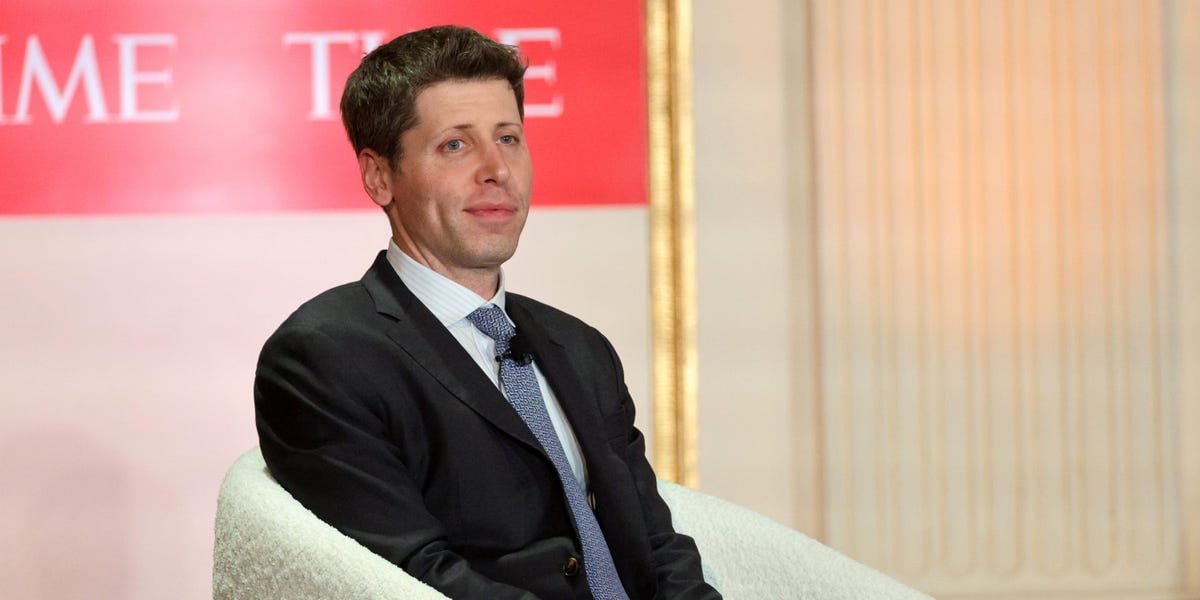
New findings from Sam Altman’s basic-income study challenge one of the main arguments against the idea
https://www.businessinsider.com/sam-altman-basic-income-study-new-findings-work-ubi-2024-12

New findings from Sam Altman’s basic-income study challenge one of the main arguments against the idea
https://www.businessinsider.com/sam-altman-basic-income-study-new-findings-work-ubi-2024-12
35 Comments
From the article:
New findings from OpenAI CEO [Sam Altman’s basic-income study](https://www.businessinsider.com/sam-altman-basic-income-study-results-2024-7) found that recipients valued work more after receiving no-strings-attached recurring monthly payments, challenging a long-held argument against such programs.
Altman’s basic-income study, which published initial findings in July, was one of the largest of its kind. It gave low-income participants $1,000 a month for three years to spend however they wanted.
OpenResearch director Elizabeth Rhodes told BI that the study participants showed a “greater sense of the intrinsic value of work.”
Rhodes said researchers saw a strong belief among participants that work should be required to receive government support through programs like Medicaid or a hypothetical future universal basic income. The study did show a slight increase in unemployment among recipients, but Rhodes said that overall attitudes toward working remained the same.
“It is interesting that it is not like a change in the value of work,” Rhodes said. “If anything, they value work more. And that is reflected. People are more likely to be searching for a job. They’re more likely to have applied for jobs.”
Average participants views: “I used it well, but I think other people wouldn’t use it well.”
JFC.
The slight increase in unemployment could be related to how awful the job market has become over the last few years tbh. People without worries about having food on the table will still want to work, because doing something gives meaning. They will just have a chance at finding something they like instead of doing whatever to survive like many of us are forced to…
Edit: by work gives meaning I refer to the feeling of accomplishment from productive action, which is subjective and can take many forms, but in the end you are putting time and effort into accomplishing an objective. Humans need that to avoid behavioural sinks.
One thing I don’t get is why we have to have special studies and funding to test this.
We already have a system up and running that is kind of a UBI program.
Can we not look to the results of people receiving veterans benefits?
Some of the best workers I’ve run into have been vets who have the supplemental income of their VA benefits.
I think a lot of it comes down to being able to tell a boss “No”. They can focus on their job and not trying to game the system to meet what ever metric management has set.
Or heck even go into a much less lucrative field, but one they have passion for.
Having that safety net allowed a few of them to start their own small businesses, which in turn allows them to employ additional people.
Are there folks who just sit around all day and play video games and endlessly scroll TikTok? Sure, but I haven’t seen that many of those folks and at the end of the day, if it ends up being cheaper than other low income programs or incarceration, isn’t that still a net benefit?
There is obscene movement of cash in many, many areas of society, look at money spent on campaigns, “for charity” and other places that never benefit individuals, the government is elite at extracting from the taxpayers, distributing it would be a great first step.
*edited refunding with distributing, different context.
Jobs still exist. People would rather support themselves to feel free.
Ubi will only be useful at a stop gap before everything is manufactured automatically and jobs and money become worthless
How do folks look at all of the politics happening in Washington D.C. (let alone the rest of the world) and come to the conclusion that UBI is something they’ll actually get?
All of these findings and studies are meant for Reddit doomscrolling, since they’ll never actually take off.
You have absolutely zero chance of this getting addressed under the incoming administration. We would need to see catastrophic levels of unemployment coupled with massive demonstrations on the streets.
Have the look at the major donors in both of these articles.
[Billionaire Dick Uihlein Poured Nearly $49 Million Into Pro-Trump PAC](https://www.forbes.com/sites/siladityaray/2024/10/16/billionaire-dick-uihlein-poured-nearly-49-million-into-pro-trump-pac-filings-show/)
[The Billionaire-Fueled Lobbying Group Behind the State Bills to Ban Basic Income Experiments](https://www.scottsantens.com/billionaire-fueled-lobbying-group-behind-the-state-bills-to-ban-universal-basic-income-experiments-ubi/)
>Who is Funding the FGA?
>According to the Center for Media and Democracy’s SourceWatch, the largest single donor to FGA has been the Ed Uihlein Family Foundation, with a total contribution from 2014-2021 of $17.85 million. Both in their 70s, the Uihleins (pronounced YOU-line) are a husband and wife team, Richard and Liz, worth around $5 billion.
There is no solution coming.
They made the problem without caring about the implications because they don’t actually care. UBI isn’t coming. They can just let you die. I don’t understand how people think these people are going to give you free money when they are literally erasing democracy before your very eyes. Sure they’ll commission a study to make themselves and you feel better. Maybe they’ll even fake ask for it in Congress.
But in the end… fuck you. Money.
One of the problems with these type of trials is they always seem to have an end date. 1000 per month for 3 years is ultimately 36000. 1000 per month for life is “I don’t need to worry about bills/feeding my children if I can’t work as much”. To me there is a massive psychological difference between getting money for a few years and getting money forever
It’d be better for the 5 basics to be free than to give people income. Because people will spend it poorly and also the price of things would simply increase and they’d still be out of luck.
Basic food aka free pantry sort of grocer store with some basics like rice, beans, etc where people can go get stuff for free to cook at home
Water same as above should be somewhere people can easily go get free water
Education age 0 to age 21 should be provided. We already do like 6 to 21 (CC are basically free).
Healthcare again should be completely free no reason we should charge for this
Housing. Probably the most controversial. But there should be super basic has electricity, has toilets, has hvac and 4 walls type of no frills housing available to everyone that is a permanent resident or citizen.
It’s strange to both say “they valued work more” when the amount of unemployment went up in the group.
when you get 1000 dollars and many others don’t then you behave differently than if every one got 1000.
I imagine it’s because they can find and do work they get fulfillment out of instead of being forced to take the first soul rending retail job that comes up.
I swear this is the same ‘finding’ that happens every time these UBI studies are done. And every time it’s reported as a surprise finding as if there wasn’t already massive amounts of evidence from years-long studies that continue to confirm them. It’s like the reports on trickle-down economics that surface every year saying something like ‘economists suggest trickle down economics isn’t working’.
“The study showed a slight increase in unemployment…”
Question.
Which definition is being used here? Because if they mean the *actual* definition, it still challenges the argument against UBI: That people would just not work.
If they mean the informal definition (Not participating in the labour force) then I have another question: Who left the labour force?
High school aged people who decided to save up? College & Trade school students who decided to put more time into schooling? Senior citizens who retired? Disabled people?
Weren’t those usually the people who stopped working under past experiments of UBI?
To me a 3 year study is not really worthwhile. It’s just a “free” $36k over 3 years. There’s an end date to it, so a rational person would try to use the period of boosted income to get ahead.
My question is, what would my tax burden be if the government gave me back $12,000 per year?
It gives people hope. With hope you want to strive for goals. You want to keep building and working.
I know when I had just a little help I did so much better. Now I have zero help and I’m just dissociating my life away in isolation and poverty.
Raising a family or spending quality time with friends and family or just hiking is plenty of meaning for many.
Most jobs don’t give the workers “meaning” – it’s just that we live in a work or die society and we’ve been conditioned to look down on those that don’t.
That said, with UBI, I’m sure many more would people would do volunteer work so they could do jobs that are meaningful to them. But many others won’t.
They are basing that on self reported feelings. Of course people participating in a UBI trial are going to tell you they still think work is important. The actual data is that there was a slight decrease in employment, which is to be expected. But that’s not really important. This is a straw man argument. Those of us skeptical of UBI aren’t all capitalist pigs who hate UBI because it will drain away our labor to exploit, we just don’t think it will help. It’s the economic equivalent of the cartoon character who brings a fan onto his sailboat, it just doesn’t work in real life.
>”It is interesting that it is not like a change in the value of work,” Rhodes said. “If anything, they value work more. And that is reflected. People are more likely to be searching for a job. They’re more likely to have applied for jobs.”
If you have to do daily labor just to get by, or can’t afford bus fare, or need to go to soup kitchens or food pantries to eat, or can’t afford new clothes, then it gets really, really hard to get back on your feet. I don’t know what the bottom range criteria the study used for “low income”, if there was one (article just says under $28k/year), but for those in a situation like this $1,000/month could make a huge difference.
The slight increase in unemployment is probably from people doing what is in their best interest — finding the best job and not the quickest job.
But this is exactly why employers will fight tooth and nail against UBI. It gives the most vulnerable leverage to negotiate their salaries and job circumstances better.
This gives individuals the much of the same power as a union. And is the same power that educated / “skilled” workers already have, and is why we strive so hard for our kids to go to college.
So they can have just a little more breathing room.
Makes a lot of sense to me; A slave cannot value their work, but a freeman can. In this case being wage slavery.
The studies are only valid when they go your way. We all know that’s how business works.
One year a native corporation gave its share holders 50k. People who had good paying jobs did not show up for work. They showed back up when they ran out of money.
Also, what happened when people who was working and found out that they can make more money by getting a COVID supplement? It took several years before restaurants could adequately fill their server positions.
Those are two real world counter examples and not a study.
How would you counter the inflationary effect of giving a large group of people money? Rent and other bills would go up to eat up the difference because you would have more money chasing the same amount of goods and services.
I encourage people to read the working papers from NBER analyzing the data: https://www.openresearchlab.org/findings/category/working-papers
Here are some brief snippets just from the abstracts:
> We find no effect of the transfer across several measures of physical health as captured by multiple well-validated survey measures and biomarkers derived from blood draws. We can rule out even very small improvements in physical health and the effect that would be implied by the cross-sectional correlation between income and health lies well outside our confidence intervals. We also find that the transfer did not improve mental health after the first year and by year 2 we can again reject very small improvements. We also find precise null effects on self-reported access to health care, physical activity, sleep, and several other measures related to preventive care and health behaviors.
Again:
> The transfer caused total individual income to **fall** by about $1,500/year relative to the control group, excluding the transfers. The program resulted in a 2.0 percentage point decrease in labor market participation for participants and a 1.3-1.4 hour per week reduction in labor hours, with participants’ partners reducing their hours worked by a comparable amount. The transfer generated the largest increases in time spent on leisure, as well as smaller increases in time spent in other activities such as transportation and finances. Despite asking detailed questions about amenities, we find no impact on quality of employment, and our confidence intervals can rule out even small improvements. We observe no significant effects on investments in human capital, though younger participants may pursue more formal education.
Yes, I’m sure you can dredge up some positive sounding conclusions, hell if you’re going to spend this much money you might as well spend a little more to spin it. But the bottom line is that UBI did not improve people’s health and it did not improve their education or income (income and hours worked actually decreased).
I don’t know how this can be interpreted as a positive result for UBI. On the surface it seems to indicate that when you give people money they work less and spend more time on leisure, and they don’t use the money on anything that will generate positive externalities, which is what critics of UBI claim will happen.
I used to support UBI and I find this study to be quite damning, especially since Altman has a huge vested interest in UBI being viable. Giving people free stuff isn’t enough when we still have scarcity, we need the production to meet people’s basic needs in excess first.
If everyone gets $1k per month what stops land lords from just raising rents prices by $1k?
Study all you like, but there’s about as close as you can get to a 0% chance in this universe that America is going to do something like this at the federal level.
> Participants reported significant reductions in stress, mental distress, and food insecurity during the first year, though those effects faded by the second and third years of the program.
The article just throws out this claim and then doesn’t elaborate. Is it really suggesting that food insecurity returned despite receiving $1,000 month? I’d really like to know what % of participants reported increased food insecurity in years 2 & 3, and if possible why?
UBI stirs up a lot of debate, but let’s cut through the noise. Sure, some worry about people not “using it well” or falling into that “crabs in a bucket” trap, but let’s be real: self-sufficiency was always a myth.
We’ve always relied on each other—it’s just **Western individualism that turned interdependence into a problem instead of a strength.**
**Look at the data.**
Most people who step back from work with UBI aren’t being lazy—they’re taking care of kids, going back to school, or finding jobs that actually matter to them.
It’s no different from how veterans with VA benefits can say “no” to exploitative jobs, focus on better opportunities, or even start small businesses that help others.
That safety net creates independence, not dependence.
And do we really need more studies? We already have systems like this in place, and they work.
The slight rise in unemployment tied to UBI just reflects how broken the job market is—not people unwilling to contribute.
**Given the choice, most people want purpose, not just survival.**
Sure, some might misuse it—scroll TikTok all day or play video games—but if the alternative is patchwork low-income programs or incarceration, isn’t it still a win? UBI isn’t about handing people an escape route; it’s about giving them the dignity and freedom to contribute on their terms.
Isn’t that the kind of society we actually want to build?
The Finnish real world study on a large scale found that it didn’t improve the outcomes of those it supported the most.
Isn’t anyone going to mention that unemployment rose in the test group?
No one?
“researchers saw a strong belief among participants that work should be required to receive government support through programs such as Medicaid or a hypothetical future unconditional cash program. The study did show a slight increase in unemployment among recipients, but Rhodes said that overall attitudes toward working remained the same.”
– a strong belief that work should be required
– overall attitudes toward working remained the same
– The study did show a slight increase in unemployment among recipients
So the claim is that people on the program began to value work more. But their opinions didn’t change. And they actually worked less.
Seems the results are inconclusive, lean towards contradicting the headline, and the only hard data actually affirms the doubters. Sounds like the researchers found what they went in wanting to see.
We gave people $1000 a month for a while, knowing it would go away.
That’s not UBI. It’s not enough to be the ‘basic’ income, and it’s not something the can actually count on. It’s interesting, but I don’t know that it’s enough to be a solid answer for how to judge a UBI. Could you live on 12k a year? I don’t know many (any?) people who could.