
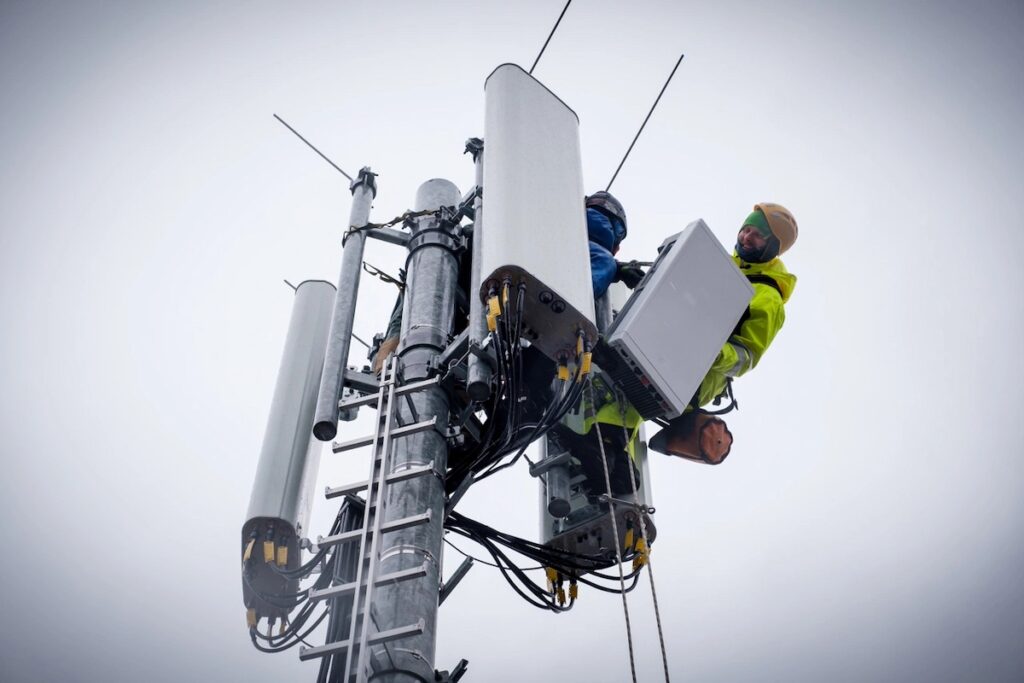
Deutsche Telecom has contracted Finland’s Nokia and its Japanese partner Fujitsu to supply 5G network equipment for more than 3,000 sites in northern Germany, a massive rollout of so-called Open RAN technology that will undercut China’s Huawei in the area.
The contract, announced on November 27, marks Nokia’s return as a supplier of radio access network (RAN) equipment to Deutsche Telekom for the first time since 2017.
The deployment in Neubrandenbeug, north of Berlin, began in December 2023 with the integration of Nokia’s Open RAN-compliant 5G AirScale baseband solution and Fujitsu’s radio units into Deutsche TeleKom’s commercial network.
Claudia Nemat, Deutsche Telekom board member for technology and innovation, said at the time, “Open RAN is crucial to Deutsche Telekom’s strategy to promote greater supplier diversity and accelerate customer-oriented innovation in the radio access network. Our commercial deployment with Nokia and Fujitsu is an important step to prepare multi-vendor Open RAN as the technology of choice for future networks.”
Tommi Uitto, Nokia’s president of Mobile Networks, said on the announcement of the new contract that the company’s technology “ensures that multi-supplier O-RAN systems can be deployed without any compromises in terms of performance, energy efficiency or security.”
He said that Nokia and Deutsche Telekom have “agreed to explore O-RAN technology around Cloud RAN, 3rd party CaaS [Connectivity-as-a-Service], RIC [RAN Intelligent Controller], SMO [Service Management and Orchestration] and energy efficiency.”
The two companies’ public statements did not say whether this would be the first step toward removing China’s Huawei and ZTE from Germany’s 5G telecom network, but the telecom trade press focused on that.
Under pressure from the US and the EU, the German government and telecom network operators in the country – including Telefonica and Vodafone in addition to Deutsche Telekom – have agreed to remove Chinese equipment from their core networks by the end of 2026 and entire networks by the end of 2029.
In June 2023, Thierry Breton, the EU’s then-commissioner for internal market, referred to Huawei and ZTE as “high-risk suppliers.”
Open RAN standards allow different companies to supply different parts of a telecommunications network. This gives telecom service providers more flexibility and independence from large suppliers of complete proprietary systems such as Huawei, Ericsson and Nokia, as well as from smaller national champions like Samsung in South Korea and NEC and Fujitsu in Japan.
In theory, Open RAN is a multi-vendor system. In practice, it tends toward what cynics call “single-vendor open RAN,” with the primary vendor being Nokia or Ericsson. Fujitsu works with both of them. In 2023, ATT chose Ericsson, along with Fujitsu and software vendor Mavenir, as its primary Open RAN vendor.
Rakuten Mobile procures equipment and software from many different vendors, but chose Japan’s leading telecom equipment maker, NEC, to make its radio units. NEC has also partnered with NTT DoCoMo to develop Open RAN. Samsung works with KDDI.
Faced with expulsion from the European market for 5G and more advanced telecom equipment, Huawei is refocusing on countries outside the US’s sphere of influence.
The largest of these is Brazil, which has a population of about 215 million compared with 85 million for Germany and 445 million for the EU, and a current GDP growth rate of about 3% compared with less than 1% in the EU and a slight decline in Germany.
Huawei has been in Brazil for more than two decades, supplying 3G, 4G and now 5G equipment to several mobile network operators, including Vivo, Claro and TIM.
It is also supplying 5G equipment to operators of private networks, including one controlling cameras, forklifts and other autonomous vehicles at Vivo’s distribution center in Sao Paulo, Brazil.
In July of this year, Claro, part of Mexico’s America Movil telecom group, successfully completed a test of 5.5G (5G-Advanced) in Brasilia using Huawei equipment, suggesting that Brazil might be the second country after China to make commercial use of the new technology.
Nokia and Ericsson also supply 5G mobile and private network operators in Brazil, including a deal between Nokia and TIM announced in August. The two European companies and Huawei all have telecom equipment manufacturing facilities in Brazil.
Elsewhere in Latin America, only Costa Rica has banned the use of Chinese telecom equipment, according to a study made at the Universidad de Navarra in Spain.
Mexico does not use Chinese telecom equipment near the US border. America Movil’s Telcel service provider has installed equipment from Ericsson in the north and Huawei in the south of the country.
On December 5, Nokia announced new agreements with Indonesia and Saudi Arabia. In Indonesia, Nokia and Indosat Ooredoo Hutchison (IOH) plan to continue their work on the expansion of IOH’s nationwide 4G and 5G mobile network through 2027.
This follows the completion of IOH’s 14-month core network consolidation project with Huawei, which was announced at the end of August. Average downlink times have since been reduced by as much as 15% in rural areas, while social media response time has shortened and internet game and video performance has improved.
In Saudi Arabia, Nokia has introduced technology to improve the efficiency, capacity and reliability of Aramco’s fiber optic network. This follows last month’s commercial launch by Saudi Telecom Company (STC) of Huawei’s Superlink high-speed 5G wireless transmission system to serve remote areas of the country.
As the situation stands now, the US and its allies have eliminated or are in the process of eliminating 5G equipment made by Huawei and ZTE, China has reduced the presence of Nokia and Ericsson to insignificance in retaliation and the rest of the world continues to award telecom equipment contracts based on quality and price.
Follow this writer on X: @ScottFo83517667