
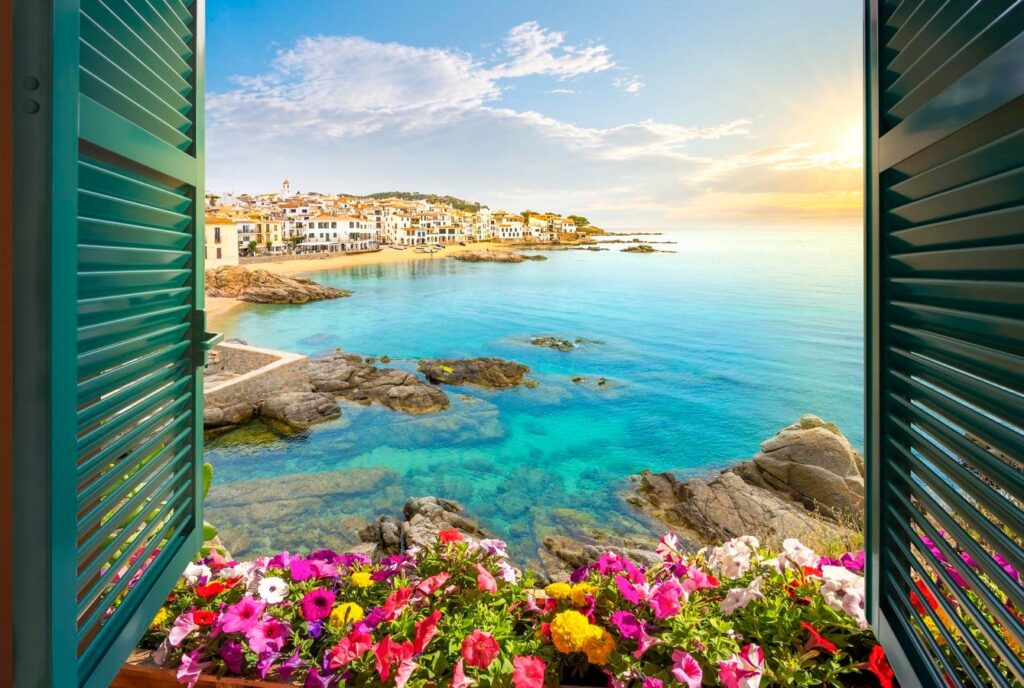
This could be the view you wake up to every day in Spain…
getty
Dreaming of retirement in a warm climate?
Afternoons of sangria, tapas, and paella…
Weekends of fiestas, flamenco, and fireworks…
Living in some of the world’s most cosmopolitan cities: Madrid, Valencia, Barcelona, Bilbao, Malaga…
With over 3,000 miles of coastline, fresh seafood, and a warm climate year-round…
And mountain ranges that offer 3,000+ meters of altitude for hiking, skiing, and sightseeing…
The reality of life in Spain is as rich as the fantasy… this country doesn’t disappoint when it comes to delivering on all the things it’s become famous for.
Tapas and pinchos are the best way to enjoy the flavors of Spain
getty
Why Is Spain A Hot Retirement Spot?
As the second largest country in Western Europe, Spain has a diverse geography, which means unlimited lifestyle options: beach, mountain, urban, rural…
This varied geography also means climate options that are completely customizable: cool on the northern Atlantic coast, cold and snowy in the Pyrenees, warm on the southern Mediterranean coast, and everything in between.
Skiing in Spain? You bet!
getty
Add to that the wealth of history, art, and culture that you’ll find across the country…
The fresh seafood, fantastic regional cuisine, and wine that’s cheaper than soda…
The fiesta attitude that reigns supreme, both in the big cities and small towns…
Plus the fact that these incredible lifestyles come at such affordable prices…
It’s little wonder that Spain is the most popular expat location in Europe. In fact, Expat Insider ranked it as the best place to live in Europe, and the fourth best country for expats in the entire world.
Why Is Spain Such A Popular Retirement Destination?
Spain has so much to recommend it, but the abundant sunshine and warmth are probably the top reasons cited for a retirement in Spain.
With 300+ days of sunshine on the Mediterranean Coast, and temperatures that rarely go below 65, even in January and February, southern Spain is a comfortable place to live if you’re looking for consistent heat.
The great year-round weather also means an active and outdoor lifestyle—in fact, many retirees here mention that between the walking they do every day and the Mediterranean Diet, they lose weight and find themselves in better health without even trying.
Speaking of the diet… the fresh seafood, abundant organic produce delivered from field to market every day, and the culture surrounding food is another reason so many fall in love with their new lives in Spain.
Seafood paella is just one way to enjoy the fresh catch of the day in Spain
getty
When it comes to health care, Spain offers some of the best in the world, with an easy-to-access system that’s open to all. Spain has the 26th best health care in the world according to the 2023 Health Care Index (for frame of reference, the United States ranks 69th on the same list). Medical services here are of the highest quality and are, above all, extremely affordable.
The fact that British retirees have been coming here for many decades already means that English is commonly spoken in the tourist and foreigner hot spots, and it’s easy to find an English-speaking community almost anywhere in the country. Spain is an easy place to make friends and to get integrated into local life.
Owning a car can be a big line item on your annual budget, but in many cities and beach communities in Spain, you could ditch that cost altogether. Many retirees in Spain appreciate being able to take advantage of the excellent public transportation, along with enjoying the chance to walk more in their daily lives, as most cities here are compact, flat, and very walkable.
How Many Americans Are Retired In Spain?
Spain boasts an estimated population of 9 million or so foreigners, with about 300,000 from the U.K., meaning it’s not hard to find fellow English speakers here.
Americans are coming to Spain in greater numbers each year, both for retirement and to work remotely, and it’s thought that there are around 41,000 Americans in the country as of 2024.
Expats are concentrated along the southern coast, as well as in the main cities, including Barcelona, Madrid, Valencia, and Seville.
And while the number of North American retirees here is smaller than the number of Brits, it’s an easy commute for those coming from the States or Canada, with two massive international airports in Madrid and Barcelona.
Beaches, boats, and blue skies in Catalonia, Spain
getty
What Are The Downsides Of Retirement In Spain?
Although you can live in Spain on much less, the income requirement to qualify for residency is relatively high at 2,400 euros per month.
Bureaucracy is much more onerous than what you’re used to in North America. Whether it’s applying for residency, getting a local driver’s license, opening a bank account, or anything else in the administrative arena, you’ll be astounded at the amount of paperwork, the time things take to get done, and the number of hoops you’ll have to jump through to accomplish things here.
Not necessarily a con, but something to be aware of, is that you’ll need to learn Spanish to really appreciate life here. Unless you’re moving to one of the major cities or resort areas, you won’t come across many locals who speak English, and those who do are typically in the service industry.
And you’ll need to get used to local mealtimes, which are very different from those of the States… Lunch is typically not earlier than 2 p.m., and dinner is rarely before 9 p.m.
How Does Retirement In Spain Affect Your Taxes?
Taxes in Spain are a serious consideration for a potential resident.
The tax burden here is about 9% higher than average among the OECD… On the other hand, Germany, Greece, France, and Italy all have greater overall tax burdens.
Taxes Rates At A Glance:
· Sales tax: 4% to 21%
· Income tax: Varies by region; averages 21.1%
· Capital gains: 10% to 26%
· Property taxes: Varies by municipality; 0.4% to 1.1%
· Wealth tax: Calculated on a sliding scale from 0.2% to 3.5%
· Inheritance/gift tax: Calculated on a sliding scale from 7.65% to 34%
Spain taxes on worldwide income, but you won’t be in danger of double taxation, as there are treaties in place with the U.K., Canada, and the States to prevent this.
On the other hand, you’ll gain access to the excellent health care system and receive allowances on inheritance and property taxes. There are many tax allowances given, including for personal exemptions, for those over 65, even more for those over 75, and for those with children.
For tax residents (those who spend more than 180 days in Spain per year), overall taxes in Spain are higher than in the United States or Canada. But for the lifestyle it offers—and the free health care that comes with being a tax resident—many expats find it a worthwhile tradeoff.
Murcia, a gorgeous small city on the Costa Cálida, is one of our top recommendations in Spain
getty
Do You Need A Visa For Retirement In Spain?
To stay in Spain beyond your 90-day tourist visa, you’ll need to apply for residency, but, unlike in most countries, you don’t need to apply for a long-term stay before leaving your home country. Once you land in Spain, you have 60 days to submit the request to change your immigration status from tourist to resident.
The most common visa American retirees use to stay in Spain is the Non-Lucrative Visa (NLV), also known as the passive income visa, which simply requires the primary applicant to prove earnings of about 2,400 euros per month, plus an extra 600 euros a month for each dependent (for 2024). Under this visa, you’re not permitted to work.
The NLV is valid for one year and renewable for another four years, provided you still meet the requirements.
Is Retirement In Spain Ethical?
Several coastal cities in Spain have seen rapid housing inflation in the last few years that has been blamed on foreign renters and buyers. This is a global problem that has begun to affect many cities across the world.
While some destinations in Spain have lashed out against tourism recently, notably the Balearic and Canary Islands, Barcelona, and Málaga, foreign residents don’t report feeling discriminated against.
The best ways to show your respect for a culture you’re visiting, whether as a tourist or a resident, is to make an effort at speaking the local language. And once you’ve moved to a new country, take some time to notice and absorb local customs and routines and adapt to them accordingly.
The architecture of Barcelona is one of Spain’s great claims to fame
getty
Who Should Consider Retirement In Spain?
Spain is a culturally and historically rich country, as well as a melting pot of different cultures who have left their marks over the centuries. Between the several coastlines, the mountain ranges, the top-tier cities, and the varied climates, Spain has something for everyone…
With one of the lowest costs of living in Western Europe, retirement in Spain is a bargain for the enviable lifestyles it offers.
MORE FROM FORBESForbesIs This Sun-Soaked Spot Europe’s Happiest Expat Haven?By Kathleen PeddicordForbesWhere To Retire In Europe For As Little As $1,865 Per MonthBy Kathleen PeddicordForbesIn A Hurry To Leave The U.S.? Here Are 3 Countries You Can Move To TodayBy Kathleen PeddicordForbes7 Steps To Take Before You Move Out Of The United StatesBy Kathleen Peddicord