
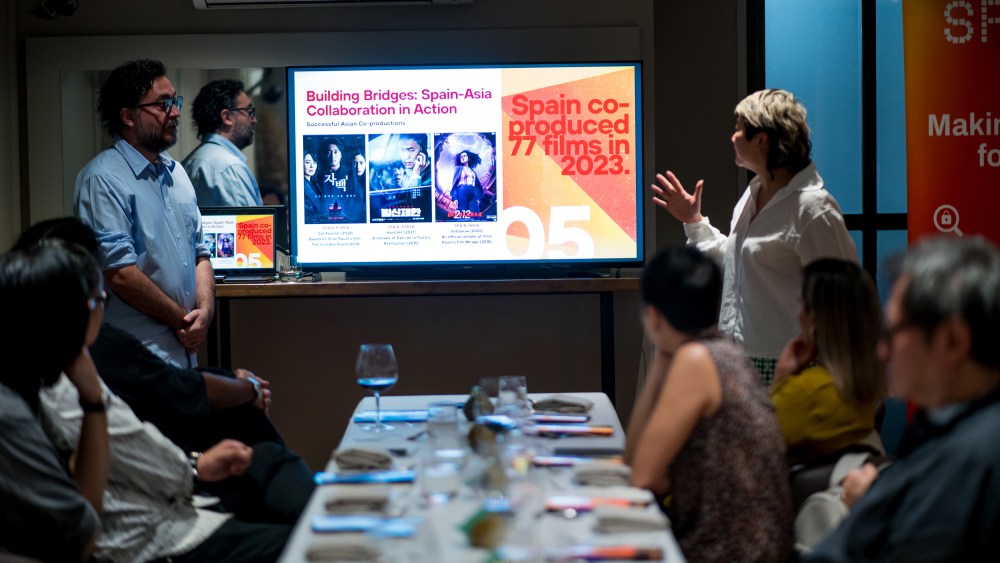
The ICEX Spain Trade and Investments (ICEX) knows how to put on a mouthwatering outreach initiative to whet the appetite of Southeast Asia’s film and TV production community. Its servings include a combination of Spanish-style fine dining, and a heaving spread of production incentives, location attraction systems and motivated co-production partners.
Such a delicious entrée-dessert combination was laid out earlier this month in Singapore, at a soiree sponsored by Variety, the Spain Audiovisual Hub and ICEX SPAIN, which is an agency of the Spanish Ministry of Economy, Trade and Business with an office at the Embassy of Spain in Singapore.
Guests included: writer-director-producer Eric Khoo; producer James Khoo; distributor and producer Lim Teck; cinematographer and director Russell Morton; Jow Zhi Wei; filmmaker Nicole Midori; documentary filmmaker Tan Pin Pin; producer Huang Junxiang; producer Debbie Lee; talent agent and producer Andrew Ooi; producer Joel Morrish; and Sony Pictures executive Jared Dougherty. Also present were Sara Rodríguez Portugués, trade officer at the Spanish Embassy, and ICEX’s Blas Garcia Zornoza.

Serving as an appetizer, Singapore-based trade counselor Antonio García Rebollar got the evening underway with an address that welcomed guests and introduced a taste of Spain’s “very viable and a very vibrant industry.”
The main dish was a casserole of facts, figures, ideas and examples from Spanish-born, Singapore-based producer Fran Borgia and multinational executive Lorna Tee, who together launched ICEX’s Asia Audiovisual Antenna earlier this year.
“Spain has probably the fourth largest film production largest industry in Europe. It is one of the top 10 globally and, in terms of gaming and animation, is right at the European forefront,” said Borgia. “Its scale is not always appreciated, but once we take a deeper look, it is easy to see that there are lots of Spanish influences throughout the world’s film industry.”
Spain offers multiple funding opportunities and incentives. Film finance is available at a regional level as well as a national level, and it is possible to combine funding from the two sources to give qualifying productions significant levels of soft money support.
“Regional facilities, like those in the Canary Islands, Barcelona, Madrid or Valencia, are very strong because they have studios and can also offer tax credits for production,” said Borgia. “They have a fast-track visa system for film shoots, so that you won’t have any problem if you need to spend 30-90 days in the country for work purposes.”
Spain boasts 13 different climate zones, some 3,000 hours of sunlight annually and diverse filming locations that range from natural landscapes, rural and historical sites and vibrant cityscapes. Also, the menu of state-of-the-art studios includes: the Madrid Content City, where Netflix has its largest hub in the EU; the Park Audiovisual de Catalunya, with its four stages near Barcelona; the six stages and water tank at the Ciudad de la Luz; and the virtual production facilities at Gran Canaria Studios.
These can be explored and accessed with the help of the Spain Film Commission, its interactive Screen Destinations map and the Directory of the Spanish Audiovisual Industry. Regional location attraction and facilitation bodies include the Iles Balears Film Commission (covering the Balearic Islands Mallorca, Menorca, Ibiza and Formentera), the Andalucia Film Commission, the Madrid Film Office and the Catalunya Film Commission.
“A lot of talent and young people are flowing into the industry right now,” Borgia explained. “These complement the large number of companies that already have deep experience of co-productions.”
In 2023 alone, Spanish firms co-produced 73 film titles with international partners. Recent examples with Asia include 2022 Korean-Spanish thriller “Confession,” based on Oriol Paulo’s 2016 original film “The Invisible Guest”; 2021’s “Hard Hit,” a Spanish-Korean remake of Dani de la Torre’s 2015 film “Retribution”; and 2022 hit “Dobaaraa,” an official Indian remake of Oriol Paulo’s film 2018 film “Mirage.” Additionally, last year saw Pham Thiên An’s “Inside the Yellow Cocoon Shell,” a Directors’ Fortnight title that was structured as a co-production by Spain’s Fasten Films with partners in Vietnam, Singapore and France.
Others may be in the works. These include Tan Siyou’s “Amoeba,” which counts on support from the Canary Island Cultural Fund and is a Singapore-France-The Netherlands-Spain co-venture; “The Violinist,” by Ervin Han and Raúl García, with support from Singapore’s Infocomm Media Development Authority and the Valencia Institute of Culture; and the Anna Saura and Bobby Bedi-produced India-Spain production “Mudras,” a tale of dancers from different generations, which is now in post-production.
Eric Khoo, who recently delivered the Catherine Deneuve-starring “Spirit World,” said that he was profoundly impressed by Spanish horror films and would be interested to explore more.
Questions from other guests ranged from queries about which parts of the country still observe Spain’s famous siesta or afternoon nap (answer: very few) and how Asian producers can find appropriate partners in Spain, through to the value of the rebate system (30% of qualifying spend) and whether the incentives also include commercials production (yes).
Borgia noted that Spain was the 2024 country of honor at the Cannes market and will again be the country in focus at the European Film Market in Berlin in February. “These selections demonstrate the vibrancy of the Spanish industry and represent further opportunities to discuss production and co-production.”
The event was backed by the European Union’s NextGenerationEU, Spain’s Plan de Recuperacion, Transformacion y Resiliencia, ICEX, the Gobierno de España: Ministerio de Economia, Comercio y Empresa and the Ministerio Para La Transformación Digital y de la Función Pública.