
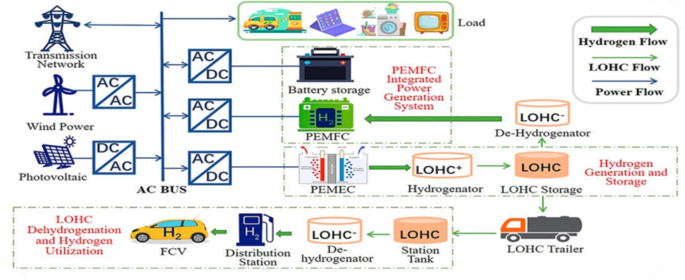
This section delves into modeling the microgrid (MG) system and its components, stressing the importance of accurately representing each subsystem. Employing a meticulous approach, crafted a precise model that includes elements like wind turbine, photovoltaic, hydrogen repository, electrolyzers and fuel cell with variable power. The section conducts a thorough investigation of each component within the system.
This research presents a microgrid system that unified several components, containing a proton exchange membrane fuel cell, an alkaline electrolyzer, oxygen and hydrogen gas storage enclosure, battery storage, and photovoltaic generators38. In precise, the fuel cell and electrolyzer utilized in this research align with the specifications of a Nexa 26 V, 46 A, 1.2 kW Proton Exchange Membrane Fuel Cell (PEMFC) established by the Ballard39and hydrogen Igen 300/1/25, 43 V, 120 A, 5 kW Alkaline Electrolyzer. To ehnace the global performance and resource usage of hybrid microgrids, a comprehensive power and energy management plan of action is put into practice40. This approach is purposefully crafted to optimize the system’s operation41. The hydrogen based microgrid is simulated using MATLAB/Simulink software.
At the initial phase in designing a microgrid is to estimate the energy requirements of the load or the capacity it will oblige. It embraces assessing the typical daily and peak energy demand, as well as recognizing the energy sources currently used and the potential for renewable energy. This comprises recognizing the quantity of hydrogen storage, fuel cells, and further components mandatory to encounter the energy demand. This involves choosing the proper fuel cells, power electronics, and other components to optimize the performance of the system. The management of the microgrid system involves monitoring the energy demand and supply, managing the hydrogen production and storage, and maintaining the system components. It requires the development of a control system that can efficiently accomplish the energy flows and optimize the system’s performance.
Wind turbine model
Wind turbines produce electrical power continuously, delivering energy for local consumption and replenishing a hydrogen storage system. Additional power is either fed back into the grid or used for non-critical purposes. Computing the output power of the wind mills entails transforming the wind speed, as measured at the anemometer height, to measure the wind turbine hub height by means of the power law Eq. (1)42.
$${\text{V}}_{\text{b}} = {\text{V}}_{\text{a}} ( {\frac{\text{h}} {{\text{h}}_{\rm ref}} ) }^{{\upgamma}}$$
(1)
In this scenario, \(\:{V}_{a}\) and \(\:{V}_{b}\) represents wind speeds at the wind turbine hub height and the reference height \(\:{h}_{ref}\), calculated in meters per second. Moreover, γ denotes the exponential factor within the power law and is usually known as the “roughness factor.” This factor is permitting to the impact of various variables, such as the local terrain, temperature, and wind velocity, which can vary with the time of day or time of year. Therefore, it can oscillate significantly between open, flat landscapes and compact forested areas. As a result, the wind turbine’s power output, considered as \(\:{P}_{Wout}\), can be determined using a series of Eq. (2).
$$\:{\text{P}}_{\text{W}\text{o}\text{u}\text{t}}\:=\:\left\{\begin{array}{c}\begin{array}{c}\left(\text{x}{\text{V}}^{3}-\text{y}\right)\:{\text{P}}_{\text{R}\text{W}},\:\:\:{\text{V}}_{\text{C}-\text{i}\text{n}}\le\:V\le\:\:{\text{V}}_{\text{R}\text{a}}\:\:\:\:\:\:\:\\\:{\text{P}}_{\text{R}\text{W}\:,\:}\:\:\:\:\:\:\:\:\:\:\:\:{\text{V}}_{\text{R}\text{a}}\:\le\:V\le\:\:{\text{V}}_{\text{C}-\text{O}\text{f}\text{f}}\:\:\:\:\:\:\:\:\:\:\:\:\:\:\:\:\:\:\:\:\end{array}\\\:0,\:\:\:\:\:\:\:\:\:\:\:\:\:\:\:\:\:\:\:\:\:\:\:\:\:\:\:\:\:\:\:Otherwise\end{array}\:\right.$$
(2)
The output of WT is relying on two key factors: the rated power \(\:{P}_{Wout}\) of the turbine and wind speed V. Moreover, vital wind velocity standards are used to control the turbine’s action. The Cut-in velocity presented by \(\:{V}_{C-in}\), the rated speed of the turbine designated by \(\:{V}_{Ra}\)and lastly, the cut-off speed can be determined by \(\:{V}_{C-Off}\). So, remaining constant values \(\:x\) and \(\:y\) can be calculated by specific expressions (3) and (4):
$$\:\text{x}\:=\:\frac{1}{{{\text{V}}_{\text{R}\text{a}}}^{3}-\:{{\text{V}}_{\text{C}-\text{i}\text{n}}}^{3}}$$
(3)
$$\:\text{y}\:=\:\frac{{{\text{V}}_{\text{C}-\text{i}\text{n}}}^{3}}{{{\text{V}}_{\text{R}\text{a}}}^{3}-\:{{\text{V}}_{\text{C}-\text{i}\text{n}}}^{3}}$$
(4)
Usually, the \(\:{V}_{C-in}\) can be found within the bracket of 2.5–3.5 m per second and \(\:{V}_{C-Off}\) has the range of 20–25 m per second.
Photovoltaic model
During this phase of the article, solar panels produce power in the presence of sunshine43. The produced power is employed to meet local energy needs and replenish the hydrogen storage. The surplus electrical power can be directed back to the grid or utilized for non-essential devices. Information necessary for solar power management is sourced from solar irradiation (I) and ambient temperature (\(\:{T}_{a}\)), which are acquired from the National Solar Radiation Database (NSRDB). When PV power production starts, the cell temperature (\(\:{T}_{Cell}\)) is computed using a specific (5).
$$T_{\rm cell} (t)= T_{a} (t)+I(t)\left(\frac{\text{N}\text{O}\text{C}\text{T}-20}{0.8}\right)$$
(5)
Where NOCT represents the nominal operating cell temperature of the solar panels, the output power of a PV cell is computed using (6).
$$P_{PV}(t)=(R_{\rm fac}) (\eta_{PV})(A_{PV})(I(t)) \left( 1-\frac{{K}_{P}}{100 \left({T}_{C} (t)-25\right)} \right)$$
(6)
\(\:{R}_{fac}\) is the reduction factor accounting for dust accretion, on the other hand \(\:{\eta}_{PV}\) denotes the solar panels conversion efficiency, \(\:{A}_{PV}\:\)signifies the surface area of the panels, and \(\:{K}_{P}\:\)represents the temperature coefficient. As a result, (7) quantifies the total power generated by an entire PV panel.
$$P_{\rm total} (t) = (N_{PV}) ({P}_{PV}(t))$$
(7)
\(\:{P}_{total\:\:}\)is the total power and the temperature rise may compromise its efficacy. The minor modification in temperature of solar panels can lead to a decrease in power concerning both voltage and current.
Hydrogen repository model
The object of a hydrogen storage system is similar to common energy storage concepts. It encloses the production of hydrogen through electrolysis by means of excess power, its storage within the tank, and its assembly to a fuel cell for hydrogen release. The repository capacity of the hydrogen tank has a direct influence on the quantity of hydrogen that can be stored and discharged. This relationship is articulated as follows in (8).
$$C_{H_{2}} (t+1)= C_{H_{2}} (t) + k P_{{\rm out} – {H_{2}} } (t) \frac{{\text{P}}_{\text{i}\text{n}-\text{F}\text{C}}\left(\text{t}\right)}{\text{k}}$$
(8)
where,\(\:{\:\text{C}}_{{\text{H}}_{2}}\left(\text{t}+1\right)\) is the refurbished capacity of the tank, while \(\:{\text{C}}_{{\text{H}}_{2}}\)(t) is the running capacity of the container and k is the storage efficiency of tank. \(\:{\text{P}}_{\text{i}\text{n}-\text{F}\text{C}}\left(\text{t}\right)\) is the power of the hydrogen container at time t.
Electrolyzer Model
Hydrogen generation is made by employing an electrolyzer, which acts as the primary device for transforming power into hydrogen. The outcomes of the electrolyzers functioning can be succinctly represented by (9)
$$\:{\text{P}}_{\text{o}\text{u}\text{t}-{\text{H}}_{2}}\left(\text{t}\right)\:=\:{\text{k}}_{1}{\text{P}}_{\text{i}\text{n}-\text{E}}\left(\text{t}\right)$$
(9)
Where, \(\:{\text{k}}_{1}\) represents the electro-hydrogen conversion ratio. \(\:{\text{P}}_{\text{i}\text{n}-\text{E}}\left(\text{t}\right)\) and \(\:{\text{P}}_{\text{o}\text{u}\text{t}-{\text{H}}_{2}}\)(t) are the input/ output power of the electrolyzer at the prescribed time t.
FC Model
When the power supply is inadequate, a fuel cell steps in to produce power by transforming chemical energy into electrical energy. The amount of power generated by fuel cells can be designated as a function of power released from hydrogen and the efficiency with which the hydrogen’s electrical energy is converted. So, the output power can be measured in (10).
$$\:{\text{P}}_{\text{o}\text{u}\text{t}-\text{F}\text{C}}\:\left(\text{t}\right)\:=\:{\text{k}}_{1}{\text{P}}_{\text{i}\text{n}-\text{F}\text{C}}\left(\text{t}\right)$$
(10)
In the present disclosure the oxygen and hydrogen chunk are to be considered is lossless. The total volume of \(\:{\text{O}}_{2}\) and \(\:{\text{H}}_{2}\) can be calculated by (11) and (12)
$${\text{V}}_{\rm O,t}={\text{V}}_{\rm {O,t}-1}+{\text{n}}_{\text{O},\text{t}}{\text{t}}_{\text{o}\text{p}\text{t}}$$
(11)
$${\text{V}}_{\rm H,t}={\text{V}}_{\rm {H,t}-1}+{\text{n}}_{\text{H},\text{t}}{\text{t}}_{\text{o}\text{p}\text{t}}$$
(12)
The volume of container level variance hinges on the primary level like \(\:{\text{V}}_{\text{O},\text{t}}\) and \(\:{\text{V}}_{\text{H},\text{t}}\). Flow rates are labelled in \(\:{n}_{O,t}{t}_{opt}\) and \(\:{n}_{H,t}{t}_{opt}\) respectively. Matlab polyfitZero function can give these terminologies. So, flow rates of oxygen and hydrogen can be measured by (13) and (14)
$${\text{n}}_{\text{O,t}} = {\text{n}}_{\text{O El,t}}+ {\text{n}}_{\text{O}\:\text{F}\text{C},\text{t}}$$
(13)
$${\text{n}}_{\text{H,t}} = {\text{n}}_{\text{H El,t}}+ {\text{n}}_{\text{H}\:\text{F}\text{C},\text{t}}$$
(14)
The flow rates of oxygen based electrolyzer and FC are expressed as \(\:{\text{n}}_{\text{O}\:\text{E}\text{l},\text{n}}\) and \(\:{\text{n}}_{\text{O}\:\text{F}\text{C},\text{n}}\), though the flow rates of the hydrogen based electrolyzer and FC are \(\:{\text{n}}_{\text{O}\:\text{E}\text{l},\text{t}}\) and \(\:{\text{n}}_{\text{H}\:\text{F}\text{C},\text{t}}\) respectively. Now the exchange current and voltage can be measured by (15–17).
$${\text{i}}_{\rm out}=\frac{2\text{F}\text{k}\:({\text{P}}_{{\text{H}}_{2}}+\:{\text{P}}_{{\text{O}}_{2}})}{\text{R}\text{h}} {\text{exp}}\left(\frac{-\Delta \text{G}}{{\text{RT}}}\right)$$
(15)
$${\text{V}}_{\rm out}={\text{E}}_{\text{O}\text{C}} – {\text{V}}_{\rm Res} – {\text{V}}_{\rm D}$$
(16)
$${\text{V}}_{\text{F}\text{C}} = {\text{N}} \times {\text{V}}_{\rm out}$$
(17)
Where \(\:{\text{V}}_{\text{o}\text{u}\text{t}}\) and \(\:{\text{i}}_{\text{o}\text{u}\text{t}}\) are output of voltage and current, ‘Rh’ is the plank’s constant and k is Boltzmann constant while N is the number of cells and output voltage taking all losses including \(\:{\text{V}}_{\text{R}\text{e}\text{s}}\) resistive and \(\:{\text{V}}_{\text{D}}\) deffusive.