
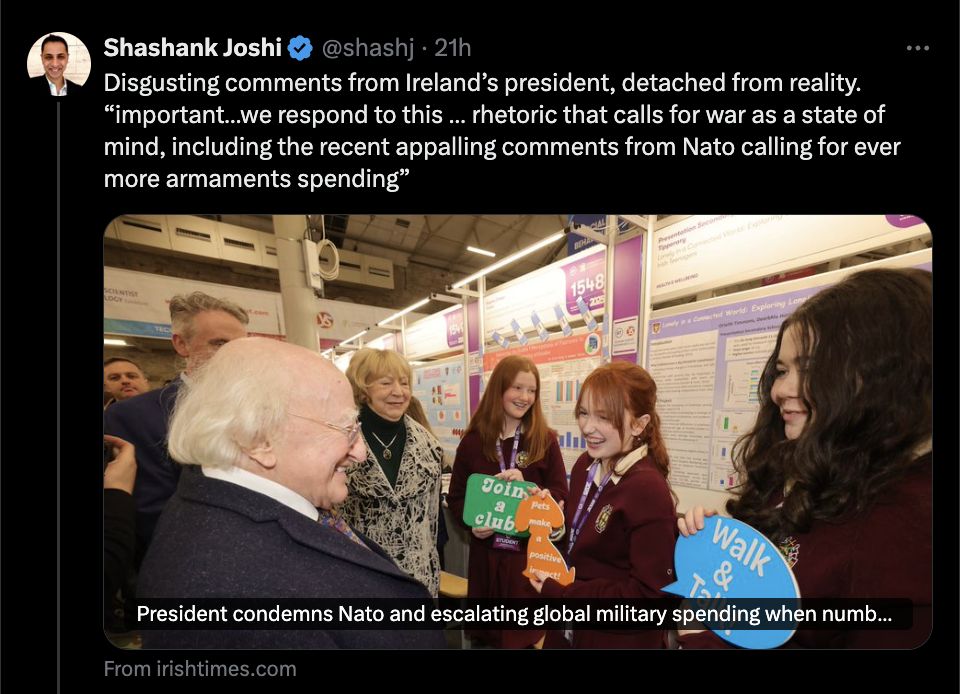
The Irish President, Michael D. Higgins, is not one to shy away from provocation. His recent critique of NATO’s call for increased defence spending, labelling it “appalling,” has sparked widespread discussion – and no small measure of controversy.
Shashank Joshi, the highly respected defence editor at The Economist, minced no words in his reaction, taking to X (Twitter), there calling Higgins’ comments “disgusting” and detached from reality. But are they truly deserving of such a visceral condemnation?
Higgins’ speech at the BT Young Scientists exhibition addressed the staggering growth of global military expenditure, which has now reached a record $2.44 trillion. He juxtaposed this against rising global hunger and poverty, painting a vivid picture of a world where resources are directed toward “death and destruction” rather than alleviating human suffering. Higgins’ rhetoric – linking the military-industrial complex to the undermining of democratic accountability and the perpetuation of fear – seems to be in line with his long-standing commitment to peace and disarmament.
Joshi, however, argues that Higgins’ remarks fail to grapple with the geopolitical realities of the moment. NATO’s increased spending, he suggests, is not a matter of choice but necessity, driven by Russia’s aggression in Ukraine and the uncertainty surrounding US commitments to European security. For Joshi, Higgins’ moralising seems detached from the practical imperatives of ensuring collective defence against an expansionist adversary.
The crux of the debate lies in whether Higgins’ comments are, as Joshi asserts, “disgusting,” or whether they represent a principled stance on a complex and deeply fraught issue.
Joshi’s use of the term “disgusting” warrants scrutiny. Disgust is a strong word, implying not merely disagreement but moral repugnance. Is it appropriate to apply such a label to comments that, while perhaps idealistic, are rooted in a genuine concern for global equity and human welfare? Higgins’ critics might argue that his framing of NATO’s actions as “appalling” invites similarly strong language in response. Yet, Higgins’ perspective – rooted in Ireland’s historical neutrality – seems entirely predictable and consistent with his broader worldview.
Is it not possible to disagree without resorting to outrage?
This brings us, then, to the matter of context. Joshi was “disgusted by claim that NATO call for higher spending is “appalling”. We are in middle of biggest war in Europe since 1945, Russia spending 7% of GDP & intent on swallowing Ukr & And uncertainty over US commitment—and he’s essentially suggesting we disarm in response to that.”
But, and here lies the rub, Higgins’ speech was not delivered to military strategists or geopolitical analysts but to a gathering of young scientists. His words were calibrated to inspire reflection on the moral dimensions of scientific and technological advancement. To interpret his remarks as a wholesale dismissal of the threats posed by authoritarian regimes or the necessity of defence spending might, arguably, be to read them out of context.
None of this is to suggest that Higgins’ position is beyond critique, and the reason this article warrants being written is that the Defence Editor of The Economist has considerable influence on military discourse and framing. Joshi’s critique has led to many people commenting similarly.
As such, Higgins’ focus on disarmament and diplomacy may indeed come across as naive to those grappling with the immediate threats facing Europe. The realities of war and peace are rarely amenable to the kind of moral absolutes Higgins champions.
But – and this is the fundamental point of this article and my engagement with Joshi on X (Twitter) – to dismiss his comments as “disgusting” risks shutting down the very debate we need to have: how to balance the demands of security with the imperatives of justice and humanity.
Ultimately, Higgins’ remarks – and the strong reactions they have provoked – reflect a deeper tension between two visions of the world. One prioritises immediate security in the face of tangible threats; the other seeks to imagine a future where such threats no longer dominate our collective imagination. Neither vision is without its flaws, but both deserve to be part of the conversation.
To brand one as “disgusting” risks impoverishing the discourse at a time when nuance and understanding are more necessary than ever.
Did you find this story interesting? Please support AOAV’s work and donate.
Donate