>Dr Bailet’s prototype 3D printer uses a granular material instead of the filaments used on Earth.
>Despite the challenges of microgravity and the vacuum of space, the materials can be drawn from a feedstock tank and delivered to the printer’s nozzle faster than other methods.
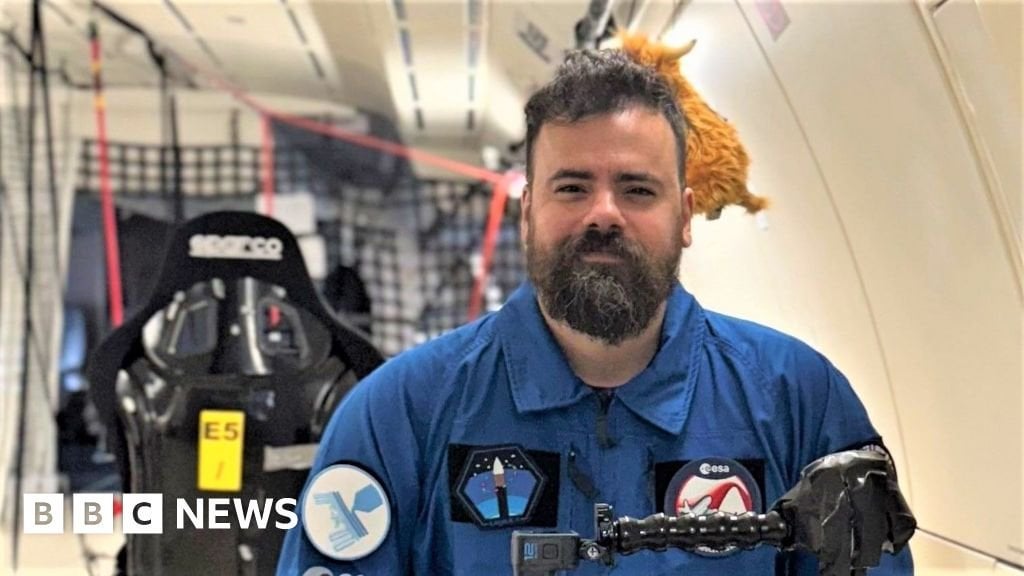
>It was tested in November as part the 85th European Space Agency parabolic flight campaign with Novespace in Bordeaux, France.
>The team took its test kit on three flights, giving them more than 90 brief periods of weightlessness at the apex of rollercoaster-like sharp ascents followed by rapid descents.
>”Seeing the technology actually working perfectly as I designed it was really breathtaking, a lot of emotions,” he said, referring to the tests on the zero gravity aircraft – known as the vomit-comet for its rollercoaster-type flight that provides 22 seconds of microgravity every time it lurches over a peak.
>”Now we know that our technology is working in a space environment and we’ll be able to do the first demonstration in space in the next milestone of our technology development.”

1 Comment
From the article
>Dr Bailet’s prototype 3D printer uses a granular material instead of the filaments used on Earth.
>Despite the challenges of microgravity and the vacuum of space, the materials can be drawn from a feedstock tank and delivered to the printer’s nozzle faster than other methods.
>It was tested in November as part the 85th European Space Agency parabolic flight campaign with Novespace in Bordeaux, France.
>The team took its test kit on three flights, giving them more than 90 brief periods of weightlessness at the apex of rollercoaster-like sharp ascents followed by rapid descents.
>”Seeing the technology actually working perfectly as I designed it was really breathtaking, a lot of emotions,” he said, referring to the tests on the zero gravity aircraft – known as the vomit-comet for its rollercoaster-type flight that provides 22 seconds of microgravity every time it lurches over a peak.
>”Now we know that our technology is working in a space environment and we’ll be able to do the first demonstration in space in the next milestone of our technology development.”