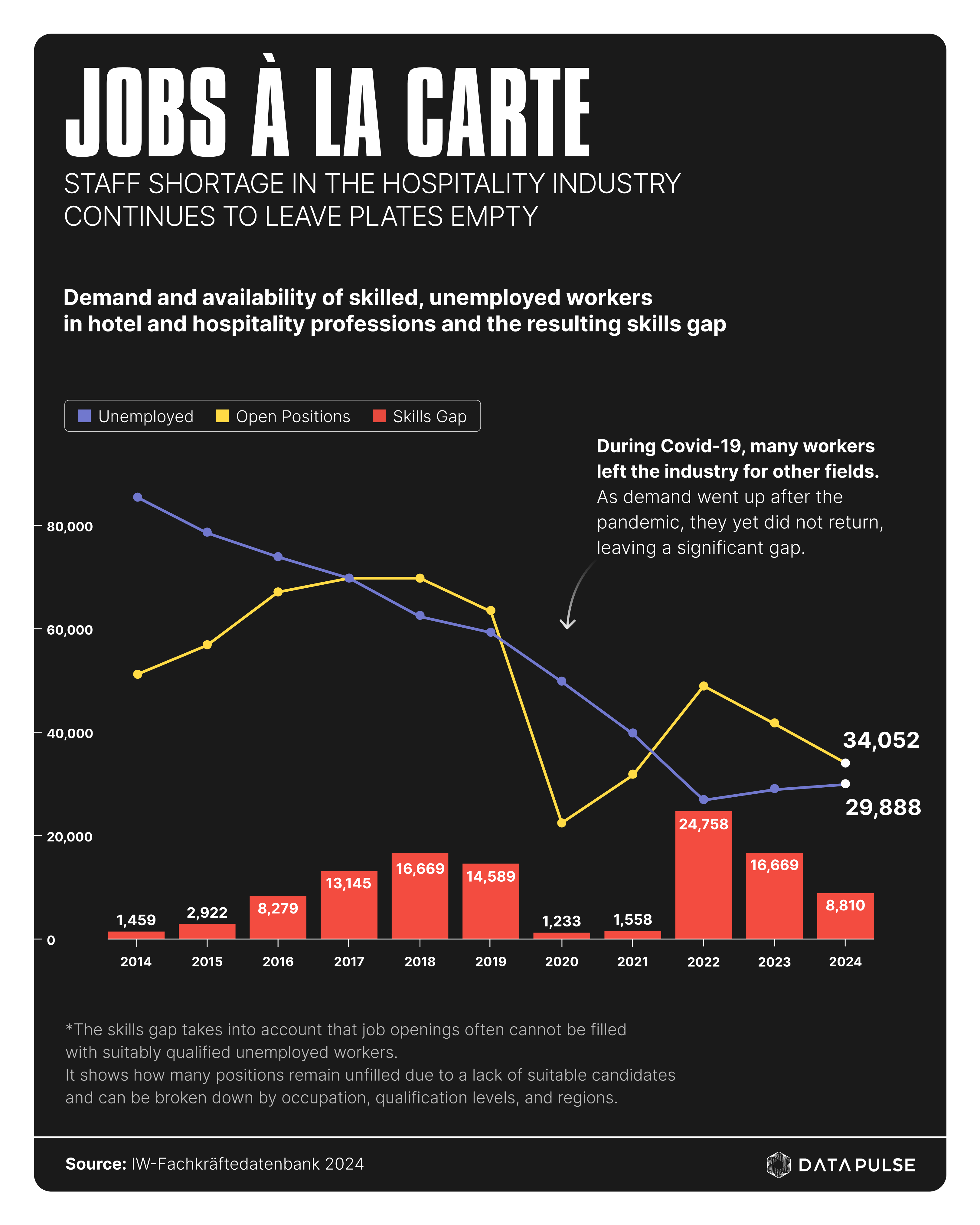
[OC] Plates stay empty – and taps run dry:
Germany’s Hospitality Industry Faces a Staffing Crisis
Posted by DataPulseResearch

![[OC] Plates stay empty – and taps run dry:
Germany’s Hospitality Industry Faces a Staffing Crisis](https://www.byteseu.com/wp-content/uploads/2025/01/ijmb38d066de1-1229x1536.png "[OC] Plates stay empty – and taps run dry:
Germany’s Hospitality Industry Faces a Staffing Crisis")
[OC] Plates stay empty – and taps run dry:
Germany’s Hospitality Industry Faces a Staffing Crisis
Posted by DataPulseResearch
1 Comment
**Article:** [**https://www.datapulse.de/en/hospitality-crisis/**](https://www.datapulse.de/en/hospitality-crisis/)
**Main data source:** [**www.kofa.de**](https://www.kofa.de/daten-und-fakten/studien/fachkraeftereport-juni-2024)
**Data:** [Google Sheets](https://docs.google.com/spreadsheets/d/1F1S3im7tIWi_F9BHS6Fls1Qvu2M_zm-VpXxT-W8oODs/edit?usp=sharing)
**Tool:** Adobe Illustrator
In 2023, *10%* of German restaurants shut their doors for good, highlighting a critical shortage of skilled workers that began during the pandemic. The numbers from Tagesschau.de tell a stark story:
* 2021: 1,558 missing hospitality professionals.
* 2022: A peak of 24,758 missing workers.
* 2024: 8,810 still unfilled positions – a drop that reflects fewer establishments, not fewer problems.
Unattractive working hours, dwindling tips, and ongoing closures are reshaping the future of the industry.