
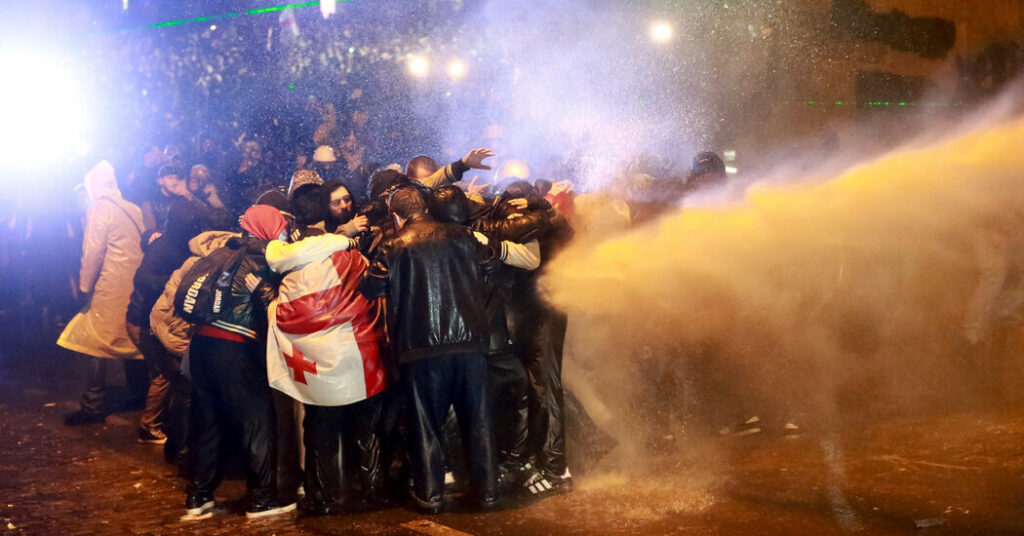
Protesters clashed with the police in the Republic of Georgia’s capital late into the night on Sunday during the fourth consecutive day of demonstrations over the recently elected government’s suspension of its bid to join the European Union.
The Black Sea country of 3.7 million has been rocked by protests since Thursday, when Prime Minister Irakli Kobakhidze announced the government would stall the process of E.U. accession — a goal enshrined in the country’s Constitution — until 2028. He also said the government would refuse all grants by the 27-member bloc, which are usually worth tens of millions of dollars annually.
As on previous nights, thousands of demonstrators, many clad in the country’s red-and-white flag, gathered in front of the Georgian Parliament building, pointing green lasers and expressing their opposition to the new government’s policy.
Later on Sunday, the police used water cannons and water from fire hydrants to disperse protesters, who shot off firecrackers and other fireworks in response, according to videos shared from the scene.
Georgia’s Interior Ministry said on Sunday morning that protests overnight had “evolved into violence.” It claimed that protesters “threw pyrotechnics” and “ignited objects” toward police officers and at Parliament, causing a fire to break out. Windows were smashed by “stones and various objects,” the ministry added in a statement, saying that protesters also had damaged protective iron barriers around the building.
More than 150 people had been arrested as of Saturday night, according to the ministry, which also said that several police officers and 42 of its employees had been hurt since the protests began.
The Associated Press reported that its journalists had seen police officers chasing and beating protesters; it was not immediately clear how many protesters had been injured.
Georgia has been gripped by political crisis since the disputed victory of the Georgian Dream party in October’s parliamentary elections. The governing party has been pivoting Georgia more toward Russia and China. Georgia’s opposition, which says the election was rigged, seeks closer ties with the West.
Georgia’s Constitution stipulates that the government “shall take all measures” to “ensure the full integration” into the European Union and NATO. The official powers of the country’s president are nominal, since the prime minister runs the government, but President Salome Zourabichvili has become a vocal supporter of the opposition and has accused the government of committing a “constitutional coup.”
She has said that she will not leave office at the end of the month, when her term expires, and that last month’s elections must be rerun. The European Union has not recognized the elections, which handed Georgian Dream a majority in the vote. The opposition, which won 61 of 150 seats in the legislature, has boycotted the new sitting of Parliament.
An aerial view of the protest in Tbilisi on Saturday. The governing party has been pivoting Georgia more toward Russia and China.
The opposition favors closer ties with the West.
Protesters burned an effigy of the prime minister on Saturday in front of the Parliament building.
Riot police officers were on the streets, and the police used a water cannon.
Protesters in Tbilisi ducked behind a makeshift barricade on Sunday.
Demonstrators set off fireworks from behind a makeshift barricade. Officials say several police officers and dozens of Interior Ministry employees have been hurt since the protests began.
One of the scores of protesters who had been detained by Saturday night.
Clashes continued into early on Sunday and resumed on Sunday night.
A masked protester by a makeshift barricade early Sunday.
The flags of Ukraine, Georgia and the European Union were displayed at the protest. The European Union has not recognized the October elections.