
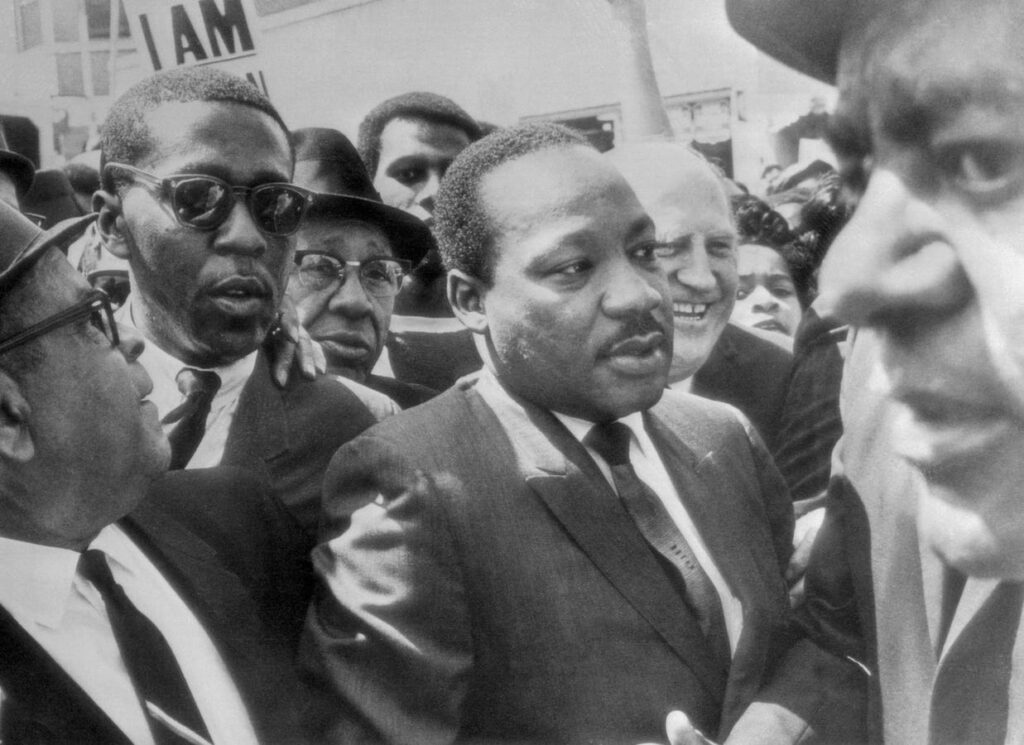
Martin Luther King Jr. spent his final days protesting the hazardous work conditions suffered by black sanitation workers in Memphis. A shadow of this problem continues today, manifesting in discussions concerning a changing climate, pollution, and America’s history of segregation.
Dr. Martin Luther King (center) is surrounded by leaders of the sanitation strike in Memphis as he … [+] arrived to lead a march in support of the striking workers in 1968. Shortly after the march began, bloody violence and looting began, forcing the National Guard to be called in.
Bettmann Archive
Redlining, the discriminatory method of encouraging geographical segregation, has resulted in a number of neighborhoods poorly adapted to the threats associated with extreme weather events and the changing climate. Compared to others, previously redlined neighborhoods have higher indoor temperatures and less outdoor shade. That’s a fact. These adverse conditions mean that residents – many of whom represent minorities – experience a higher risk of the dangerous health conditions associated with extreme heat.
Martin Luther King Jr.’s determination to publicize and change the fact that underserved and marginalized communities disproportionately experience environmental dangers remains unfinished today. More extreme weather patterns, hotter and hotter days, high levels of climate-related pollution, and progressive biodiversity loss — all of which we are seeing more of today — affect us all, but vulnerable populations even more. And these populations include seniors, the very young, the poor, those with chronic lung and heart disease, individuals being treated for cancer, those, like my former heart-lung transplant patients, on immunosuppressive medicines.
Marchers wear signs that read ‘Honor King: End Racism!’ and ‘Union Justice Now’ as they participate … [+] in the Sanitation Workers march, soon after the assassination of Dr. Martin Luther King, Jr., Memphis, TN, April 1968. (Photo by Robert Abbott Sengstacke/Getty Images)
Getty Images
Though King in those last days of his life was not speaking directly to the changing climate and weather patterns, he was speaking as to how the environment and the conditions in which people live and work do affect their lives and well-being.
In his Christmas Sermon of 1967, Martin Luther King Jr. said, “It really boils down to this: that all life is interrelated. We are all caught in an inescapable network of mutuality, tied into a single garment of destiny. Whatever affects one directly, affects all indirectly.” As a Senator focusing on national and global issues, I thought a lot about the philosophy behind this now familiar quotation. And as chair of the global board of The Nature Conservancy, with a focus on nature and its connectedness to our lives as human beings, I think about it even more.
For example, our world’s biodiversity – the range of plant and animal species on earth – benefits all life, and specifically human life, in a number of ways. According to The Nature Conservancy, “From 1970 to 2016 there was a nearly 70% average decline in populations of birds, amphibians, mammals, fish and reptiles. And by the year 2070, research suggests, the Earth could lose a third or more of its species if steps aren’t taken now to stop it.” Most people aren’t aware of this. And why does it matter?
As human beings reliant on nature and the earth’s resources for life, what we eat, drink, and breathe depends on a delicate balance achieved over thousands of years in nature. The loss of a species can destroy that precise balance and thus an entire ecosystem. The removal of one essential species can disrupt the food chain, putting strain on the species relying on it for food, while also opening the door for the over-reproduction of certain species preyed upon by it. This leads to destabilization of the ecosystem. This, of course, affects humans as well, who may either rely on threatened species for food, or who may lose crops due to an overabundance of invasive species or native species allowed free rein by biodiversity loss. Yes, it all ties back to the “inescapable network of mutuality” in King’s Christmas Sermon of 1967.
But there are other ways in which biodiversity benefits – and biodiversity loss threatens – us as human beings. One of the less regularly discussed impacts of biodiversity is from my own profession of medicine. Jay Lemery and my former medical colleague Paul Auerbach’s book Enviromedics elaborates on this subject. Many medicines (and some say most) that we trust and use today were derived from nature and all its rich biodiversity. One example is aspirin, probably the most widely consumed of all medicines.
Ancient cultures and Indigenous peoples around the world, particularly in Europe and North America, used the bark of certain species of the willow tree for its pain-relieving and anti-inflammatory effects. In the mid-1700s, Edmund Stone, a British surgeon, actively promoted using willow bark for medicinal purposes, publishing a medical paper in 1763 detailing its use for treating fevers. Stone developed a powder from this bark which, while extremely bitter, proved an effective treatment for headaches. The following century, Friedrich Bayer, a scientist living in present day Germany, fine-tuned Stone’s discovery by adding a chemical to neutralize its acidity. The consequence of his work? The aspirin that’s known and used across the globe today.
Other world-changing medicines, like quinine (a treatment for malaria), were discovered similarly. A plant would be identified as having potential medical applications, leading, after long and deliberate study, to the refinement of a new medication capable of treating diseases or ailments that had left a long trail of human suffering.
My own medical specialty of transplantation would not have flourished in the 1990s had it not been for the discovery of cyclosporine in a fungus in a soil sample from Norway. This immunosuppressant drug turned heart and lung transplantation from a long shot to a routine, life-saving innovation, stopping the body’s T-lymphocytes from attacking the new, transplanted organ. It was the discovery of this single drug — a drug derived from nature — that allowed me in my own practice of transplant surgery at Vanderbilt University Medical Center to begin doing lung transplants successfully. And millions of patients the world over have benefited.
Progressive biodiversity loss means progressive loss of potential cures for the future. As we lose plant species, we lose secrets that we could harness to cure many of the diseases that trouble us today. Concern for animal and plant species for their own sake is undoubtedly admirable; but we should also consider the impact of losing these species on the health and well-being of us human beings.
Martin Luther King Jr. continues to teach us a lot. About the conditions he addressed affecting specific populations like the sanitation workers in his final days, or just reminding us that we as a human species are interconnected with each other and the world around us. King took on the big issues. He makes us think about vulnerable populations and our responsibility to act. It’s our job to continue to apply those same principles he espoused to the issues we face today. And, I believe, our changing climate and biodiversity loss are just that.