
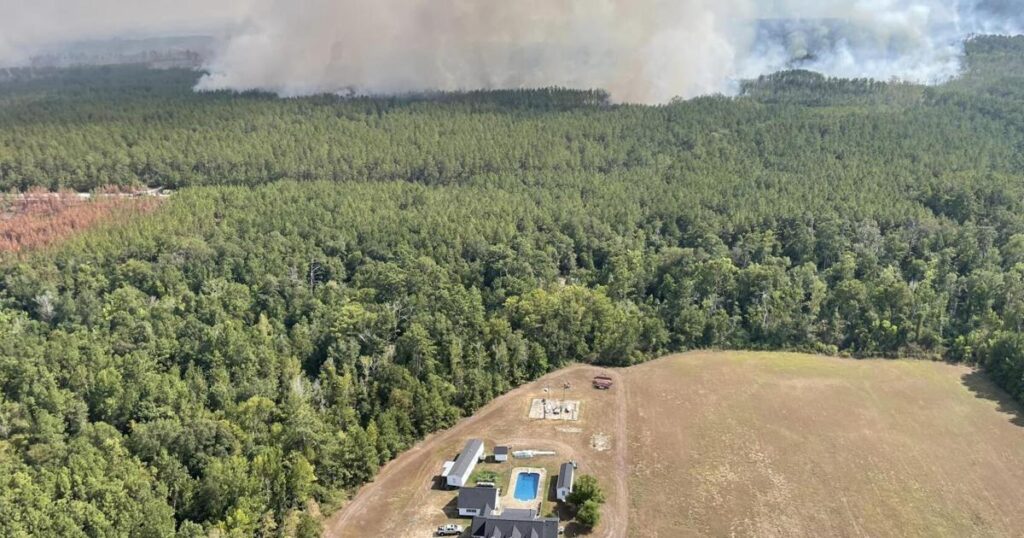
As wildfires consume neighborhoods on the other side of the country in Los Angeles, displacing entire communities and overwhelming local resources, forestry experts and scientists say the devastation should be a wake-up call for the South, including Louisiana.
While the western part of the United States experiences some of the most damaging wildfires in the nation, the South endures more wildfires per year than any other region. And Louisiana, despite its swampy geography across much of the state, is not exempt from this trend.
“To me the takeaway from the Los Angeles fires is just how unpredictable and how rapidly the fires can spread,” Jay Grymes, Louisiana’s state climatologist, said.
In 2023, during an extreme period of summer drought, Louisiana saw more than 1,300 wildfires. The largest fire that year, the so-called Tiger Island Fire, burned more than 31,000 acres and wreaked millions of dollars in damage in the largely rural west of the state. In contrast, the deadly Palisades Fires in Los Angeles had burned less than 24,000 acres as of Thursday, but could inflict more than $50 billion in damage.
“Even here, where water is normally in a fair amount of abundance, it doesn’t take long for drought to take hold,” Grymes said.

Firefighters from New Mexico walk down a dusty road in search of Tiger Island Fire hotspots near Merryville on Wednesday, Aug. 30, 2023.
STAFF PHOTO BY CHRIS GRANGER
According to an LSU study, the wildfire monetary losses in Louisiana are estimated to increase more than 100% by 2050 compared to 2010 values.
Supratik Mukhopadhyay, an LSU professor in the department of environmental sciences, explained how climate change contributes to wildfire conditions.
“Unseasonal drought means you have this brush accumulation happening in the forest that should not have happened,” he said. “Now, we have no shortage of lightning strikes in Louisiana. So once the conditions are created, then one lightning strike can light up the fire.”
“We need to get prepared for wildfire in the South,” he said.
Greater risk
Louisiana averages between 700 and 1,000 wildfires per year, Louisiana Department of Agriculture and Forestry Commissioner Mike Strain said, a figure directly related to drought conditions.
“Over the years, we have seen the number of wildfires increase,” Strain said.
In 2020, there were 328 fires; in 2021, there were 441; and in 2022, there were 1,211 before the high in 2023. Last year, however, saw a decrease in Louisiana wildfires with 587 burning 5,798 acres, for an average fire size of around ten. Strain said the department aims to maintain wildfires between nine to 11 acres.
There are far more wildfires in the western part of the state, Strain said, but the Florida parishes on the Northshore are also prone to flame.
“The concentration of the timber, then you have more wildfires,” he said.
In addition to drought, other environmental factors are increasing wildfire risk to the region.
Chelsea Ealum, communications director for the Southern Group of State Foresters, said the Southeast region is also at greater risk of wildfires due to the debris accumulated from recent hurricanes. The process is cyclical: warmer ocean temperatures are powering larger storms, and the flammable debris they leave behind increases wildfire risk.
“The downed trees from the hurricanes and storms and tornadoes, we’re prone to all sorts of fun stuff here in the South,” Ealum said. “So we’ve got a lot of burnable debris that’s continuing to dry out on the ground.”
A major outbreak of southern pine beetles and other invasive pests in the Southeast similarly lead to timber loss, further exacerbating fire risk.
And once the fire takes hold, the heat can create microscale wind, furthering the flames and movement of the disaster, Grymes explained.
“Fires create their own weather,” he said. “That makes controlling or trying to manage the fire that much more difficult.”
Wildland urban interface
For the cohort of Southern forestry agencies, another unique wildfire concern is the high percentage of private ownership of forests in the region. In the South, 86 percent of forested land is privately owned. On the Pacific Coast, this figure is 39 percent, and in the Rocky Mountain area, only 22 percent.
The area where unoccupied wildland and communities meet, called the “wildland urban interface,” has grown in the South by nearly 25 million acres since 1990, according to the Southern Group of State Foresters. That has largely to do with residents moving farther out into exurbs that were once primarily rural.
Water is poured on hotspots at the Tiger Island Fire Tuesday, August 30, 2023. (Photo by Chris Granger | The Times-Picayune | NOLA.com)
Staff photo by Chris Granger NOLA.com | The Times-Picayune
“It’s really important that we work with our private landowner base as well as local communities to make sure that the wildfire risk is being mitigated in those areas, but also on the community side,” Ealum said.
This might include financially or logistically helping clean up debris to minimize wildfire risk on their property.
“It’s useful both in terms of reducing wildfire risk, but also helping the landowner be able to maintain their forestland in such a way that they are not more apt to sell it,” Ealum said.
‘We are very aggressive’
To combat intensifying disasters, the Louisiana forestry agency, in charge of handling wildfires, has expanded its firefighting arsenal of dozer units and other equipment across the state.
Day to day, there are 150 active wildland firefighters statewide. In 2024, 87 volunteer fire departments were awarded grants, up from a historical average of 65.
In addition to bolstering its firefighting equipment and personnel, the agency also works with the state fire marshal’s office to issue statewide burn bans during fire-prone conditions. It also coordinates with the governor’s office on outreach and educational programs “to urge responsibility, especially when those conditions are really dry and high winds,” Strain said.
Half burned, half green pine trees along the roadway where a logging truck passes through the Tiger Island Fire area near Merryville, Louisiana on Tuesday, August 30, 2023. (Photo by Chris Granger | The Times-Picayune | NOLA.com)
Staff photo by Chris Granger NOLA.com | The Times-Picayune
While the forestry agency cannot control natural phenomena like lightning or wind, it can punish arsonists literally stoking flames in a vulnerable environment. LDAF made 17 arson-related arrests last year.
“We are very aggressive in investigating and making those arrests and thoroughly prosecuting,” Strain said.
Fighting fire with fire
Another key tactic is fire. Though it may be counterintuitive, low-grade fires are one of the best ways to prevent destructive wildfires. Fires occur naturally in the Southeast, and the “fire adapted” vegetation in the region depends on fire to thrive, Ealum explained.
“If the human species was not around, fires would come through every now and again, very low to the ground and burn off that excess vegetation,” she said.
Over the past few decades, “controlled burns” or “prescribed fire” has grown as an acceptable forest management tool for wildfire mitigation, Ealum explained. The terrain of the Southern region — mostly flat land — is more conducive to the application of prescribed fires than other parts of the country.
“It’s a very good management practice,” Strain said. “The appropriate use of prescribed fire reduces the extent and intensity of wildfires.”