
The Spanish Navy has recently carried out an extensive naval exercise, showcasing the submarine S-81 Isaac Peral in a prominent role within the waters near Cartagena.
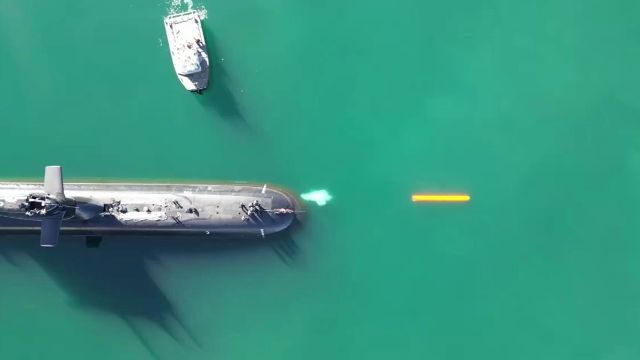 Video screenshot
As the first vessel of the advanced S-80 series, the S-81 was joined in this high-profile operation by the frigates Almirante Juan de Borbón and Numancia, the rescue and salvage ship Neptuno, and an SH-60B helicopter from the Tenth Air Squadron. This ensemble highlighted the Navy’s emphasis on integrated maritime defense capabilities.
According to the Navy, this exercise was a vital component of the operational assessment of the S-81. This evaluation is not merely routine but a pivotal process designed to scrutinize the submarine’s technical and operational capacities.
The goal is to ensure the S-81’s systems and performance align seamlessly with the operational demands and that it can function effectively alongside other naval units. This rigorous testing phase seeks to certify that the submarine meets all established operational standards, setting the stage for its role in future missions.
Looking ahead, the operational qualification of the S-81 is slated for the second quarter of 2025. This next phase will be particularly significant, as it will measure both the training level of the crew and the operational performance of the submarine’s equipment and onboard systems.
The comprehensive nature of these evaluations underscores the Navy’s commitment to maintaining a cutting-edge underwater fleet.
During the exercise, the frigate Numancia played a crucial role by testing its anti-submarine warfare capabilities. This involved launching training torpedoes, not only from the frigate itself but also from the SH-60B helicopter.
These drills were designed to enhance the coordination and efficiency of multiple naval assets working in unison against potential underwater threats.
As preparations for the endurance cruise of the S-81 reach their final stages, this mission remains a cornerstone of the submarine’s activities for 2025. This lengthy deployment is expected to push the limits of the S-81, confirming its readiness for sustained operations in various maritime environments.
Concurrently, the Navy is refining the details for the S-81’s upcoming debut in live-fire maneuvers, a critical milestone that will test the submarine’s combat readiness under realistic conditions.
In an exciting development, the waters south of the Canary Islands have been chosen as the initial theater for a major exercise scheduled for mid-June. If all goes according to plan, the S-81 will play a pivotal role in this drill.
The anticipation surrounding this event is palpable, as it will feature the live firing of a torpedo, targeting a decommissioned ship. This exercise will not only demonstrate the S-81’s firepower but also validate the Navy’s strategic use of retired vessels as practice targets.
The announcement of the S-81’s involvement in these waters was made by Lieutenant General Julio Salom, Commander of the Canary Islands Military Command, during his speech at the recent Military Easter celebrations. His revelation has heightened interest in the submarine’s capabilities and the strategic objectives of the upcoming maneuvers.
By integrating advanced technology and rigorous training, the Spanish Navy is clearly positioning the S-81 Isaac Peral as a cornerstone of its future underwater defense strategy.
This exercise, along with the planned operational qualifications and live-fire tests, underscores the Navy’s dedication to maintaining a formidable and versatile fleet, prepared to meet the challenges of modern naval warfare.
The Spanish submarine S-81 Isaac Peral, the lead vessel of the S-80 Plus class, represents a significant advancement in non-nuclear submarine technology. Developed by Navantia for the Spanish Navy, the S-81 Isaac Peral is a state-of-the-art diesel-electric submarine with advanced air-independent propulsion [AIP] capabilities.
The submarine measures approximately 81 meters in length, with a beam of 11.68 meters and a draft of 6.2 meters, offering a displacement of around 2,965 tons when surfaced and 3,814 tons when submerged.
The propulsion system of the S-81 includes a hybrid combination of diesel engines and the AIP system, which utilizes a bioethanol fuel cell technology.
This system provides the submarine with enhanced underwater endurance, allowing it to remain submerged for extended periods without the need to surface for air, a key advantage over traditional diesel-electric submarines. The AIP system significantly reduces the submarine’s acoustic signature, making it harder to detect by sonar.
The S-81 is equipped with state-of-the-art sensors and combat systems designed to enhance situational awareness and combat effectiveness. Its sonar suite includes an advanced cylindrical array sonar, flank array sonar, and towed array sonar, providing comprehensive underwater surveillance and target detection capabilities.
The integration of the Indra Sistemas combat system further boosts its ability to process and analyze the data from these sensors, delivering a complete operational picture.
The weaponry of the S-81 includes six 533 mm torpedo tubes capable of launching a variety of torpedoes, mines, and missiles. It is compatible with the DM2A4 heavyweight torpedo, and the UGM-84 Harpoon anti-ship missile, and can also deploy special forces through its torpedo tubes.
Additionally, the submarine can carry up to 12 torpedoes or a combination of torpedoes and missiles, ensuring a versatile response to various threats.
The navigation and communication systems on the S-81 are equally advanced, featuring GPS, inertial navigation systems, and secure satellite communication links. These systems allow for precise navigation and real-time data exchange with command units, essential for modern naval operations.
The submarine’s periscope and photonic mast are fitted with high-resolution cameras and infrared sensors, providing enhanced visual capabilities without compromising stealth.
The S-81 Isaac Peral also boasts a high level of automation, which reduces the required crew size to about 32 sailors, including 8 officers.
The design prioritizes crew comfort and safety, with advanced life-support systems, including CO2 scrubbers and oxygen generators, allowing for longer missions. The submarine is also equipped with an escape and rescue system, reflecting the latest safety standards.
In summary, the S-81 Isaac Peral is a cutting-edge platform that combines stealth, endurance, and firepower, making it a formidable asset for the Spanish Navy and a significant leap in conventional submarine design. Its integration of modern technologies and systems positions it among the most advanced non-nuclear submarines in the world.
***
Follow us everywhere and at any time. BulgarianMilitary.com has responsive design and you can open the page from any computer, mobile devices or web browsers. For more up-to-date news, follow our Google News, YouTube, Reddit, LinkedIn, and Twitter pages. Our standards: Manifesto & ethical principles.