
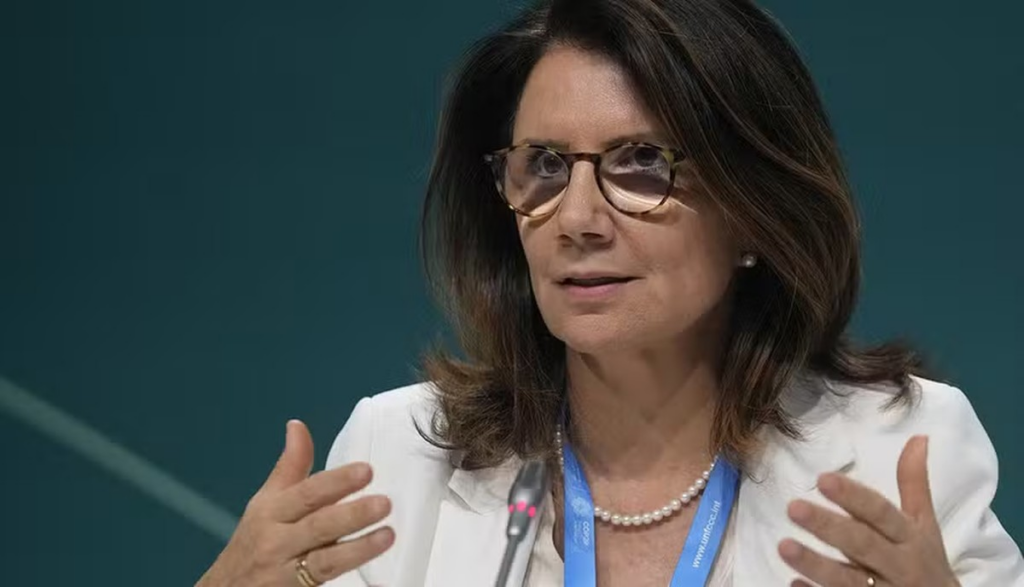
“COP30 will be the first United Nations climate conference to occur after surpassing the 1.5ºC global warming limit,” says Ana Toni, Secretary for Climate Change at the Ministry of the Environment (MMA). “This is no longer a matter of the future; it’s happening now. We’re all aware of it. We know that 2024 was the hottest year on record.”
In an interview with Valor, Ana Toni discusses the key themes and challenges of COP30. “We are already experiencing the impacts of climate change, and adaptation has become a necessity,” says the economist and PhD in political science. “At COP30, adaptation must take center stage. Decarbonization alone is not enough.”
One of the primary topics for negotiation at the UN climate conference, set to take place in Belém this November, will be implementing the agreement reached at COP29 in Baku—namely, establishing a $1.3 trillion annual flow of climate finance by 2035 from various public and private sources.
Below are highlights from Valor’s interview with Ana Toni:
Valor: What themes have already been established as mandates for Brazil at COP30?
Ana Toni: Every COP operates around three main pillars. The first is negotiation. The second, which continues to gain prominence, is the action agenda, engaging the private sector and broader society. The third is mobilization—how people connect with and participate in the COP. For COP30, we’re approaching these three pillars alongside the legacies we aim to leave. These include international, national, and local legacies, the latter focusing on the Amazon and Belém. Negotiation remains central, and a structured agenda has already been programmed.
Valor: What’s included in that agenda?
Ms. Toni: Among the key topics for Belém, the first is setting indicators for adaptation objectives. We must define what these objectives are. Another priority is the just transition. A working group has been addressing this issue for two years, and Belém will serve as a midpoint. We need to solidify the groundwork so that it can be finalized at the next COP, likely in Australia. Additionally, we have a mandate from Baku to initiate a roadmap for the $1.3 trillion in climate finance, targeting public and private contributions by 2035. Other critical issues will also be on the table.
Valor: Which additional issues are on the agenda?
Ms. Toni: A fourth issue likely to spark debate is Article 2.1c of the Paris Agreement, which calls for all financial flows to align with its implementation goals. Other pressing matters include operationalizing Article 6, which addresses market mechanisms like carbon credits, and ensuring transparency in climate actions.
Valor: Regarding the roadmap to the US$1.3 trillion target by 2035, what can be achieved at COP30?
Ms. Toni: Let’s examine that. Brazil demonstrated strong leadership during the G20, where climate considerations were integral to financial discussions. We mapped global initiatives aimed at mobilizing climate resources, including proposals such as new taxes for the super-rich and fossil fuels, reforms in multilateral banks, debt swaps, and addressing barriers to financial access. While those discussions were framed within the G20, we now face a more complex task—building a comprehensive roadmap at COP, which involves 194 countries. However, Brazil already has a solid foundation from the G20 experience that it can bring to the table.
Valor: Do you see adaptation gaining traction? What would these indicators look like?
Ms. Toni: Absolutely. We need concrete indicators tied to the adaptation objectives established during COP in Dubai, specifically in areas like food security, health, and cities. For instance, in food security, indicators could include metrics such as the volume of available food, the number of people served, and calorie availability per capita. These indicators would enable the global community to track progress and determine whether we’re meeting adaptation goals.
Valor: What form might this take?
Ms. Toni: COP30 will be historic, as it marks the first conference after surpassing the 1.5ºC warming threshold. This is no longer a matter of the future; it’s happening now. We’re all aware of it. We know that 2024 was the hottest year on record and that this past decade was the hottest in history. Climate change is here, and we know we must adapt. It’s no longer a matter of choice or prioritizing adaptation versus mitigation—both are equally critical. COP30 must elevate adaptation to the same level of importance mitigation has already achieved. At COP30, adaptation must take center stage. Decarbonization alone is not enough; we have to adapt. To succeed, adaptation must go beyond theoretical goals and become tangible.
Valor: There’s been speculation that COP30 will focus heavily on countries’ climate commitments, particularly the NDCs [Nationally Determined Contributions].
Ms. Toni: No, this will not be the COP of NDCs, nor will it be solely focused on forests.
Ms. Toni: NDCs are not negotiated at COPs. It’s not as though we sit down to hash out China’s or the United States’ NDCs during a climate conference—that’s not how it works. These are commitments determined at the national level and submitted to the Climate Convention, typically by February. For instance, Brazil and the United Kingdom have already submitted their NDCs. Some countries will meet the deadline, while others may not. At COP30, we’ll review the collective set of NDCs, assess how far they bring us toward the 1.5ºC goal, and strategize on how to accelerate progress. Robust and ambitious NDCs are essential, but they depend on national actions, which is why mobilization is so critical.
Valor: Why isn’t COP30 considered the forest COP?
Ms. Toni: Naturally, forests will be a key topic—this COP is being held in the heart of the Amazon. However, forests are part of the solution, not the problem. Let’s not forget that 90% of global emissions come from energy, not deforestation. Forests are a vital tool in combating climate change. Brazil’s deforestation rates are dropping significantly, largely thanks to Minister Marina Silva’s efforts. The conversation should focus on valuing reforestation, forest preservation, and biodiversity, including financial incentives. Forests offer an urgent and cost-effective climate solution.
Valor: What about climate finance, which has been a sticking point at many COPs?
Ms. Toni: Historically, financing wasn’t a central agenda item at climate COPs. That changed at COP29 in Baku, where it was addressed for the first time. While opinions differ on the outcome, there was an agreement. Financing has posed challenges at other environmental COPs, such as the biodiversity COP and the desertification COP. However, climate COPs have shown that multilateral governance remains the preferred platform for countries to negotiate. Despite geopolitical tensions, this framework enables collective agreements. Climate change is a shared issue; no single country can solve it in isolation. If one country acts but others don’t, everyone is still impacted. That said, progress on funding is far too slow. We need to unlock that. The Global South, for example, is incredibly ambitious about adopting low-carbon, resilient, and adaptive development models but lacks the financial resources to implement them. It’s not about a lack of will—it’s about a lack of means. This is why unlocking climate finance is absolutely critical.