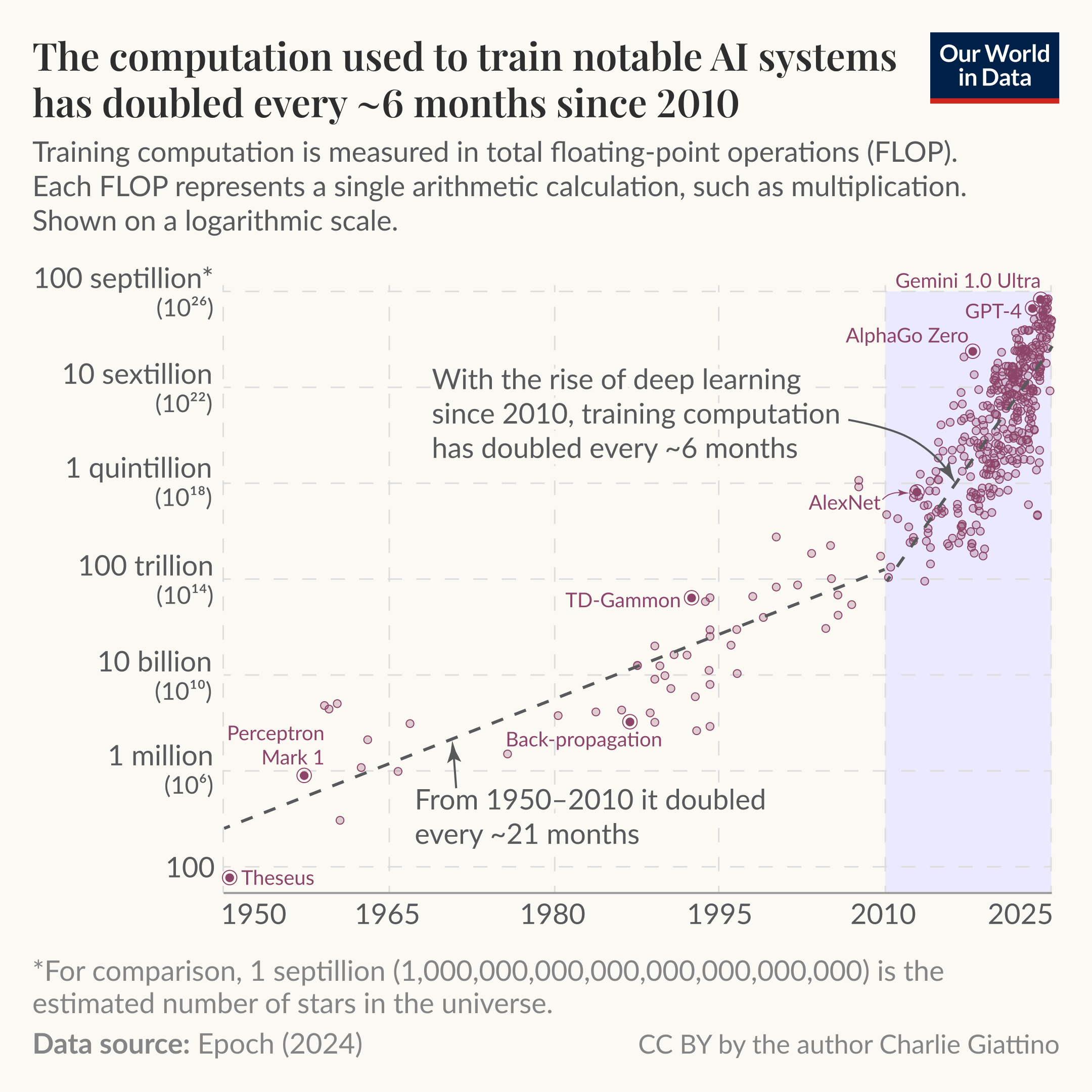
[OC] Since 2010, the training computation of notable AI systems has doubled every six months
Posted by cgiattino

![[OC] Since 2010, the training computation of notable AI systems has doubled every six months](https://www.byteseu.com/wp-content/uploads/2025/01/u02ql12ldbee1-1536x1536.png "[OC] Since 2010, the training computation of notable AI systems has doubled every six months")
[OC] Since 2010, the training computation of notable AI systems has doubled every six months
Posted by cgiattino
2 Comments
Data source: The data comes from [Epoch](https://epoch.ai/data/notable-ai-models), a research organization that tries to understand where AI might be headed by analyzing trends in computation, data, investments, and more. They maintain one of the most comprehensive datasets on AI available.
Tools used: I downloaded an .svg version of the chart and data from Epoch, and then used Figma to remix it in our style at Our World in Data (where I work).
If you’re interested, you can [read more](https://ourworldindata.org/scaling-up-ai) about how scaling AI systems has driven a lot of recent progress.
It’s interesting how the results aren’t getting much better with size. But a lot of AI companies are still using labor from Africa for most of their projects which doesn’t seem to be panning out. It makes you wonder how they will shift over as the gig economy doesn’t really work for this. I guess it means that these companies will likely need to start putting billions into hiring academics (phds, fellows, etc.) In order to work towards iteratively improving their tech.
Given how large the language barriers can be and the accreditation of universities. I guess that really only means Europe and America benefit from this kind of transaction. But localizations in other languages seem interesting I wonder if that means we’ll see foreign AI companies or if the cost is too large for this to even occur. Given how much money likely would be required.
It really makes you think of the implications of all of this when you consider that the majority of Post Docs and PhDs come from a select group of universities. How does this impact other groups will it?
1 in 8 PhDs come from 5 Institutions. The number rises when you include a few more.
“80% of professors at PhD granting universities attended the same handful of colleges.”
[https://www.highereddive.com/news/Berkeley-Harvard-Michigan-Wisconsin-Stanford-most-faculty/](https://www.highereddive.com/news/Berkeley-Harvard-Michigan-Wisconsin-Stanford-most-faculty)