
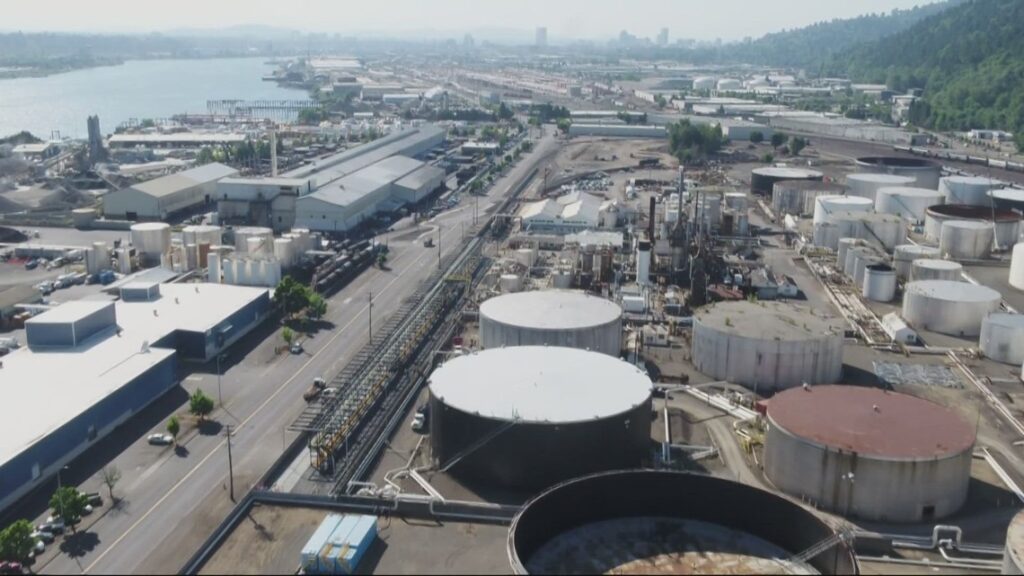
The expanded and almost entirely new council could shake up the long-running battle over the future of Zenith’s fuel export terminal on the Willamette River.
PORTLAND, Ore. — Portland’s new city council jumped into a long-running and contentious political battle on Tuesday: the future of Zenith Energy’s fuel export terminal on the Willamette River. There were no votes during back-to-back work and listening sessions, but the proceedings offered a first glimpse of where the new councilors come down on the issue.
The terminal stores large quantities of crude oil waiting to be shipped out via pipelines and tankers, and has long faced intense opposition from environmental groups who argue that the facility is out of step with Portland’s climate goals and endangers the city by bringing in crude oil on trains running through densely populated areas.
The facility is also part of the broader Critical Energy Infrastructure Hub, which stores about 90% of Oregon’s gas and diesel supplies and has drawn increasing public concern because it sits along a stretch of shoreline that is highly vulnerable to soil liquefaction, creating the potential for a catastrophic environmental disaster when the next major earthquake strikes.
Zenith needs to renew its state air quality permit to continue operating and build a planned expansion, and the process requires a Land Use Compatibility Statement (LUCS) from Portland. The city denied the LUCS in 2021 but reversed course in 2022 after Zenith pledged to transition the facility to renewable fuel within five years.
But in December, the state fined Zenith for expanding its operation to two adjacent leased docks before obtaining proper authorization, and threw out the 2022 LUCS because it didn’t account for the use of the docks. The state ordered the company to get a new LUCS by Feb. 4, kicking the issue back to the city just as the new council took office.
Public testimony was overwhelmingly opposed to Zenith on Tuesday, both in the work session and the listening session, with many activists and environmental groups arguing that the switch to renewable fuel wouldn’t solve the underlying safety concerns, and calling on the council to deny the LUCS and block any expansion of the terminal.
But a large part of the councilors’ discussion revolved around whether they have any meaningful power to step in.
Deputy city administrator Donnie Oliveira said the LUCS process has to be treated as a narrow administrative decision, and if city staff find that Zenith’s new application complies with existing city code, they would be obligated to send that determination to the state.
Councilor Dan Ryan, the sole continuing member from the previous iteration the council, explained that he used his power as then-commissioner in charge of the Bureau of Development Services to order the LUCS denial in 2021, but the councilors don’t have any administrative authority under Portland’s new system of government.
Multiple councilors said they wanted to make those rules clear to the public and get a better sense of what levers are available for the council to pull under the new system.
“I’m getting emails from folks who think that we have the ability to stop this,” said Councilor Loretta Smith. “And if we don’t, we need to make it very clear that we don’t, as a body, have the ability to do this.”
Staff from Zenith gave a presentation at the work session, casting the company’s facility as an essential piece of the effort to switch Oregon to renewable fuels by providing a space for imported fuel to be stored for distribution throughout the state, and stressing the company’s commitment to completely giving up fossil fuels.
Council discussion was fairly limited outside of the question of whether the council had the authority to deny the LUCS, with only a few councilors weighing in directly. Councilor Eric Zimmerman said he broadly supported the transition to renewable fuels but felt that the placement of the terminal site didn’t fit with Portland’s climate and safety goals.
Councilor Angelita Morillo expressed skepticism about Zenith’s planned transition to renewable fuels, arguing that a renewable fuel spill in the Willamette River could be even worse than a crude oil spill because different renewable fuels sink at different rates, making cleanup more complicated.
Oliviera replied that renewable fuel itself doesn’t mitigate the environmental risks, but Zenith’s renewable transition plan would increase safety by removing several older storage tanks and ensuring that any newly built tanks for renewables would be seismically resilient.
Councilor Olivia Clark said the Zenith issue highlighted some contradictions in city policy, and councilors Sameer Kanal and Mitch Green both called for a more robust public process around the terminal.
Oliviera pointed to a planned council work session in March that will tackle the overall Critical Energy Infrastructure Hub and its environmental risks, suggesting that the council would have more options at that point in terms of setting new policy.