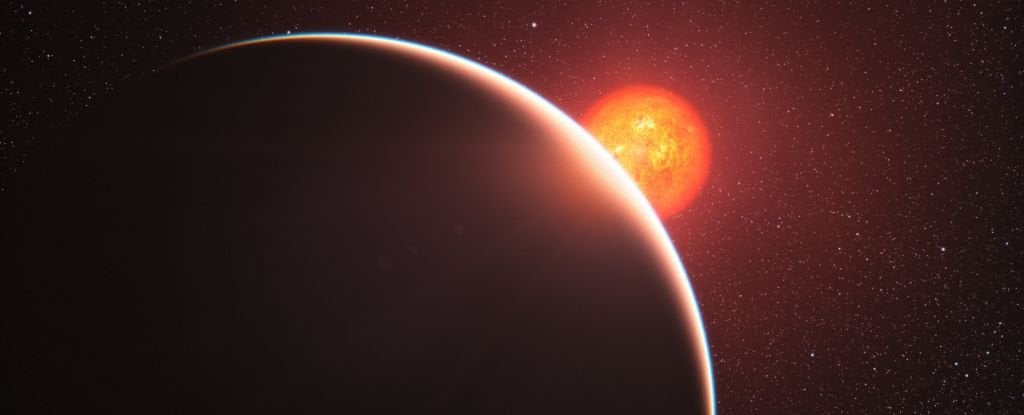
New Kind of Planet Unlike Anything in Our Solar System Discovered
https://www.sciencealert.com/new-kind-of-planet-unlike-anything-in-our-solar-system-discovered

New Kind of Planet Unlike Anything in Our Solar System Discovered
https://www.sciencealert.com/new-kind-of-planet-unlike-anything-in-our-solar-system-discovered
6 Comments
Click-bait headline, it’s not it Solar system at all and it’s just a large Venus-like planet (a super-venus)
This isn’t that out of the ordinary because we’ve discovered other planets that are larger than would be expected when compared to the planets in our solar system.
I’m getting really tired of these sensationalized headlines. Especially when the JWST is actually discovering cool shit in a regular basis.
There’s nothing wrong with reporting on these kinds of these accurately.
Two things about this that the papers make clear: first, the detection of CO2 is marginal, and right on the edge of statistical significance. Second, the formal result from trying to model the resulting spectrum is effectively a pure CO2 atmosphere, which seems hard to believe for an object this massive.
If this is true, this would be a very surprising result and provide a great challenge for planet formation and evolution models, but the two papers describing the result are very up front about the difficulty in making this measurement and the need for more observations to confirm (or refute) it.
Generally speaking GJ 1214b (the planet in question) is a bit of a puzzle, because the transmission is almost perfectly flat with no spectral features. It has proven difficult to construct realistic atmosphere models that convincingly replicate the flatness seen in the data.
Can we please stop with these click-bait titles?
What would a lower atmosphere rich in metal be like?
I saw it was ScienceAlert and clicked anyway. Why did I do that?
Aren’t a lot of planet unlike the ones in our solar system…?