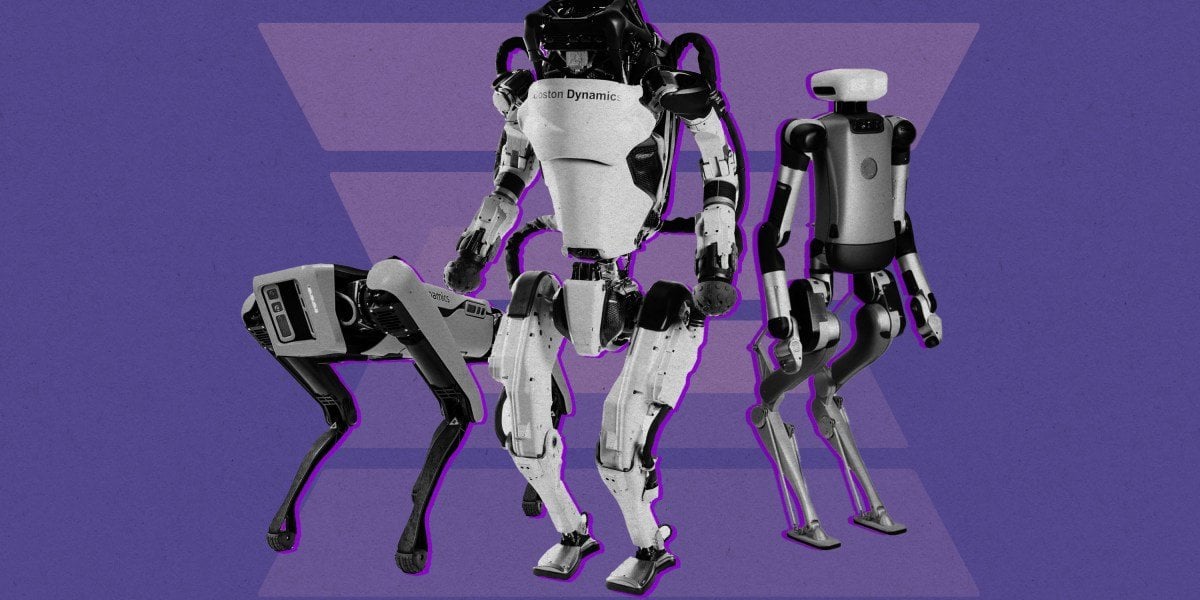
What’s next for robots – With tests of humanoid bots and new developments in military applications, the year ahead will intrigue even the skeptics.
https://www.technologyreview.com/2025/01/23/1110496/whats-next-for-robots/

What’s next for robots – With tests of humanoid bots and new developments in military applications, the year ahead will intrigue even the skeptics.
https://www.technologyreview.com/2025/01/23/1110496/whats-next-for-robots/
5 Comments
From the article
>The race to build humanoid robots is motivated by the idea that the world is set up for the human form, and that automating that form could mean a seismic shift for robotics. It is led by some particularly outspoken and optimistic entrepreneurs, including Brett Adcock, the founder of Figure AI, a company making such robots that’s valued at more than $2.6 billion (it’s begun testing its robots with BMW). Adcock recently told [*Time*](https://time.com/7012726/brett-adcock/?utm_source=chatgpt.com), “Eventually, physical labor will be optional.” Elon Musk, whose company Tesla is building a version called Optimus, has said humanoid robots will create “a future where there is no poverty.” A robotics company called Eliza Wakes Up is taking preorders for a $420,000 humanoid called, yes, [Eliza](https://elizawakesup.ai/robotics).
Also from the article
>Another initiative—sparked in part by the Replicator project, the Pentagon’s plan to spend more than $1 billion on small unmanned vehicles—aims to develop more autonomously controlled submarines and surface vehicles. This is particularly of interest as the Department of Defense focuses increasingly on the possibility of a future conflict in the Pacific between China and Taiwan. In such a conflict, the drones that have dominated the war in Ukraine would serve little use because battles would be waged almost entirely at sea, where small aerial drones would be limited by their range. Instead, undersea drones would play a larger role.
>All these changes, taken together, point toward a future where robots are more flexible in how they learn, where they work, and how they move.
Tests? Literally on sale: [https://uk.robotshop.com/products/unitree-g1-humanoid-robot-uk](https://uk.robotshop.com/products/unitree-g1-humanoid-robot-uk)
I’m expecting robotics and AI to enter society very aggressively and even for me thats about 5 years ahead of expectations. That one is basically an industrial unit but the domestic model will not need many prototypes and will be here quickly.
Once those exist you are immediately into the world of replacing jobs like plumbing even. As soon as an AI can reliably understand context and appropriate actions its done. Training the models and building the model store will take no time at all.
Hey, thanks for sharing our story!
**Here’s even more context from the article:**
In the many conversations I’ve had about robots, I’ve found that most people tend to fall into three camps. Some are upbeat and vocally hopeful that a future is just around the corner in which machines can expertly handle much of what is currently done by humans, from cooking to surgery. Others are scared: of job losses, injuries, and whatever problems may come up as we try to live side by side.
The final camp, which I think is the largest, is just unimpressed. We’ve been sold lots of promises that robots will transform society ever since the first robotic arm was installed on an assembly line at a General Motors plant in New Jersey in 1961. Few of those promises have panned out so far.
But this year, there’s reason to think that even those staunchly in the “bored” camp will be intrigued by what’s happening in the robot races. Here’s a glimpse at what to keep an eye on:
* **Humanoids are put to the test:** If 2024 was the year of unsettling humanoid product launch [videos](https://www.technologyreview.com/2024/08/27/1103035/a-skeptics-guide-to-humanoid-robot-videos/), this year we will see those humanoids put to the test, and we’ll find out whether they’ll be as productive for paying customers as promised.
* **Learning from imagination:** Nvidia, the world’s most valuable company, has long aimed to meet the need for robot training data with simulated worlds. In December, the company released what it’s calling a “world foundation model.” Called Cosmos, the model has learned from 20 million hours of video—the equivalent of watching YouTube nonstop since Rome was at war with Carthage—that can be used to generate synthetic training data. Teaching robots through AI and simulations isn’t new, but it’s going to become much cheaper and more powerful in the years to come.
* **A smarter brain gets a smarter body:** Plenty of progress in robotics has to do with improving the way a robot senses and plans what to do—its “brain,” in other words. Those advancements can often happen faster than those that improve a robot’s “body,” which determine how well a robot can move through the physical world, especially in environments that are more chaotic and unpredictable than controlled assembly lines. The military has always been keen on changing that and expanding the boundaries of what’s physically possible.
I don’t need one to do crazy backward flips. I just want one that will do chores and repairs around the house.
I feel like room clearing robots are the next thing. Imagine 5 humanoid robots barrelling through a building with no caution, all clearing.
Wether autonomous or not