
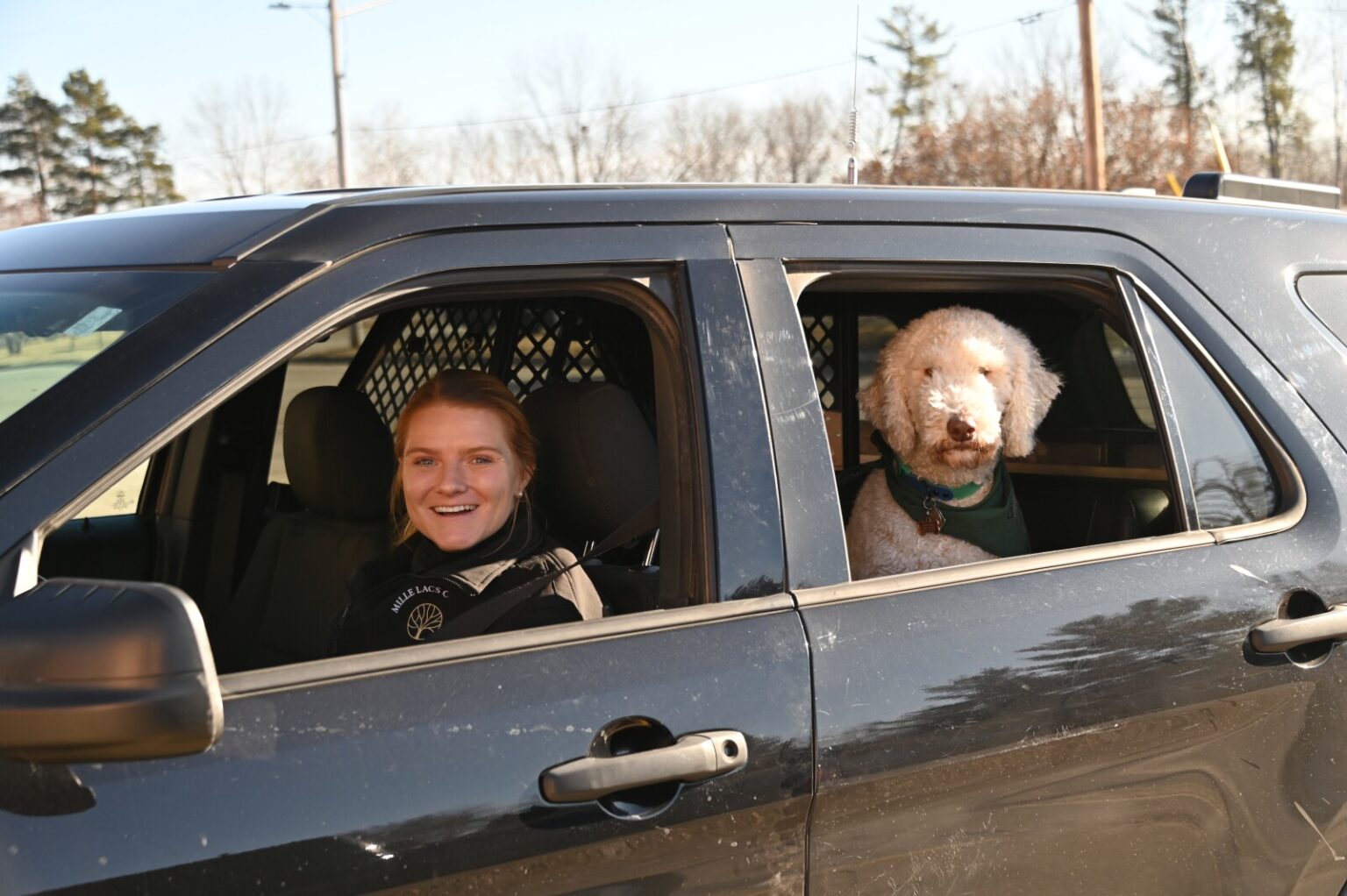
MILACA — Working with and in the community for the past year, Mille Lacs County co-responders are helping the county take a step forward in how it handles mental health calls from the public.
Leading the way in Mille Lacs County for the past year is co-responder Jessi Noehring and her partner Rufus, a 2-year-old Goldendoodle, who is certified as a therapy dog.
The Mille Lacs County Sheriff’s Office operations manual states co-responders in the department strive to improve public mental and behavioral health by responding to crisis situations with or without law enforcement officers, offering person-centered resources and collaborating with other community agencies. The co-responder works to safely connect people living with or experiencing mental illness, behavioral health, chemical dependency, inter and intra-personal problems and homelessness and connect them with appropriate support services.
The co-responder program in Mille Lacs County is currently funded by opioid settlement money.
“I assist deputies with crisis calls and that varies daily,” Noehring said. “It could be mental health, behavioral health, substance use, domestics, really anything public assistance, anything that could be related to someone having a hard time or a hard day.”

Tim Speier / Brainerd Dispatch
In 2024, Noehring and Rufus responded to 519 calls for service across Mille Lacs County.
While she was getting her masters in social work, Noehring said she worked part time to build up the Mille Lacs County Drug Treatment Court along with working with the Anoka County Medical Examiner’s office. Working in and around the sheriff’s office as part of her work on other projects, Noehring built up a rapport with Mille Lacs County Sheriff Kyle Burton.
“Drug treatment court was a fairly new program to the county when it came and we had never had something like it,” Burton said. “I was able to just watch and see how well she was able to manage that and help kind of mold into what it ended up becoming, and she definitely wasn’t afraid of a challenge.”
Burton said Noehring was a perfect fit as her role in drug treatment court familiarized her with many of the individuals and services she would be working with on a daily basis.
Noehring said she had just finished up her master’s program and was leaning toward a career in something that involved law enforcement but did not want to have to go back to school for law enforcement training when the position became available.
“In the beginning, they weren’t quite sure what it was going to look like. We weren’t quite sure what it was going to look like,” Noehring said.
Though she has a desk at the Mille Lacs County Sheriff’s Office, Noehring is not limited to the county’s calls for service as she works with and alongside the local police departments and Mille Lacs Tribal Police in the county.
Working in the department for almost a year, Burton said the co-responder position is the missing link a lot of law enforcement agencies have needed, though it is not yet an industry standard.
“What I mean by the missing link or the missing piece is we show up to a lot of mental health calls/people in crisis every year and we’re basically just kind of putting Band-Aids on situations,” Burton said. “I mean, we’re police officers. We’re not social workers, we’re not counselors, we’re not any of those things.”

Tim Speier / Brainerd Dispatch
Burton said he hears from his deputies time and time again who said having Noehring and Rufus on the force is helping officers deal with calls where nothing criminal has happened and she has the needed skills to deal with or help the situation.
Though many times an officer or deputy is the first to respond to a call for help, if they determine the situation is not a hazard to public safety and no crime has been committed, they are often able to turn the scene over to Noehring as she can provide more services. She has the training to deal with crisis situations.
“That’s where Jessi is a game changer for us because that’s not what we’re tasked to do as cops,” Burton said. “Her ability to connect with people because she’s not a cop. Oftentimes, for us, just the uniform itself is a barrier for some people, particularly people suffering from mental health issues. I’ve been on a number of calls with Jessi, where I’ve seen her be able to just make that connection right off the bat because she’s not a cop, and she can get down to somebody’s level and doesn’t have to overcome that, that barrier of the uniform that we do sometimes just by showing up on a scene.”
Also breaking down barriers on scenes is therapy dog Rufus, who both Noehring and Burton said can come in and completely change a situation around.
“Sometimes, even just the presence of Rufus is enough to break the ice with somebody,” Burton said. “I’ve seen that multiple times where somebody didn’t want to talk, but then they see Rufus, and it’s like, ‘Oh, wait a minute, what’s that about?’ And that can sometimes be just that icebreaker to start up a conversation with somebody.”
A day in the life of a co-responder
At around 10 a.m. on Wednesday, Jan. 8, 2025, Noehring and Rufus were preparing to visit a family whose daughter was diagnosed with schizophrenia and had asked for assistance.
Before they were able to load up into their squad car, Noehring received a call from the school resource officer at Princeton Middle School asking for assistance with a juvenile who was having thoughts about suicide.
When they showed up to the building, Noehring talked to the school resource officer, Princeton Police Officer Nicole Josephes, to find out what happened as Rufus made his rounds around the school’s office, getting pets and leaving people smiling.
When they entered the room, Rufus seemed to know exactly who needed help as he went over and sat next to the juvenile.
“We’re there to listen to their concerns and talk through what can happen,” Noehring said.
Though not much was said in the beginning, the tension in the room started to melt with the help of a therapy dog and a rapport was slowly built between Noehring and the juvenile. After discussing their options, the juvenile made the decision to seek further help and requested to be seen in the emergency room.

Tim Speier / Brainerd Dispatch
Rufus sat with the juvenile on the ride to the hospital as Noehring continued to build rapport with them. She told them the process the hospital would go through and how things would happen, not leaving the juvenile to guess or wonder what was going on.
As they arrived at the hospital, Rufus and Noehring helped the juvenile check in as they waited in the hospital to be called back.
The pair stuck with the juvenile as they talked with the doctors and nurses, only leaving after being told by the juvenile they were OK now that they were talking with the nurses. Prior to leaving the room, they came up with a plan to talk in the future, and Noehring handed them her contact information if they needed anything before meeting again.
At about noon, Noehring and Rufus headed toward their original call for assistance. Noehring said she had been working with the family for a few months and has seen the progress the family member made, noting when they first started working together, they would only talk to her through the door but over time they became more comfortable and were able to take walks and have conversations.
The family asked Noehring to help them check the home as there were some concerns due to recent activity.
Though nothing was found, Noehring said it was a good way to help the community by relieving some of the stress and tension people are dealing with. And by her going to the home to help, they were able to keep a deputy from being tied up on a call that was better situated for her.
TIM SPEIER, staff writer, can be reached on Twitter
, call 218-855-5859 or email
tim.speier@brainerddispatch.com
.