
Western countries rejected the state having a large role in their economies in the 1980s and ushered in the era of neoliberal economics, where everything would be left to the market. That logic dictated it was cheaper to manufacture things where wages were low, and so tens of millions of manufacturing jobs disappeared in the West.
Fast-forward to the 2020s and the flaws in neoliberal economics seem all too apparent. Deindustrialization has made the Western working class poorer than their parents' generation. But another flaw has become increasingly apparent – by making China the world's manufacturing superpower, we seem to be making them the world's technological superpower too.
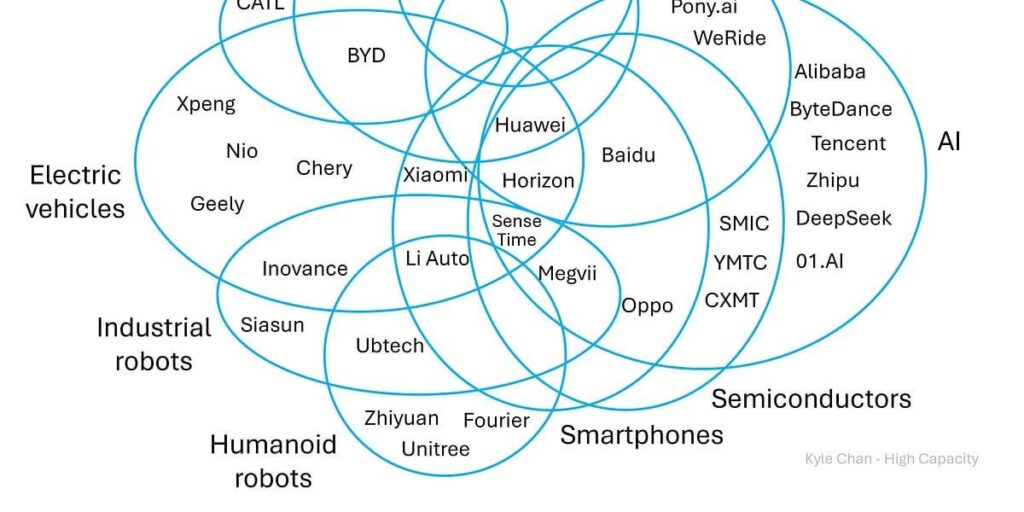
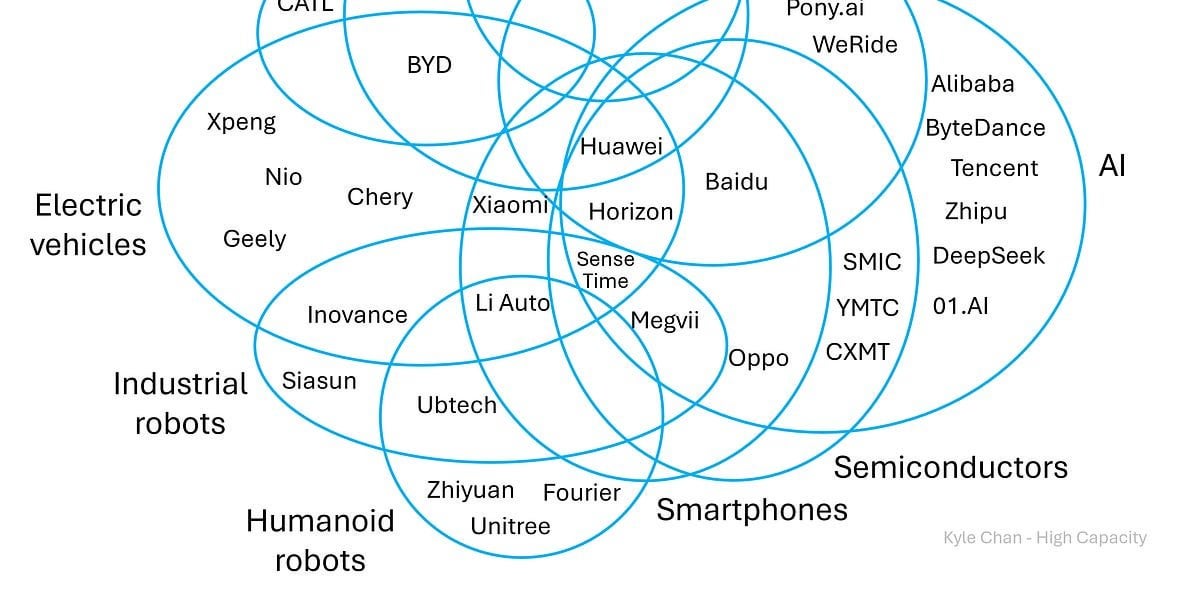
Furthermore, this seems to be setting up a self-reinforcing virtuous cycle. EVs, batteries, lidar, drones, robotics, smartphones, AI – China seems to be becoming the leader in them all, and the development of each is reinforcing the development of all the others.
Where does this leave the Western economic model – is it time it copies China's style of capitalism?
Is China's rise to global technological dominance because its version of capitalism is better than the West's? If so, what can Western countries do to compete?
byu/lughnasadh inFuturology
33 Comments
China have a huge and incredibly cheap workforce.
China actively encourages corporate espionage to steal Western companies IPs.
Please explain how either of these are linked to capitalism
China’s style of capitalism hinges on the ability to steal/copy anything manufactured there by outside companies, unlimited governmental power to tell the people “we are doing this and you can’t say no”, and even further abuse of the workers in a capitalist system.
China can and will always “catch up” especially at ridiculous speeds, but their level of being “the future” is suspect in my opinion.
China doesnt flip flop their policies every 4 years.
They work harder. They are more incentivized, and they have a larger workforce. Chinese imitating the west is old news, they are the innovators now.
No. They graduate millions more STEM than we do per year.
There can be some advantage to a capitalist leaning centralized authoritarian government. The CCP has essentially made a deal with its people saying we will lift you out of poverty if you forgo political and many other freedoms. It may work for a while and obviously has. At some point the people are gonna start asking for freedoms that the CCP is not willing to provide. This may happen if the economy crashes significantly or basically if the CCP can no longer keep it side of the bargain or the people start pushing for freedoms.
They invested heavily into education. Something a few western countries have forgotten out. The value of the country is in the people. Not the corporations.
They do have a demographic crisis very soon though thanks to their one child policy. I think the rise of China is good for the west, a common enemy so we can get our shit together. Without one, we’re falling apart. We don’t care about our middle class + we either let corporations run the country (US+JP+SK) or we regulate everything to death (EU). Maybe we are not designed to live without competition..
Yes, market socialism is better than capitalism. Yes, the west should shift to market socialism. It won’t happen though, because rich people would loose some of their money.
Not everything is capitalism vs communism.
Western countries do not have a monopoly on brilliant ideas for technological and sociopolitical advancement.
I’ve come across many people in other parts of the world that have for more brilliant and innovative minds and designs in the area of technology, governance, political theory and more; that not even our best entrepreneurs and scholars come anything close to.
The only thing that has inured to the benefit of the West is availability of capital (without necessarily an argument of capitalism) as well as preexisting geopolitical and economic advantages, as the rich get richer and the poor poorer, within the global community.
China has done well to, yes, through the state, make bold moves to capitalise on its advantages and it’s determination not to be left behind
But declining standards in the West are not caused by China’s rise but by it’s own failures.
Ignorant and obnoxious about it’s sense of superiority, the West has continued to decline in certain areas and will continue to decline due to a delusion that the West is naturally meant to be the best.
If other countries has a fraction of the opportunities here, I guarantee you, Western markets got nothing. I’ve seen people in other parts of the world just show unmatched brilliance when it comes to education, engineering capabilities, software design, social media platform design (better than Facebook or anything around), and general scholarship.
Take Facebook for instance. Through it’s entire life all Zuckerberg has done is steal others ideas. He has no innovation.
Others innovate. The only advantages we have had is resources and other economic opportunities (such as IMMIGRATION and pooling of minds and MARKET here!) and yet we continue to lose sight of those on account of some “manifest destiny”
I don’t know, my parents and teachers never taught me global dominance as a main subject or agenda for my up bringing. Fill your boots
A good bit of it is because the US outsourced a large portion of its technological development to China, and China was more than happy to do it for us. Especially since it coincided with their desire to “catch up” with the rest of the developed world.
The sheer number of manufacturing jobs that we outsourced to them is quite staggering. And they worked really hard to catch up and surpass what we were asking for. And here we are.
If you want to have a fun fact to roll around in your head: assuming a standard distribution of intellect (*I know* this a problematic measure, but roll with it) given China’s population, there are more geniuses in China than there are people in America. Given that, it’s no real surprise that they’re where they are technologically.
Despite common claims a few years ago about ‘when’ China will have the world’s largest GDP, in fact the gap between their GDP and that of the US only continues to increase. So the very premise of your question is incorrect.
This take comes mostly from listening to Peter Zeihan. But there are 3 factor.
One I’ve seen a lot is they steal lot of IP to catch up both formally and informally (the west got them to make all our stuff for 40 years so they learned all our secrets)
Second factor, demographics as they grew quick they had a population that had very little old people and (due to urbanization and 1 child policy) very little children so they had lot of output and very little dependence population.
Third factor, good old levered debt at all levels of the government. It’s higher than the official numbers because lot of it is held by cities and provinces compared to the national government.
So now they have caught up, aged and there growth is slowing we will see if they are running a better model then the west.
I think your first paragraph is kinda wrong. The state still has a huge role in western economies.
A lot of large corporations wouldn’t exist without juicy state contracts (defense being the most obvious)
The whole world is capitalist. There’s no such thing as a free lunch. You gotta give someting up to get somehting else. You want cheap and also want to retain your freedom of whatever and everything? well you gotta outsource all the “icky” stuff.
China’s daily lived-reality is significantly less prosperous and forward-thinking than you suggest. Not to defend our system particularly, but the marketing image the CCP promotes and maintains in the largest cities where westerners are likely to observe them is *very* different from the rest of the country.
The biggest tech companies in the West are all operating in the same market: Dopamine.
In the last 2 decades, the vast majority of tech funding has gone into keeping the masses hooked into the dopamine drip feed and putting advertising in front of everyone.
China has taken a stance that this is harmful to society and taken steps to limit this market.
This frees up talent and resources for the development of more “practical” technologies.
Every dollar and hour of labour spent developing a better advertising algorithm, or improving a recommendation algorithm to increase user attention is a dollar and an hour not being spent developing better materials simulation algorithms or improving EV charging efficiency.
> Is China’s rise to global technological dominance because its version of capitalism is better than the West’s?
No
> what can Western countries do to compete?
Stop electing Republicans
it’s not. OEPNAI is literlly open source, that was a whole point about that (sam alt man forget that part). so they used the west tech and run it on the massive amount of data coming from china customers. and the result is amazing – either way, it’s good for everyone!
The United States had the most technologically sophisticated manufacturing plants on the market, and that created supply chains, where the world shipped in cheap resources and the United States made expensive end products.
Those manufacturing plants were top of the line, end results of over a 100 years of industrialization, where we built on those plants, and the expertise created was a feedback loop.
Engineers, material scientists, machinists, could all work together to work out real time and real world problems, design new parts and new technologies to continue to improve.
It’s not that one just turns a wrench all day, but it’s a practice in long term critical thinking, central planning around the grid, grid expansion, and resource consolidation.
Technological improvement happened because of generational support of all these expertises combining and shifting.
The United States gave up its generational wealth, literally sold it to China for cheaper labor. And now instead of learning how to create things at scale, which arguably should be the goal of a society, we are told to consume.
Now since we lost the generational ability to make entire industries at scale, we created ecosystems in China where engineers, machinists and supply chains converge to build on the wealth those factories produce. There is a reason a factory can pay a living wage, and a sandwhich shop can’t. The scale of what is produced matters more than the currency exchanged.
https://www.visualcapitalist.com/china-consumes-mind-boggling-amounts-of-raw-materials-chart/#:~:text=Notably%2C%20China%20uses%2049%25%20of,global%20consumption%20of%20raw%20materials.
Colonialism was about shipping these raw materials because countries used to understand the point of money was to be able to have, make and buy the most things.
Money became the end goal, and the USA sold its golden age to China.
Now manufacturing doesn’t stay stagnant it responds to market forces. And China can switch from one type of manufacturing to another because all the materials are shipped to China cheaply, the expertise remains in China.
When a new product like solar panels wants to be built, there are plenty of trained factory workers, and materials to set up that industry rapidly. The west doesn’t have that flexibility, because capital can’t buy experience.
So the west has lost the war to build the future, because it paid China to build the future for it
China and Russia are feudal states. They are not capitalist, or communist, or fascist. They are ruled by the modern equivalent of a god king who has vassals. The vassals are given free hands as long as they don’t stand up against the king. If they do everything can and will be taken from them. Under Trump the US is slowly moving in the same neo feudalistic direction.
The general population is treated as serfs and the economy is 100% centralised when needed. If the king want’s to buy a foreign port to increase their strategic dominance there will be no afterthought in letting a city starve to gather enough resources to achieve the goal.
Will this be a sustainable model in the long run? I bloody hope not. But looking at the pressure free market capitalism and liberal democracy are under from both left and right I fear that this model will spread. Feudalism was dependent on constant wars to get enough natural resources and keep the population in check. Neo feudalism will most likely be the same. We have had the best 30 years in human history but managed to waste them.
Well the west could promise to put 60% tarrifs on China but then mysteriously pivot to tariff their closest allies and neighbours instead.
Then the west could threaten to invade or buy some of those aforementioned allies – just to make sure the west is as isolated as possible.
Then the west could put 100% tarrifs on Taiwan, the most advanced chip maker in the world – a strategic partner even building Fab in the west, to make innovation as expensive as possible.
The west can then divert investment from useful things like rewneables and instead put it all on meme coins and a strategic reserve of ape NFTs at tax payer expense, and encourage entrepreneurs to really focus on various rug pulls and the latest ponzi techniques.
The west could then start randomly gutting government programs and firing people on mass while also deporting other workers , all at once , ensuring a healthy level of chaos in which surely the people will enjoy and thrive in.
I think the plan is solid, and China’s days are totally numbered.
There are two Wests: America and Europe. America’s weaknesses compared to China are poor STEM scores, weaker work ethic and strong copyright laws. Even though the US has a lot of intellectual capital, if it gets leaked to Chinese entities they unabashedly reverse engineer it and merge it into tech they were already working on.
Europe’s been high off its farts for years and is besotted with the idea of regulating new tech instead of at least first developing it. It believes Intels to be the pinnacle of civilization without actually doing anything. It’s ironically reminiscent of how China was when it isolated in the 18th and 19th century.
A couple of things happened. We allowed our political parties to be completely subjugated and bought off for comparably cheap(many are bought off for tens of thousands which sounds like a lot but when it leads to you controlling a country that has a 20+ trillion gdp it’s return on investment is insane). We allowed subversive elements to interrupt the forward momentum of the country. We put questionable moral posturing above merit. We allowed corporations to put themselves above everyone. The list goes on and on. Our mistakes are numerous. China is very good at taking something and then making it better. While it seems better in the short term, long term it will still require creatives to continue to invent stuff. Whoever invents the stuff of the future will need to be careful.
China’s position is unsustainable in the long run.
– Demographic trend and low immigration
– very high debt-to-GDP (comparable to the US)
– low social safety nets
– reliance on exports rather than domestic-consumption even as the population has gotten richer (this is fine, so long as the rest of the world is ok with Chinas exports competing, which it looks like the rest of the world is turning against)
– reliance on state-subsidized industries (related to the debt and export issues above)
Most of all, the centralization of power under Xi and inability for the government to tolerate a plurality of opinions and criticism.
The party actually had disagreements and different party members and economists proposing things from the Deng Xiaoping to Hu Jintao eras.
Obviously you couldn’t criticize communism or the party in themselves, but people disagreed on how much to privatize, how much social safety nets to be, how much to subsidize etc.
This is not coincidentally the era with the most growth and development.
Xi Jingping has completely consolidated power and given decision making to himself, as well as clamped down on any open policy disagreements within the party.
In the medium to long run (we are already seeing it as Chinas economy since Covid has been terrible) this will lead to worse outcomes.
Unpopular opinion but America should have a mixed market system where certain things aren’t allowed to be for profit and certain things are allowed to be owned by the people to increase federal revenues.
China executes CEOs convicted of corruption. America needs vigilantes to hold CEOs responsible.
> where everything would be left to the market
This is where the problem is. We still advocate this dream that the market regulates itself. 40 years of corruption, subsidies and bailouts have proven that this system doesn’t work.
China is communist with 5 year plans. They just allow some capitalism, but the oligarchs have little input to the ruling class, unlike in the west, where they buy the goverment and the media.
And China shows that a planned economy can work well in combination with free markets. No need to plan tampon production, but having clear strategic goals with companies cooporating with each other and the state to achieve them.
Also protectionism. Blocking western internet means chinese companies could run their own social media plattforms and train their own know how and specialist, something europe for instance lacks completely.
And lastly it seems that the state really reinvests in its people, with cheap modern housing, public transport, hospitals, etc build endlessly. Now even with more and more iniatives to improve the living conditions in rural areas.
In the west capitalism is eating itself because of pure greed. If the bottom cannot afford goods the wheel stops spinning. There is a high need for a middle class and they worked hard to screw it over for 70 years.
The most important difference is that the PRC allows its policies to be set by technocrats over the long term, not corrupt politicians for a 4- or 5-year period. Xi may be dictator-for-life but he broadly leaves the technocrats alone to do their thing; while he is obviously able to influence the overall area the technocrats focus on, how they accomplish his desired goals is up to them.
All I know is that the Chinese political party plan for 100 years, America is 2..