
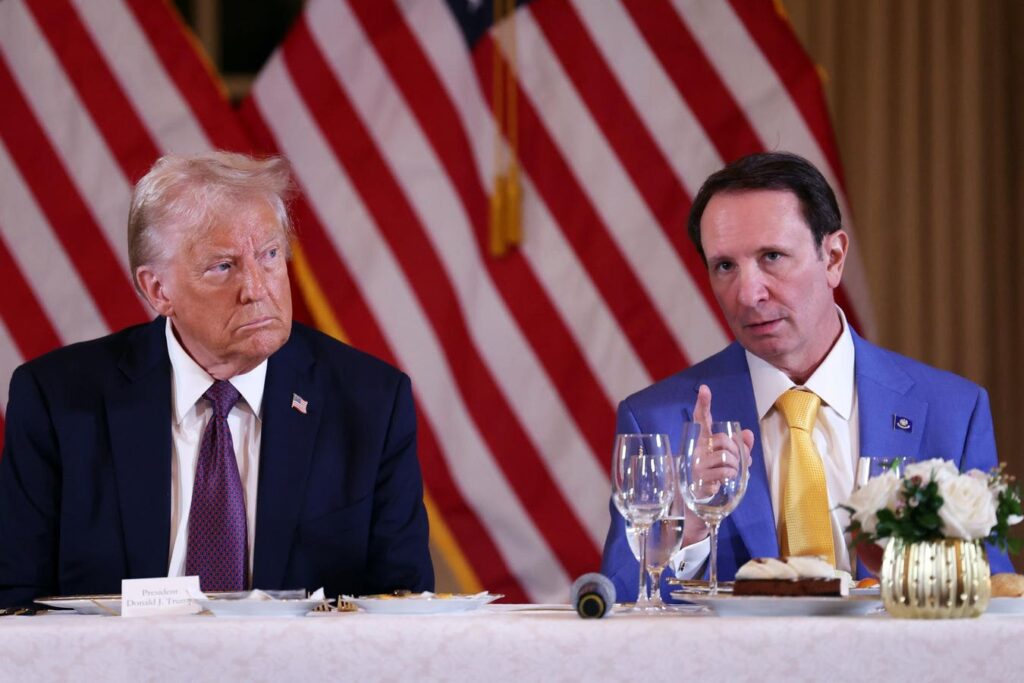
PALM BEACH, FLORIDA – JANUARY 09: Louisiana Gov. Jeff Landry (R) speaks during a meeting with US … [+] President-elect Donald Trump and other Republican governors at the Mar-a-Lago Club on January 09, 2025 in Palm Beach, Florida. Trump will be sworn in as the 47th president of the United States on January 20, making him the only president other than Grover Cleveland to serve two non-consecutive terms in office. (Photo by Scott Olson/Getty Images)
Getty Images
When President Donald Trump attends Super Bowl LIX at the Caesars Superdome in New Orleans this Sunday, he will be accompanied by Republican Governor Jeff Landry, who was elected in 2023 after serving as the state’s attorney general since 2016. The President may or may not be aware that his game-watching companion has chosen to involve Louisiana as a plaintiff in a campaign of coordinated lawsuits targeting the state’s oil and gas industry which works directly at odds with Trump’s agenda to restore American energy dominance.
Over the past decade, no fewer than 43 Louisiana parishes have worked with prominent trial lawyers to sue oil and gas companies over questionable claims that their operations have caused coastal erosion issues south of the Mississippi River. Make no mistake: It isn’t just the state that is a plaintiff in these cases, but Governor Landry himself. A May, 2024 decision by the United States 5th Circuit Court of Appeals in a case filed against BP, Chevron, Shell, and a variety of other defendants specifically lists the “State of Louisiana, ex rel, on Behalf of Jeff Landry” as the intervenor plaintiff in the action.
Lawsuits Campaign’s Origins
The origins of this slate of lawsuits dates back to 2013. In these cases, the numerous parishes have partnered with prominent trial lawyer John Carmouche to sue an array of oil and gas companies who have been active in South Louisiana for decades under these coastal erosion claims.
CHARENTON, LA – AUGUST 21: A boat makes its way along the Atchafalaya River in the Atchafalaya … [+] Basin, the largest wetland and swamp in the United States, on August 21, 2019 in Charenton, Louisiana. (Photo by Drew Angerer/Getty Images)
Getty Images
It has long been widely accepted that the land loss issues in the state have resulted from a combination of a) the loss of the natural silting processes by the Mississippi River that largely built the land in the first place, as the result of flood control efforts by both the federal and state governments, and b) the more than 10,000 miles of man-made canals that cross-cross the region, many of which were constructed to facilitate oil and gas development.
On the topic of flood controls, the Louisiana Coastal Protection and Restoration Authority (CPRA) has this to say:
“One of the most significant causes of land loss is the straitjacketing of the lower Mississippi River with huge levees to control the river and protect communities, economic infrastructure and other resources from river flooding. The problem is the delta’s wetlands were and still are built and sustained by sediment delivered by the river. Leveeing of the river cut the tie between the sediment-filled river and its delta, stopping the cycle of new wetland growth.”
Obviously, no one has any desire to deconstruct the complex system of man-made dikes and levees to restore the Mississippi’s flooding and silting processes in a region now populated by millions of Louisianians, one which is a huge driver of the state’s economy.
Industry Activities Date to World War II
The realities surrounding the other proximate cause, the man-made canals that crisscross the region, is just as troubling for the plaintiffs’ arguments. The fact is that the activities of these energy producers date back to the 1940s when their work played a vital role in building and maintaining America’s military capabilities in WWII. During this time, these companies’ production of crude oil in the Louisiana coastal zone was used to supply the federal government with high-octane aviation gasoline or “avgas.”
A petition for writ for certiorari submitted to the Supreme Court in late January details how these companies were literally serving as federal contractors and working at the direction of the federal government. It seems both ironic and disingenuous for these local and state governments to now sue these federal contractors in state court, in part for actions undertaken to fulfill contracts that were crucial to that war effort. It is also a simple, undeniable fact that every canal built, every well drilled, and every pipeline constructed in South Louisiana has been undertaken only after the operators were awarded permits issued by the state’s regulators.
NEW ORLEANS, LOUISIANA – OCTOBER 13: A general view exterior of Caesars Superdome, home of the NFL … [+] New Orleans Saints, on October 13, 2024 in New Orleans, Louisiana. (Photo by Aaron M. Sprecher/Getty Images)
Getty Images
In a 2019 study, the Louisiana-based Pelican Institute for Public Policy (PIPP) found the state has experienced significant economic consequences caused by this litigation, based on the logical concept, “when the risk of getting sued increases, the expected costs faced by companies increases and as a result, drilling activity decreases.” The group released a report which details negative impacts from the litigation to the state’s economy, including a loss in drilling activity, reduced royalty and tax collections, and an annual economic loss of $44.4 million.
The Bottom Line
As the world witnessed during Trump’s first presidency, America possesses an ability to not just become less reliant on foreign sources of energy, but to assume a dominant position across all forms of energy production under the right set of government policies. But getting to that requires not just the federal government, but governments at all levels to get out of the way and allow markets to work.
What’s happening with this Louisiana lawsuits campaign is obviously counterproductive to President Trump’s objectives. It’s a topic that seems ripe for discussion with Governor Landry as they take in Sunday’s big game.