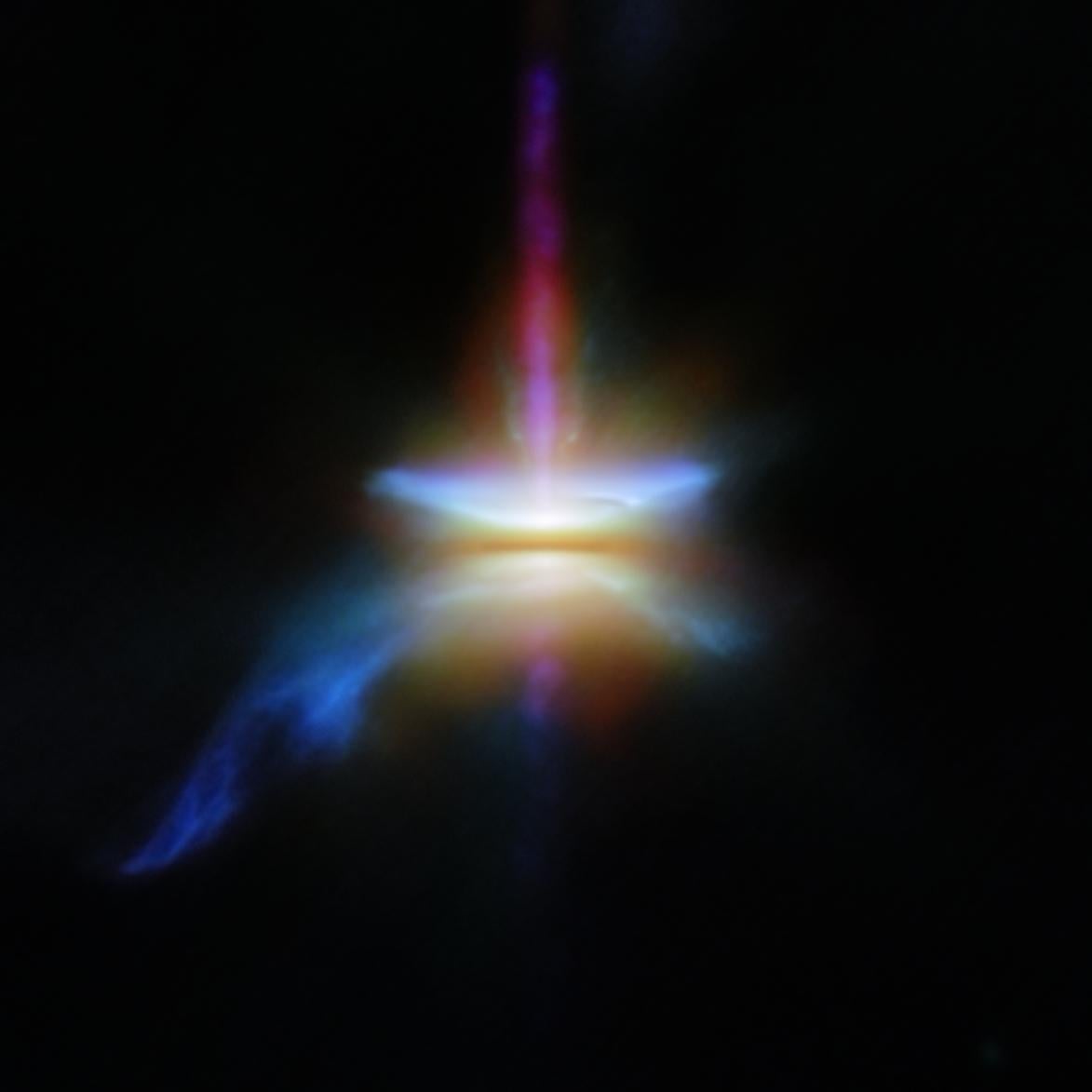
Webb telescope image of HH 30, an edge-on protoplanetary disc that is surrounded by jets and a disc wind
https://i.redd.it/bqqq7w69o3ie1.jpeg

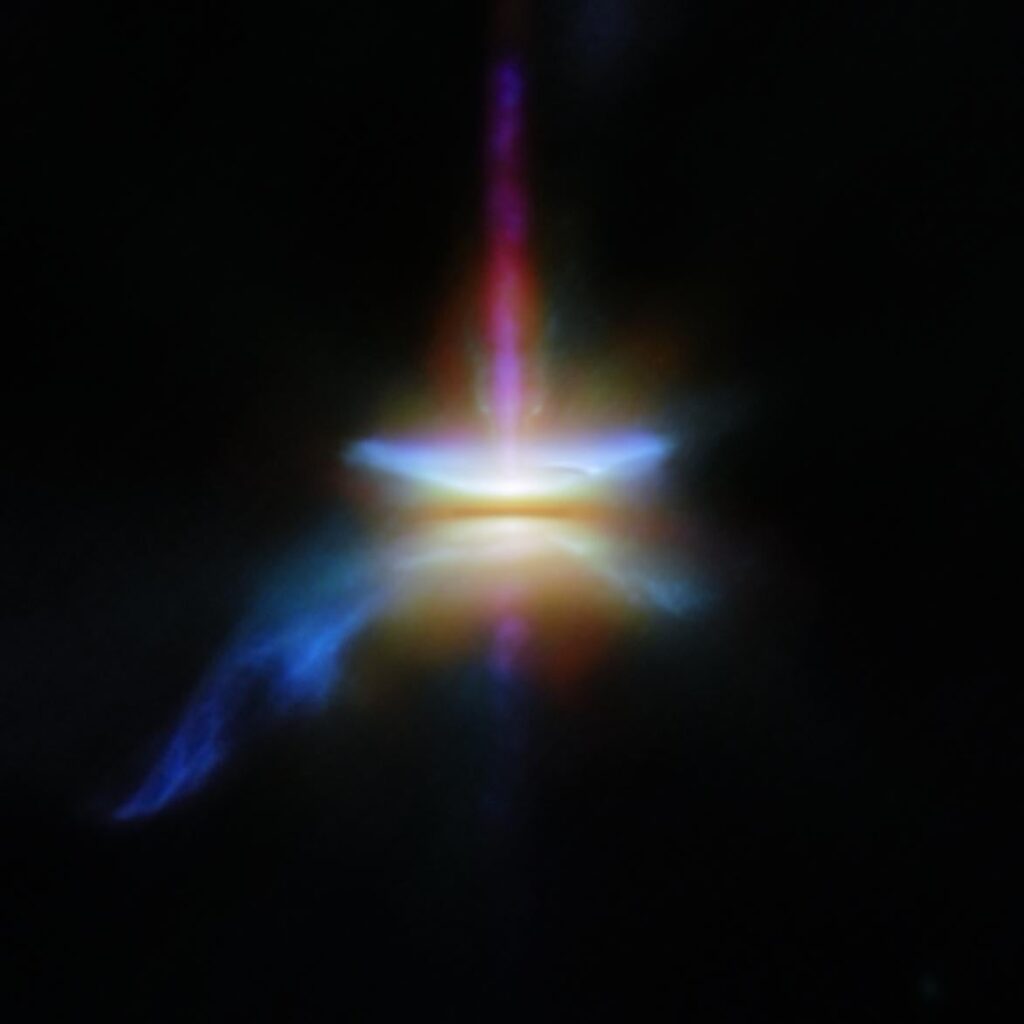
Webb telescope image of HH 30, an edge-on protoplanetary disc that is surrounded by jets and a disc wind
https://i.redd.it/bqqq7w69o3ie1.jpeg
8 Comments
Really cool to see the light distortion.
Is this photo raw or is it edited for visuals?
image from here (image credit ESA/Webb, NASA & CSA, Tazaki et al.)
[https://www.esa.int/ESA_Multimedia/Images/2025/02/HH_30_MIRI_NIRCam_image](https://www.esa.int/ESA_Multimedia/Images/2025/02/HH_30_MIRI_NIRCam_image)
excerpt from page
This new NASA/ESA/CSA James Webb Space Telescope Picture of the Month presents HH 30 in unprecedented resolution. This target is an edge-on protoplanetary disc that is surrounded by jets and a disc wind, and is located in the dark cloud LDN 1551 in the Taurus Molecular Cloud.
Herbig-Haro objects, like HH 30, are luminous regions surrounding newborn stars (known as protostars). They form when stellar winds or jets of gas spewing from these newborn stars form shockwaves as they collide with nearby gas and dust at high speeds.
HH 30 is of particular interest to astronomers. In fact, the HH 30 disc is considered the prototype of an edge-on disc, thanks to its early discovery with the NASA/ESA Hubble Space Telescope. Discs seen from this view are a unique laboratory to study the settling and drift of dust grains.
An international team of astronomers have used Webb to investigate the target in unprecedented detail. By combining Webb’s observations with those from the Hubble Space Telescope and the Atacama Large Millimeter/submillimeter Array (ALMA), the team was able to study the multiwavelength disc appearance of the system.
The long-wavelength data from ALMA trace the location of millimetre-sized dust grains, which are found in a narrow region in the central plane of the disc. The shorter-wavelength infrared data from Webb reveal the distribution of smaller dust grains. These grains are only one millionth of a metre across – about the size of a single bacterium. While the large dust grains are concentrated in the centre of the disc, the small grains are much more widespread.
Just incredible. The Webb is an absolute blessing to humanity, capturing these new views of the universe.
Holy shit, wow!! You can almost picture the way it spins and moves over these massive time scales.
I wish this sub allowed pics in comments but this is my new wallpaper.
Are we absolutely certain that it’s not a disk on the back of a giant turtle?
If I ever record an album, this is going to be the album cover
The bottom portion looks like a mirrored effect, like it’s reflecting off the surface of a fluid it sits on top of.