Also this is supposed to be “data is beautiful” not a screenshot of a google sheet.
Formal_Sandwich1949 on
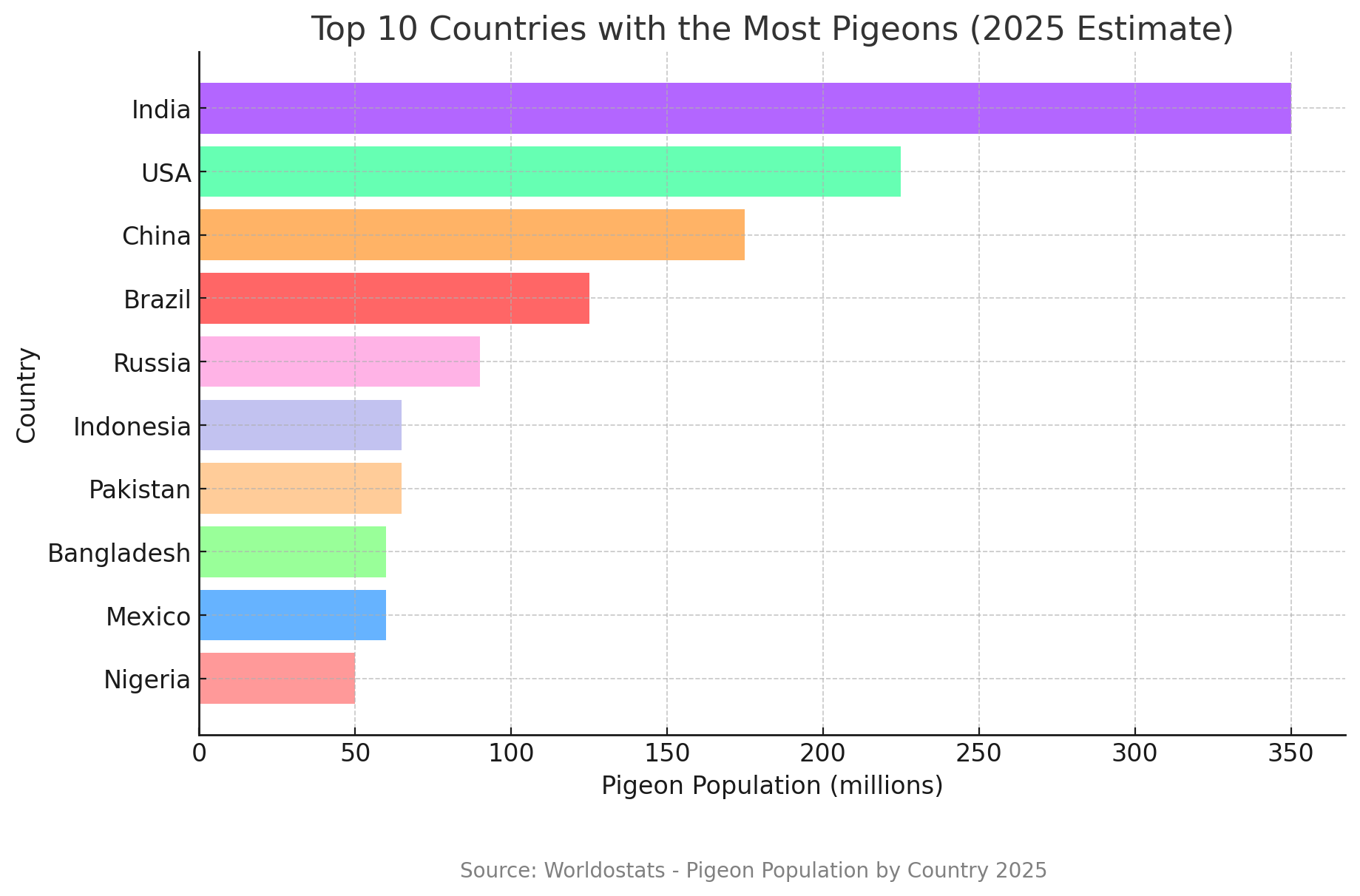
Didn’t see the millions down below so I thought there were only 50 pigeons in Mexico lmao
Nimbu_Ji on
India has a massive pigeon population due to several factors:
Urbanization and Human Feeding – Pigeons thrive in urban environments, and in India, people often feed them as part of religious and cultural practices. Large-scale feeding at public places (e.g., temples, parks) has significantly boosted their numbers.
Favorable Climate – India’s warm and diverse climate allows pigeons to breed year-round, unlike in colder countries where harsh winters limit their reproduction.
Availability of Nesting Sites – Pigeons prefer nesting on tall buildings, old structures, and ledges. India’s dense cities with high-rise buildings and historical monuments provide ideal nesting spots.
Religious and Cultural Significance – In Hinduism and Jainism, feeding birds (especially pigeons) is considered an act of kindness and a way to gain good karma. This practice further sustains their population.
Essentially, human activities combined with ideal environmental conditions have created a perfect scenario for pigeons to thrive in India.
bluecalx2 on
This seems to be total pigeon population in millions, but I’d be more curious to see pigeons per square mile. The size of these countries is potentially skewing the data. Maybe San Marino is absolutely covered in pigeons but you wouldn’t be able to tell here.
Fiery_Hand on
I’m surprised to learn about India considering how many raptors I’ve seen there. Literally hundreds of thousands in New Delhi alone, more than many countries’ population combined.
revuestarlight99 on
I feel that there aren’t many pigeons in Chinese cities, unless you count the ones that are bred. The bird that mainly occupies this ecological niche is the spotted dove, and there’s no animal more stupid than it.

![Countries with the most pigeons [OC]](https://www.byteseu.com/wp-content/uploads/2025/02/apm6p7a7xaie1-1536x1012.png "Countries with the most pigeons [OC]")
7 Comments
Who the fixk counts pigeons?
Also this is supposed to be “data is beautiful” not a screenshot of a google sheet.
Didn’t see the millions down below so I thought there were only 50 pigeons in Mexico lmao
India has a massive pigeon population due to several factors:
Urbanization and Human Feeding – Pigeons thrive in urban environments, and in India, people often feed them as part of religious and cultural practices. Large-scale feeding at public places (e.g., temples, parks) has significantly boosted their numbers.
Favorable Climate – India’s warm and diverse climate allows pigeons to breed year-round, unlike in colder countries where harsh winters limit their reproduction.
Availability of Nesting Sites – Pigeons prefer nesting on tall buildings, old structures, and ledges. India’s dense cities with high-rise buildings and historical monuments provide ideal nesting spots.
Religious and Cultural Significance – In Hinduism and Jainism, feeding birds (especially pigeons) is considered an act of kindness and a way to gain good karma. This practice further sustains their population.
Essentially, human activities combined with ideal environmental conditions have created a perfect scenario for pigeons to thrive in India.
This seems to be total pigeon population in millions, but I’d be more curious to see pigeons per square mile. The size of these countries is potentially skewing the data. Maybe San Marino is absolutely covered in pigeons but you wouldn’t be able to tell here.
I’m surprised to learn about India considering how many raptors I’ve seen there. Literally hundreds of thousands in New Delhi alone, more than many countries’ population combined.
I feel that there aren’t many pigeons in Chinese cities, unless you count the ones that are bred. The bird that mainly occupies this ecological niche is the spotted dove, and there’s no animal more stupid than it.